
In today’s digital world, a business without a website is like a shop without a signboard. Customers expect every legitimate business to have an online presence where they can learn about products, services, contact details, and company information. Whether you own a small local store, a startup, or an established company, having a professional website has become a necessity rather than a luxury.
Many business owners still rely solely on word-of-mouth marketing, social media pages, or offline advertising. While these methods can generate some business, they often limit growth opportunities. The absence of a business website can lead to lost customers, reduced credibility, lower visibility, and missed revenue opportunities.
At Infotech Wayout, we have worked with businesses across various industries and have seen firsthand how a well-designed website can transform growth, improve customer engagement, and increase sales.
In this comprehensive guide, we will explore what happens if a business does not have a website, the risks involved, and why investing in professional web development services is crucial for long-term success.
Why a Website Matters More Than Ever
The internet has fundamentally changed how consumers search for products and services. Before making a purchase decision, most customers conduct online research.
When someone hears about your company, one of the first things they do is search for your business online. If they cannot find a professional website, they may question your legitimacy and choose a competitor instead.
A website acts as your digital storefront and remains accessible to potential customers 24 hours a day, seven days a week.
Benefits of a Website Include:
- Increased credibility
- Improved customer trust
- Greater visibility on search engines
- Better customer support
- More sales opportunities
- Enhanced brand awareness
- Competitive advantage
Without these benefits, businesses often struggle to reach their full potential.

Loss of Online Visibility
One of the biggest consequences of not having a website is losing online visibility.
When customers search Google for services related to your business, companies with optimized websites appear in search results. Businesses without websites are largely invisible.
For example, if someone searches for:
- Website development company near me
- Best restaurant in Kolkata
- Plumbing services nearby
- Mobile app development services
Google primarily displays businesses with websites and optimized online content.
Without a website, your chances of appearing in relevant search results decrease significantly.
Impact on Search Engine Rankings
Search engines rely heavily on websites to understand and rank businesses.
Without a website:
- You cannot rank for important keywords.
- You lose organic traffic.
- Competitors gain more visibility.
- Customers cannot discover your services easily.
Over time, this can result in substantial revenue loss.
Reduced Customer Trust and Credibility
Consumers have become more cautious about where they spend their money.
A professional website acts as proof that your business is genuine and trustworthy.
When potential customers cannot find your website, they may wonder:
- Is this business legitimate?
- Are they still operating?
- Can I trust them?
- Do they provide professional services?
A well-designed website helps answer these questions instantly.
First Impressions Matter
Research consistently shows that people form opinions about businesses within seconds.
Your website allows you to showcase:
- Company information
- Testimonials
- Reviews
- Certifications
- Portfolio
- Contact information
Without these trust-building elements, customers may choose competitors who appear more professional.
Missing Valuable Leads and Sales Opportunities
A business website works around the clock generating leads and sales.
Imagine a customer searching for your services at midnight. Your physical office may be closed, but your website can still:
- Display information
- Collect inquiries
- Accept orders
- Schedule appointments
Without a website, these opportunities are lost.
Lost Revenue Potential
Many businesses underestimate how many customers they miss by lacking an online presence.
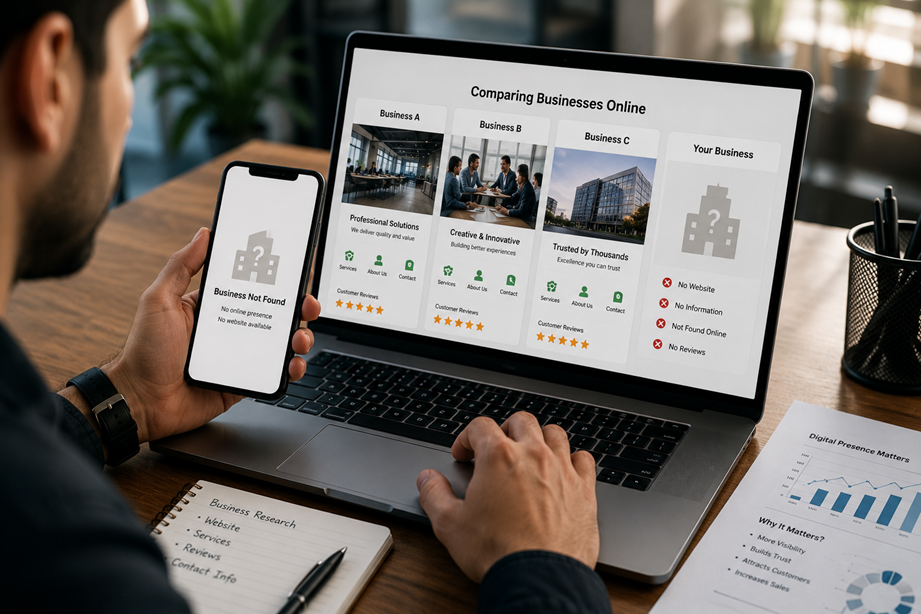
Potential customers often move through this process:
- Search online.
- Visit websites.
- Compare options.
- Contact the best provider.
If your website does not exist, you are eliminated from consideration before the customer even contacts you.
Dependence on Social Media Alone Is Risky
Many businesses believe a Facebook or Instagram page is enough.
While social media is valuable, it should not replace a professional website.
Problems with Relying Only on Social Media
Limited Control
Social media platforms control:
- Reach
- Visibility
- Algorithms
- Content exposure
Your business can lose visibility overnight due to algorithm changes.
Account Suspension Risks
Accounts can be:
- Hacked
- Suspended
- Restricted
- Deleted
If social media is your only online presence, your entire digital identity is at risk.
Lack of Professionalism
Customers generally view websites as more professional and trustworthy than social media profiles.
A website demonstrates commitment and credibility.
Competitors Gain a Significant Advantage
Your competitors are likely investing in:
- Website design
- SEO
- Content marketing
- Digital advertising
- Online lead generation
Without a website, you allow competitors to dominate online search results.
How Competitors Win Customers
When customers search online, competitors can:
- Appear in Google searches
- Showcase portfolios
- Display testimonials
- Capture leads
Meanwhile, your business remains invisible.
Over time, this creates a widening gap between your business and competitors.
Poor Brand Recognition
Strong brands maintain a consistent online presence.
A website allows businesses to establish:
- Brand identity
- Company story
- Mission and vision
- Unique value proposition
Without a website, customers have fewer opportunities to engage with your brand.
Branding Opportunities Lost
Your website can communicate:
- Professionalism
- Expertise
- Reliability
- Industry leadership
Without these touchpoints, building long-term customer relationships becomes more difficult.
Limited Marketing Opportunities
Modern digital marketing revolves around websites.
Many marketing strategies require a website as the central destination.
Marketing Channels That Depend on Websites
Search Engine Optimization (SEO)
SEO helps businesses attract organic traffic.
Without a website:
- No keyword rankings
- No blog content
- No organic lead generation
Google Ads
Paid advertising campaigns often direct users to landing pages on websites.
Content Marketing
Blogs, case studies, and educational resources typically reside on a website.
Email Marketing
Lead generation forms on websites help build email lists.
Without a website, these marketing opportunities become severely limited.

Difficulty Showcasing Products and Services
A website provides a structured way to present products and services.
Customers expect detailed information such as:
- Features
- Pricing
- Specifications
- Service descriptions
- FAQs
Without a website, customers may struggle to understand what your business offers.
Portfolio and Case Study Challenges
Businesses such as:
- Website development companies
- App developers
- Architects
- Consultants
- Designers
Need professional portfolios.
A website provides the ideal platform to display previous work and build trust.
Poor Customer Experience
Modern consumers value convenience.
A website allows customers to quickly find:
- Business hours
- Contact details
- Locations
- Service information
- Pricing
Without a website, customers must spend extra effort contacting you.
Many simply choose a competitor with easier access to information.
Customer Expectations Have Changed
Today’s customers expect immediate answers.
A website can provide:
- Contact forms
- Chat support
- FAQs
- Service pages
This improves customer satisfaction and conversion rates.
Difficulty Expanding Beyond Local Markets
Businesses without websites often remain dependent on local customers.
A website enables expansion into:
- Regional markets
- National markets
- International markets
Geographic limitations become less significant when customers can discover your business online.
Growth Opportunities
A professional website helps businesses:
- Reach new audiences
- Generate nationwide leads
- Sell products online
- Build authority
Without a website, scaling becomes much harder.
Missed Data and Analytics Insights
Websites provide valuable data about customer behavior.
Business owners can track:
- Visitor numbers
- Traffic sources
- Popular services
- Conversion rates
- Customer interests
Without a website, these insights are unavailable.
Better Decision Making
Analytics help businesses:
- Improve marketing
- Optimize content
- Increase conversions
- Understand customer needs
This data-driven approach is difficult to achieve without a website.
Challenges During Economic Changes
Businesses with strong online presences often adapt better during economic disruptions.
Examples include:
- Remote service delivery
- Online consultations
- E-commerce sales
- Virtual appointments
Companies without websites often struggle to adapt quickly.
A website provides resilience during changing market conditions.

The Cost of Not Having a Website
Many business owners focus on the cost of creating a website.
However, the bigger question is:
What is the cost of not having one?
Potential losses include:
- Missed leads
- Reduced sales
- Lower visibility
- Weak branding
- Customer distrust
- Competitive disadvantages
The cumulative impact often exceeds the investment required for professional web development services.
How a Professional Website Helps Businesses Grow
A professionally designed website serves as a powerful business asset.
Key advantages include:
Increased Visibility
Customers can find your business online through search engines.
Better Lead Generation
Contact forms and landing pages capture inquiries automatically.
Enhanced Credibility
A polished online presence builds trust.
Improved Customer Engagement
Customers can access information anytime.
Greater Revenue Opportunities
More visibility often leads to increased sales.
Why Choose Infotech Wayout for Website Development?
At Infotech Wayout, we specialize in creating professional, user-friendly, and SEO-optimized websites that help businesses grow.
Our services include:
- Custom website development
- Responsive web design
- E-commerce development
- SEO optimization
- Website maintenance
- Business website solutions
We focus on creating websites that not only look great but also generate measurable business results.
Conclusion
So, what happens if a business does not have a website?
The consequences can be significant. Businesses without websites often face reduced visibility, lower credibility, missed sales opportunities, weaker marketing performance, and slower growth. In today’s digital-first marketplace, customers expect businesses to maintain a professional online presence.
A website is no longer optional. It is one of the most important tools for attracting customers, building trust, and growing your business.
Investing in a professional website today can position your business for long-term success tomorrow. If you are ready to establish a powerful online presence, Infotech Wayout can help you build a website that drives results and supports your business goals.
Frequently Asked Questions (FAQs)
1. Can a business survive without a website?
Yes, some businesses can survive without a website, especially if they rely heavily on local referrals. However, growth opportunities are significantly limited compared to businesses with a strong online presence.
2. Is social media enough for a business?
No. Social media is valuable for engagement, but a professional website provides greater control, credibility, and long-term stability.
3. How does a website improve customer trust?
A website showcases company information, testimonials, portfolios, contact details, and professional branding, making customers more confident in your business.
4. What industries benefit most from having a website?
Almost every industry benefits, including retail, healthcare, education, real estate, hospitality, consulting, technology, and professional services.
5. How much business can be lost without a website?
The amount varies, but businesses can lose substantial revenue from missed online searches, inquiries, and sales opportunities.
6. Can a website help generate leads automatically?
Yes. Contact forms, landing pages, chat systems, and lead magnets can capture inquiries even outside business hours.
7. Does having a website improve SEO?
Yes. A website is essential for SEO because it allows businesses to rank for relevant keywords and attract organic traffic from search engines.
8. Why should I hire a professional website development company?
A professional website development company ensures your website is visually appealing, mobile-friendly, secure, SEO-optimized, and designed to support business growth.

