
In today’s digital-first world, mobile applications have become an essential part of how businesses interact with customers. From food delivery and eCommerce to healthcare and fintech, mobile apps are everywhere. While users only see the interface and features on their screen, the real power of any mobile application lies behind the scenes. That unseen engine is known as the backend of mobile apps.
At Infotech Wayout, we often meet business owners who are excited about app design but unsure about what happens behind the app. Many believe backend development is just about storing data, but in reality, it is much more complex and critical. The backend controls performance, security, scalability, integrations, and the overall reliability of a mobile app.
This blog is a detailed and practical guide to understanding the backend of mobile apps, how it works, why it matters, and how businesses can make the right backend decisions for long-term success.
What Is the Backend of a Mobile App?
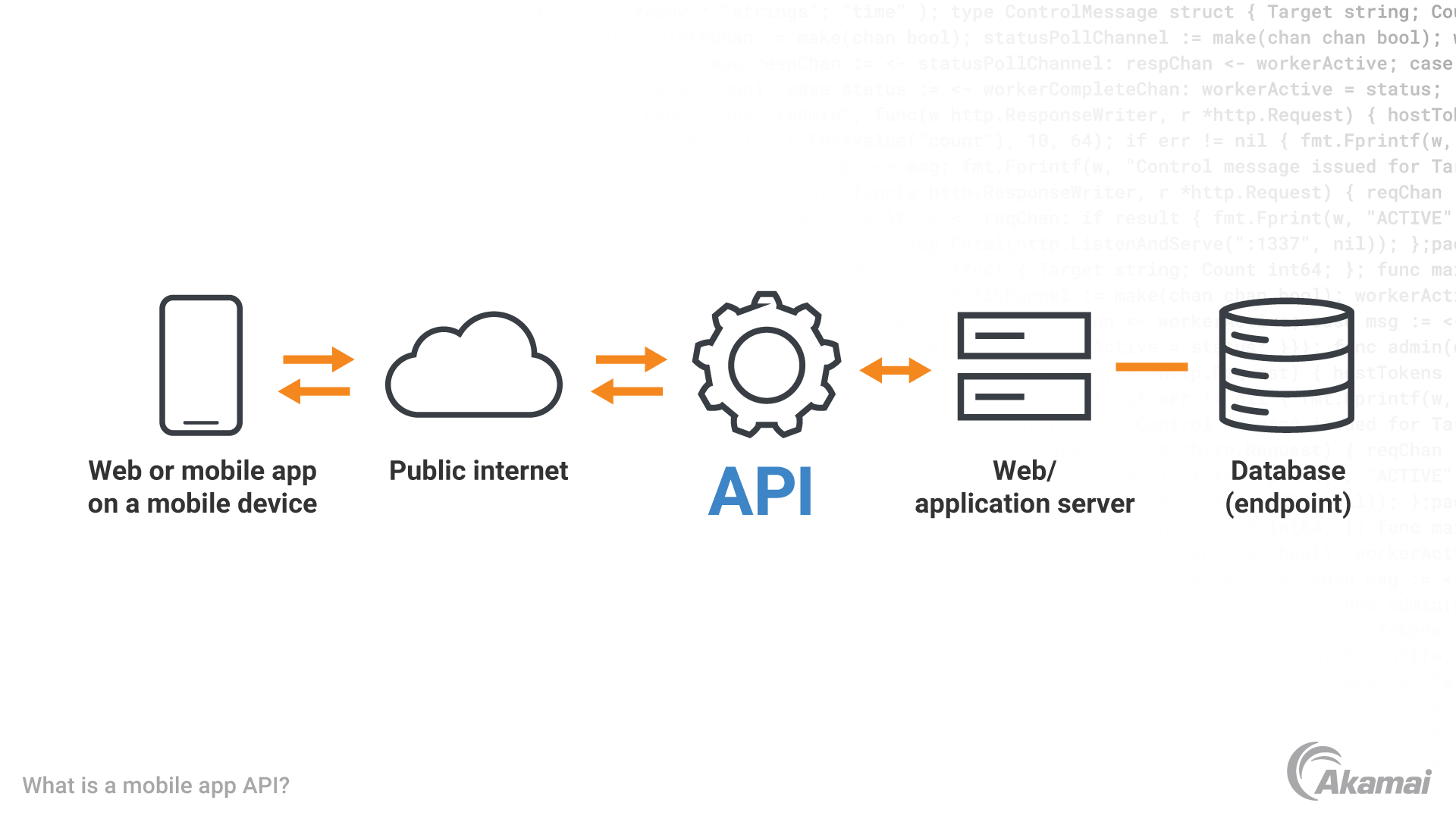
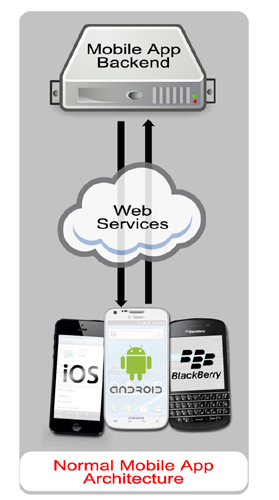
The backend of a mobile app refers to the server-side infrastructure that processes requests, manages data, and ensures communication between the app interface and databases. It is not visible to users, but every action they perform depends on it.
Whenever a user logs in, uploads a photo, places an order, sends a message, or receives a notification, the backend is responsible for handling that request.
Key Responsibilities of Mobile App Backend
- Storing and managing data securely
- Processing business logic and workflows
- Authenticating users and managing permissions
- Handling API requests from mobile devices
- Ensuring performance, speed, and scalability
- Protecting the app from security threats
Without a strong backend, even the most visually appealing app will fail to deliver a smooth experience.
Why Understanding the Backend of Mobile Apps Is Important
Understanding the backend of mobile apps is important for business owners, startups, and decision-makers, not just developers. Backend choices directly affect cost, performance, and future scalability.
Business Benefits of a Strong Backend
- Faster app performance and reduced loading time
- Better data security and compliance
- Ability to scale as users increase
- Seamless integration with third-party services
- Improved reliability and uptime
At Infotech Wayout, we always emphasize backend planning early in the app development process to avoid costly redesigns later.
Core Components of the Backend of Mobile Apps
To fully understand the backend of mobile apps, it helps to break it down into its main components. Each part plays a specific role in ensuring smooth app functionality.
1. Servers
Servers are powerful computers that receive requests from mobile apps and send back responses. They handle logic, computations, and data processing.
Servers can be:
- Physical servers
- Virtual private servers
- Cloud-based servers
Cloud servers are now the most popular choice due to flexibility and scalability.
2. Databases
Databases store all application data such as user profiles, transactions, messages, and preferences.
Common database types include:
- Relational databases like MySQL and PostgreSQL
- NoSQL databases like MongoDB and Firebase
Choosing the right database depends on the app’s data structure and scalability needs.
3. APIs
APIs act as messengers between the mobile app frontend and backend systems. They allow secure and structured communication.
APIs define:
- What data can be accessed
- How requests are sent
- What responses are returned
REST and GraphQL are widely used API architectures.
4. Backend Logic
This is where the actual rules of the app are written. Backend logic determines how data is processed and how features behave.
For example:
- Validating login credentials
- Calculating order totals
- Triggering notifications
How Backend and Frontend Work Together
The frontend is what users see and interact with. The backend handles everything else.
Here is a simplified flow:
- User taps a button in the mobile app
- Frontend sends a request to the backend API
- Backend processes the request
- Database is updated or queried
- Backend sends a response
- Frontend displays the result
Understanding the backend of mobile apps helps businesses realize why backend failures often lead to crashes, slow loading, or data loss.
Backend Architecture Models for Mobile Apps
Choosing the right architecture is crucial for long-term success. Different mobile apps require different backend structures.
Monolithic Backend Architecture
All backend components are built as a single system.
Pros
- Easier to develop initially
- Lower setup cost
Cons
- Difficult to scale
- Harder to maintain as app grows
Microservices Architecture
Backend is divided into independent services.
Pros
- High scalability
- Better fault isolation
- Easier feature updates
Cons
- More complex to manage
- Higher initial development cost
At Infotech Wayout, we often recommend microservices for apps with long-term growth plans.


Popular Backend Technologies for Mobile Apps
Understanding the backend of mobile apps also means knowing the technologies used to build it.
Programming Languages
- Node.js for real-time applications
- Python for data-heavy and AI-driven apps
- Java for enterprise-grade systems
- PHP for content-based apps
Backend Frameworks
- Express.js
- Django
- Spring Boot
- Laravel
Cloud Platforms
- AWS
- Google Cloud
- Microsoft Azure
Cloud platforms provide scalability, reliability, and cost control.
Authentication and User Management in Mobile App Backend
User authentication is one of the most critical backend functions.
Common Authentication Methods
- Email and password login
- OTP-based authentication
- Social login integration
- Biometric authentication
The backend ensures that only authorized users can access specific features.
Security misconfigurations in backend authentication are a common cause of data breaches.
Data Security in the Backend of Mobile Apps
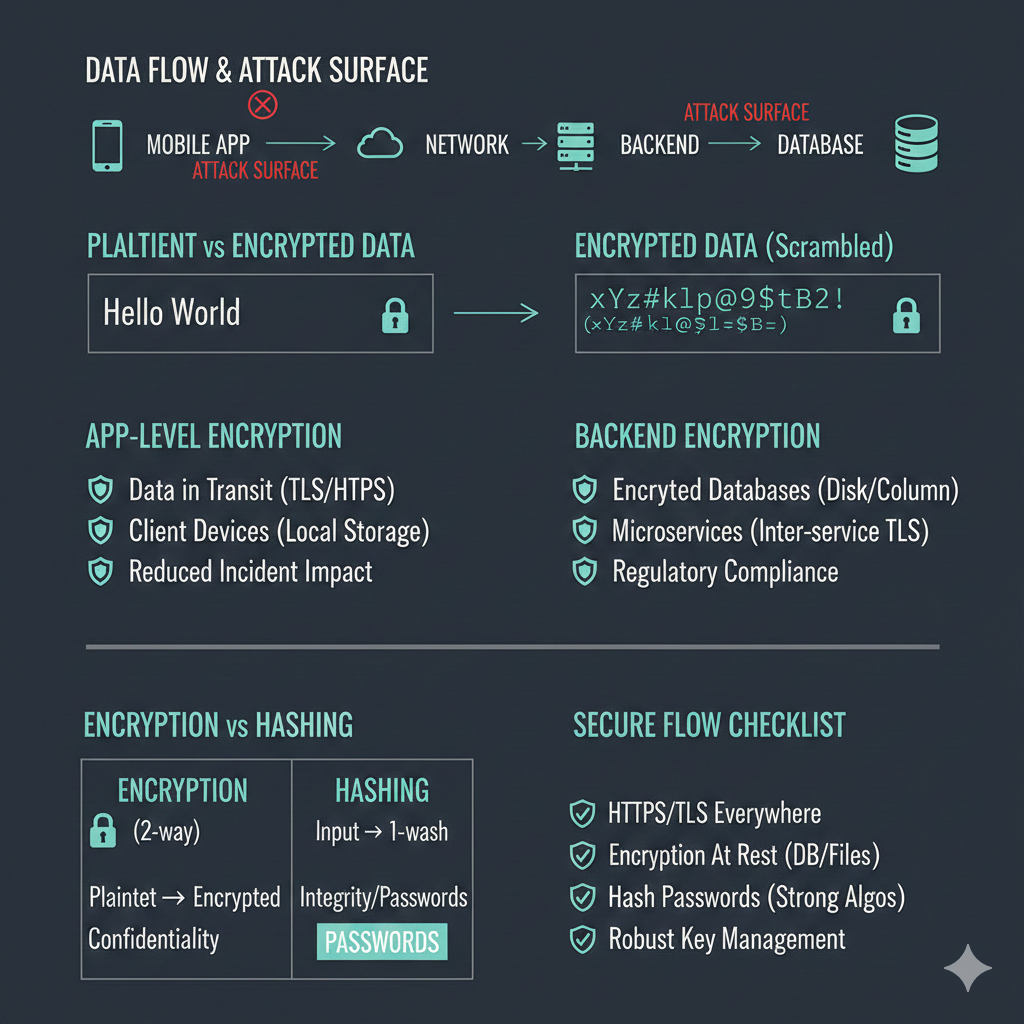
Security is a top priority when designing backend systems.
Key Backend Security Measures
- Data encryption
- Secure API endpoints
- Role-based access control
- Regular security audits
- Secure token management
Understanding the backend of mobile apps helps businesses protect sensitive user data and maintain trust.
Scalability and Performance Optimization
As your user base grows, your backend must handle increased traffic without performance loss.
Backend Performance Strategies
- Load balancing
- Caching mechanisms
- Database optimization
- Horizontal and vertical scaling
A scalable backend ensures your app performs well even during peak usage.
Third-Party Integrations in Mobile App Backend
Most modern apps rely on external services.
Common Integrations
- Payment gateways
- SMS and email services
- Analytics tools
- Maps and location services
The backend manages these integrations securely and efficiently.
Challenges in Mobile App Backend Development
Despite its importance, backend development comes with challenges.
Common Backend Challenges
- Managing high traffic loads
- Ensuring data security
- Maintaining uptime
- Handling real-time data
- Integrating multiple services
Understanding the backend of mobile apps helps businesses plan for these challenges early.
Backend Testing and Maintenance
Backend testing ensures reliability and performance.
Types of Backend Testing
- Unit testing
- API testing
- Load testing
- Security testing
Regular maintenance keeps the backend stable and future-ready.


Backend Development Cost Factors
Backend development cost depends on several factors.
- App complexity
- Technology stack
- Security requirements
- Scalability needs
- Integration complexity
At Infotech Wayout, we help businesses choose cost-effective backend solutions without compromising quality.
How Infotech Wayout Builds Reliable Mobile App Backends
At Infotech Wayout, we follow a structured approach:
- Requirement analysis
- Architecture planning
- Secure backend development
- API optimization
- Performance testing
- Continuous monitoring
Our goal is to build backend systems that are scalable, secure, and future-ready.
FAQs on Understanding the Backend of Mobile Apps
1. What is the backend of a mobile app?
The backend of a mobile app is the server-side system that manages data, logic, authentication, and communication between the app and databases.
2. Why is backend development important for mobile apps?
Backend development ensures performance, security, scalability, and reliability, which directly impact user experience.
3. Can a mobile app work without a backend?
Simple apps may work offline, but most modern apps require a backend for data storage, authentication, and real-time updates.
4. Which backend technology is best for mobile apps?
The best technology depends on app requirements. Node.js, Python, and Java are commonly used for mobile app backends.
5. How secure is a mobile app backend?
Security depends on implementation. Proper encryption, authentication, and testing make mobile app backends highly secure.
6. How long does backend development take?
Backend development timelines vary based on complexity, usually ranging from a few weeks to several months.
7. Is cloud backend better than traditional servers?
Cloud backends offer better scalability, reliability, and cost efficiency compared to traditional servers.
8. How much does mobile app backend development cost?
Costs depend on features, integrations, and scalability. A custom backend can range from moderate to high investment.

