
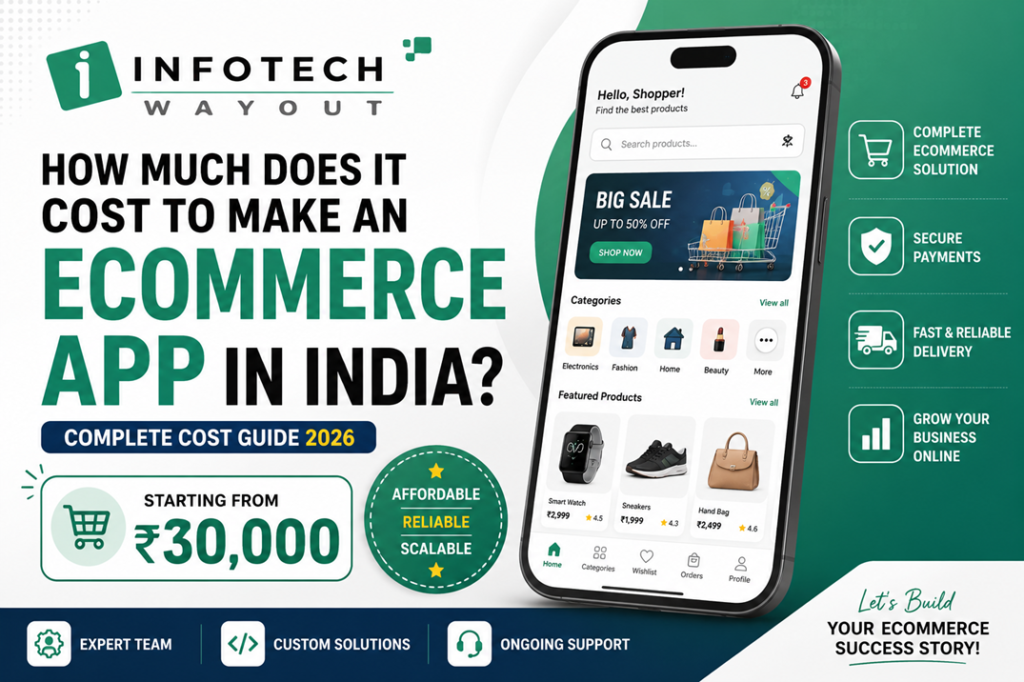
If you are planning to take your business online, one of the first questions you may have is, “How much does it cost to make an eCommerce app in India?”
The good news is that you do not always need a huge budget to get started.
At Infotech Wayout, our eCommerce app development starts from ₹30,000, making it possible for small businesses, startups, retailers, and entrepreneurs to launch their own mobile shopping application without making a very large initial investment.
However, the final cost depends on what you want your application to do.
A simple eCommerce app with essential shopping features can be developed at a much lower cost than a highly customized marketplace with multiple sellers, advanced analytics, sophisticated inventory management, loyalty programs, delivery integrations, and other advanced functionality.
In this guide, we will explain the cost of developing an eCommerce app in India, what you can expect at different budget levels, the features that influence the price, development timelines, ongoing expenses, and how to choose the right approach for your business.
If you are searching for eCommerce app development cost in India, this guide will help you understand where your money goes and how you can build an application according to your actual business requirements.
Quick Answer: How Much Does It Cost to Make an eCommerce App in India?
The cost can vary significantly depending on the scope of the project.
For businesses working with Infotech Wayout, an indicative pricing structure can look like this:
| Type of eCommerce App | Approximate Cost | Suitable For |
|---|---|---|
| Basic eCommerce App | Starting from ₹30,000 | Small businesses and startups |
| Standard eCommerce App | ₹50,000 to ₹1,00,000 | Growing businesses |
| Advanced eCommerce App | ₹1,00,000 to ₹2,50,000+ | Established businesses |
| Multi-Vendor eCommerce App | ₹1,50,000 to ₹4,00,000+ | Online marketplaces |
| Highly Customized App | ₹3,00,000+ | Businesses with complex requirements |
These prices are indicative starting ranges. The actual quotation depends on the features, design, technology, number of platforms, integrations, and customization required.
The important point is that you do not necessarily need to spend several lakhs to launch an eCommerce app.
If your objective is to start selling online with essential functionality, a basic application can be developed from ₹30,000.
What Do You Get in a ₹30,000 eCommerce App?
For a small business, the goal should be to launch with the essential features instead of paying for functionality that may not be needed initially.
A basic eCommerce app starting from ₹30,000 can be designed around essential shopping functionality such as:
- Customer registration and login
- Home page
- Product categories
- Product listing
- Product details
- Product images
- Shopping cart
- Basic checkout
- Order placement
- Order history
- Customer profile
- Basic admin management
- Basic product management
- Basic order management
The exact features included in the starting package should be confirmed according to the project scope.
This type of application can be particularly useful for:
- Local retailers
- Small businesses
- New entrepreneurs
- Boutique stores
- Clothing businesses
- Grocery businesses
- Home-based businesses
- D2C brands
- Small electronics businesses
- Beauty and cosmetics businesses
- Furniture businesses
Instead of investing a large amount before knowing whether customers will use the application, a business can start with the core shopping experience and expand later.
Why Does eCommerce App Development Cost Differently for Every Business?
There is no universal price for an eCommerce application because every business has different requirements.
Consider two businesses.
The first is a local clothing store with 100 products. It needs a basic product catalogue, cart, checkout, order management, and customer login.
The second is a marketplace with 1,000 sellers. It needs seller registration, seller dashboards, product approval, commissions, seller payouts, inventory synchronization, delivery management, refunds, disputes, analytics, and multiple administrative roles.
Both are technically eCommerce applications, but their development requirements are completely different.
This is why the cost to build an eCommerce app in India should be calculated according to the project’s scope rather than simply comparing a few development prices.
eCommerce App Development Cost by Project Type
Understanding different application categories makes it easier to estimate the budget.
1. Basic eCommerce App: Starting From ₹30,000
A basic application is designed around the fundamental shopping journey.
The customer should be able to open the application, browse products, view product information, add products to the cart, place an order, and check their order information.
The business owner should be able to manage products and orders.
This approach keeps the initial development cost low while providing the essential functionality required to start an online store.
A basic application is ideal when:
- You are starting a new online business
- You have a limited initial budget
- You want to test your business idea
- You already have a website or offline store
- You want your own branded mobile shopping app
- You plan to add advanced features later
2. Standard eCommerce App: ₹50,000 to ₹1,00,000
A standard application adds more functionality and customization.
Depending on requirements, it may include:
- Customized UI/UX
- Product search
- Product filters
- Wishlist
- Coupons
- Discounts
- Customer reviews
- Multiple product variations
- Payment gateway
- Push notifications
- Order status updates
- Improved admin panel
- Basic analytics
- Inventory management
This level is suitable for businesses that already have customers and want a more complete shopping experience.
3. Advanced eCommerce App: ₹1,00,000 to ₹2,50,000+
An advanced application can include more sophisticated business functionality.
Possible features include:
- Advanced product filtering
- Advanced search
- Multiple payment methods
- Multiple shipping options
- Delivery tracking
- Loyalty programs
- Referral systems
- Advanced coupon management
- Customer segmentation
- Detailed analytics
- Multiple warehouses
- CRM integration
- ERP integration
- Marketing automation
- Personalized recommendations
The actual cost depends heavily on the integrations and customization required.
4. Multi-Vendor Marketplace: ₹1,50,000 to ₹4,00,000+
A multi-vendor marketplace is more complicated than a normal online store.
In a single-vendor application, one business controls the products and orders.
In a multi-vendor marketplace, different businesses or sellers use the platform.
The application may therefore require:
- Customer application
- Seller registration
- Seller login
- Seller dashboard
- Product listing by sellers
- Product approval
- Seller inventory
- Commission management
- Seller order management
- Seller payouts
- Refund management
- Seller reports
- Customer management
- Admin controls
Because of these additional workflows, marketplace development generally requires a larger budget.
5. Highly Customized eCommerce Application: ₹3,00,000+
Some businesses require functionality that cannot easily be covered by a basic or standard application.
For example:
- Large product catalogue
- Multiple warehouses
- Complex inventory rules
- Custom ERP integration
- Advanced CRM integration
- AI-based recommendations
- Advanced logistics
- Multiple seller types
- Multiple business locations
- Subscription models
- B2B pricing
- Wholesale ordering
- Advanced reporting
- Custom customer journeys
In these cases, development can start from ₹3 lakh and increase according to the scope.
Main Factors That Affect eCommerce App Development Cost
When considering how much does it cost to make an eCommerce app in India, it is important to understand the factors that affect the price.
1. Number of Platforms
Do you need:
- Android only?
- iOS only?
- Android and iOS?
- Android, iOS, and website?
- Customer app and admin panel?
- Customer app, seller app, and admin panel?
The more platforms and applications required, the greater the development effort.
For businesses starting with a limited budget, launching an initial Android application can be a practical option.
As the business grows, iOS and other platforms can be added.
2. UI/UX Design
Design has a major influence on both development effort and customer experience.
A basic application can use a relatively straightforward interface.
A premium custom application may require:
- Custom wireframes
- User journey planning
- Custom graphics
- Brand-specific design
- Custom product layouts
- Animations
- Micro-interactions
- Custom icons
- Design systems
A good eCommerce design should make purchasing easy.
The customer should not have to think too much about where to search, how to add products, or how to complete an order.
3. Number of Features
Features are one of the biggest factors affecting development cost.
A basic application may require only 10 to 15 core functions.
An advanced application can have dozens of interconnected features.
For example, adding a wishlist is relatively straightforward compared with implementing a sophisticated loyalty system that manages points, customer tiers, promotional rules, expiry dates, and rewards.
Therefore, businesses should prioritize features according to their actual requirements.
4. Backend Development
The mobile app is only one part of an eCommerce system.
The backend manages important operations such as:
- Customer accounts
- Products
- Categories
- Inventory
- Orders
- Payments
- Coupons
- Notifications
- Shipping
- Reports
A well-designed backend is particularly important if you expect your business to grow.
5. Admin Panel
The admin panel allows the business owner or staff to manage the application.
A basic admin panel might provide:
- Product management
- Category management
- Customer management
- Order management
An advanced admin system may include:
- Inventory
- Coupons
- Promotions
- Seller management
- Reports
- Analytics
- Staff roles
- Permissions
- Delivery management
The complexity of the admin panel directly affects development time.
6. Payment Gateway
An eCommerce business generally needs a convenient payment process.
Depending on the business model and payment provider, the application can support options such as:
- UPI
- Debit cards
- Credit cards
- Net banking
- Wallets
- Cash on delivery
Payment integration also requires handling successful transactions, failed payments, cancellations, refunds, and order confirmation.
7. Shipping Integration
Businesses can choose different approaches to delivery.
You may:
- Handle delivery manually
- Use a shipping provider
- Integrate multiple shipping services
- Use your own delivery team
If real-time shipping information and automated tracking are required, additional development and API integration may be necessary.
8. Third-Party Integrations
Integrations can increase both development complexity and ongoing costs.
Common integrations include:
- Payment gateways
- SMS services
- Email platforms
- Shipping APIs
- Maps
- CRM systems
- ERP systems
- Analytics tools
- Marketing platforms
Each integration should be evaluated based on whether it provides sufficient business value.
Basic Features Every eCommerce App Should Have
Regardless of budget, certain functions are essential for a usable shopping application.
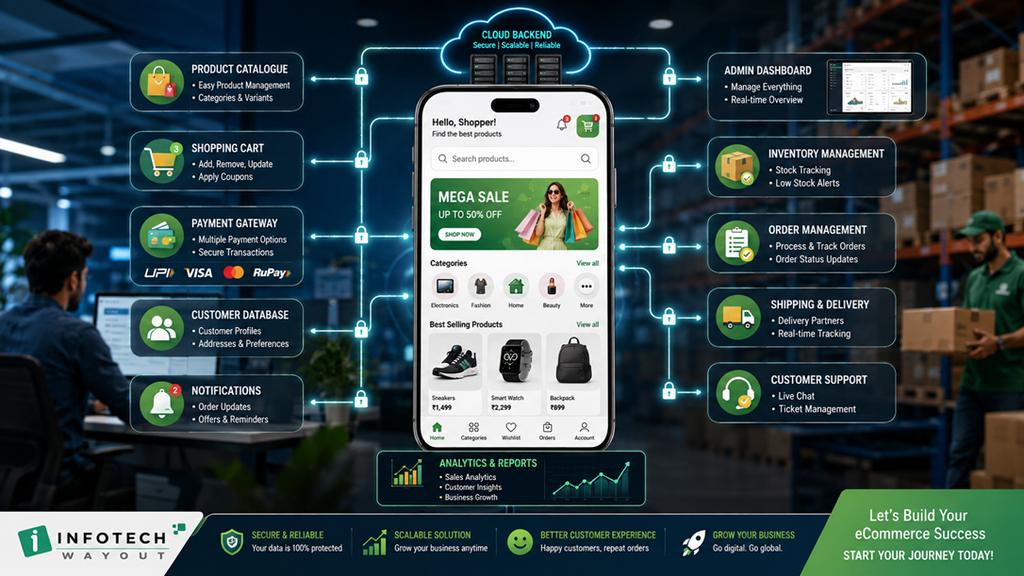
Product Catalogue
Customers need to browse available products.
The catalogue should include:
- Product name
- Product image
- Price
- Description
- Availability
- Product variations where applicable
Product Search
Search helps customers find products quickly.
Even a simple search feature can significantly improve usability when the product catalogue grows.
Shopping Cart
The cart allows customers to review their selected products before checkout.
It should show:
- Products
- Quantity
- Price
- Total amount
- Applicable discounts
- Delivery charges where applicable
Checkout
Checkout should be simple and easy to understand.
Customers may need to enter:
- Name
- Phone number
- Address
- Delivery details
- Payment method
Order Management
Customers should be able to see their orders and their status.
The business should also be able to manage orders from the admin panel.
Customer Account
An account area can contain:
- Personal information
- Saved addresses
- Order history
- Wishlist
- Other relevant settings
Advanced Features You Can Add Later
You do not need to build every feature in the first version.
After launching your app, you can add functionality such as:
Wishlist
Customers can save products for later.
Coupons
Businesses can create promotional codes.
Reviews and Ratings
Customers can provide feedback on products.
Loyalty Program
Customers can earn points and rewards.
Referral Program
Existing customers can invite new customers.
Push Notifications
The business can send order updates and promotional messages.
Abandoned Cart Recovery
Customers who add products to their cart but do not complete checkout can receive reminders.
Personalized Recommendations
The application can recommend products based on browsing and purchasing behaviour.
Advanced Analytics
Businesses can monitor:
- Sales
- Orders
- Customers
- Popular products
- Conversion
- Revenue
- Repeat purchases
How to Reduce the Cost of Building an eCommerce App
If your budget is limited, there are several ways to control development expenses.
Start With an MVP
An MVP focuses on essential features.
For example, instead of launching with:
- Loyalty program
- Referral program
- AI recommendations
- Advanced analytics
- Multiple seller accounts
- Complex promotions
you can start with:
- Products
- Categories
- Cart
- Checkout
- Orders
- Payment
- Admin management
Once customers start using the application, you can identify which features deserve investment.
Launch One Platform First
If you are targeting a specific customer segment, starting with one platform can reduce the initial investment.
You can expand to other platforms later.
Use Existing Integrations
Instead of developing every service from scratch, established APIs can be used where appropriate.
This can reduce development time and make it easier to add services such as payments, SMS, shipping, and analytics.
Avoid Unnecessary Customization
Customization is valuable when it improves the customer experience or solves a genuine business requirement.
It is less useful when it only adds complexity without providing meaningful value.
Prepare Requirements Before Development
One of the easiest ways to control development cost is to define the project scope before development begins.
A clear requirement document can specify:
- Features
- Platforms
- User roles
- Integrations
- Design requirements
- Admin requirements
- Delivery requirements
This helps minimize unexpected changes.
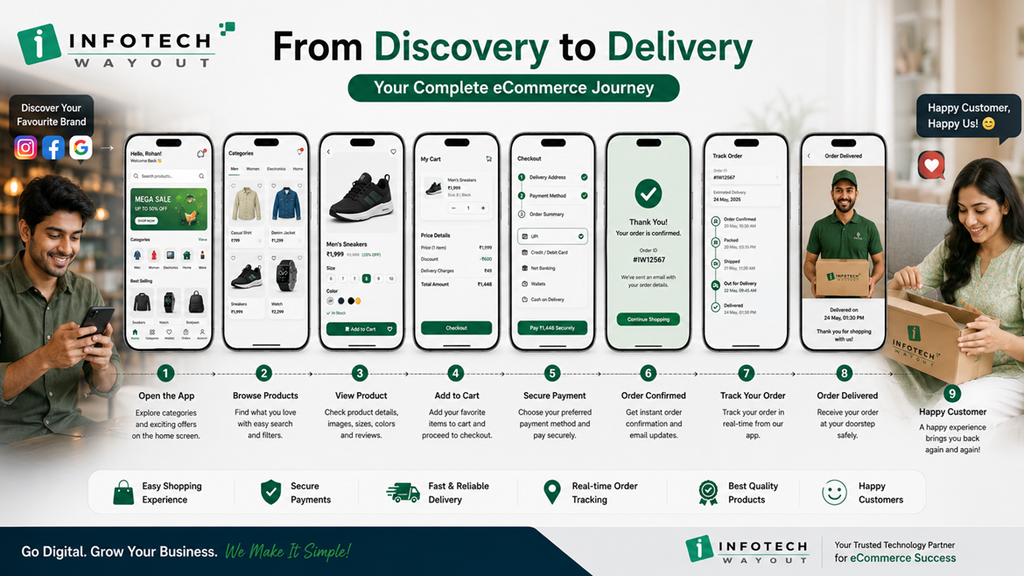
Hidden and Ongoing Costs of an eCommerce App
When calculating how much does it cost to make an eCommerce app in India, development is not the only expense you should consider.
There may be additional costs after development.
Hosting
Your backend and database need infrastructure.
The cost can depend on:
- Number of users
- Traffic
- Database size
- Storage
- Bandwidth
- Media files
- Backup requirements
Domain
If your application uses a website or API domain, you will need a domain name.
SMS and OTP
If you use mobile-number authentication, OTP services may have usage-based costs.
Payment Processing
Payment gateways generally charge transaction fees according to their commercial terms.
App Store Accounts
Publishing applications may require developer accounts and compliance with app store requirements.
Maintenance
Mobile operating systems, devices, libraries, APIs, and security requirements change over time.
Ongoing maintenance may therefore be required for:
- Bug fixes
- Security updates
- OS compatibility
- Performance improvements
- API changes
- New features
Marketing
Launching an app does not automatically bring customers.
You may need:
- SEO
- Google Ads
- Meta Ads
- Social media marketing
- Email marketing
- Influencer marketing
- Referral campaigns
- Promotional offers
Your technology and marketing strategy should work together.
How Long Does It Take to Develop an eCommerce App?
The timeline depends on the complexity of the project.
Indicative timelines may be:
| Project Type | Approximate Timeline |
| Basic eCommerce App | 3 to 6 weeks |
| Standard eCommerce App | 6 to 10 weeks |
| Advanced eCommerce App | 10 to 16+ weeks |
| Multi-Vendor App | 12 to 24+ weeks |
| Highly Customized Platform | 4 to 8+ months |
These are approximate planning ranges, not guaranteed delivery times.
The actual schedule depends on:
- Number of features
- Design complexity
- Number of platforms
- API integrations
- Client feedback
- Testing
- Content availability
- Scope changes
A clear project scope can help keep both cost and timeline under control.
Should a Small Business Build an eCommerce App?
For many businesses, starting small can be a smart approach.
Suppose you run a local clothing store.
You could initially invest in a basic eCommerce application that allows customers to:
- Browse products
- View prices
- Add products to a cart
- Place orders
- Make payments
- Receive order updates
Once your customer base grows, you could introduce:
- Loyalty rewards
- Coupons
- Personalized offers
- Advanced analytics
- Delivery tracking
- Multiple payment options
- Customer segmentation
This approach allows your technology investment to grow alongside your business.
eCommerce App vs eCommerce Website
Many businesses ask whether they should build an app or website first.
Both have advantages.
eCommerce Website
A website is accessible through a browser and can be discovered through search engines.
It can be useful for:
- SEO
- New customer acquisition
- Online visibility
- Sharing product links
- Desktop users
eCommerce App
An app can be useful for:
- Repeat customers
- Push notifications
- Personalized experiences
- Faster mobile shopping
- Customer loyalty
- Direct communication
For many businesses, the long-term strategy can include both.
However, if your budget is limited, you should prioritize the platform that best matches your current customer behaviour.
Why Choose Infotech Wayout for eCommerce App Development?
At Infotech Wayout, we understand that every business does not need a complicated eCommerce platform from day one.
Our approach is to understand the business first and then recommend a suitable development scope.
With eCommerce app development starting from ₹30,000, our goal is to make digital commerce more accessible to startups and small businesses.
Depending on your requirements, we can help with:
- eCommerce mobile app development
- UI/UX design
- Android app development
- iOS development
- Cross-platform development
- Backend development
- Admin panels
- Payment gateway integration
- Product management
- Order management
- Inventory management
- API integrations
- App deployment
- Maintenance and support
We can also help you identify which features should be included in your first version and which features can be added later.
The objective is not simply to build an application.
The objective is to build an application that supports your business.
How to Choose the Right eCommerce App Development Package
Before choosing a development package, ask yourself a few questions.
What Are You Selling?
The application requirements for clothing can be different from grocery, electronics, furniture, or B2B products.
How Many Products Do You Have?
A business with 20 products has very different catalogue requirements from a business with 20,000 products.
Who Are Your Customers?
Your target audience can influence design, platform selection, payment options, and features.
Do You Need Online Payments?
If yes, determine which payment options your customers are likely to use.
Do You Need Delivery Tracking?
If you provide delivery, decide whether you need manual order updates or automated shipping integration.
Do You Need Multiple Sellers?
If you are building a marketplace, seller management should be considered from the beginning.
What Is Your Initial Budget?
Your budget can help determine whether you should build an MVP, standard application, or advanced platform.
Is a ₹30,000 eCommerce App Enough to Start?
For some businesses, yes.
A ₹30,000 starting package should not be viewed as a complete enterprise eCommerce platform.
It is better understood as an affordable starting point for businesses that need essential eCommerce functionality.
The idea is simple:
Start with what you need today. Add what you need tomorrow.
For a startup, this can be more practical than spending several lakhs before validating the business idea.
However, businesses should always confirm the exact features, platforms, integrations, hosting, maintenance, and other inclusions before beginning development.
How to Plan Your eCommerce App Budget
A simple approach is to divide your budget into three stages.
Stage 1: Launch
Focus on essential functionality.
Budget example:
Starting from ₹30,000
Build the basic application and start acquiring customers.
Stage 2: Improve
Once you understand customer behaviour, invest in improvements.
Potential additions:
- Better UI/UX
- Coupons
- Wishlist
- Reviews
- Notifications
- Better search
- Analytics
Stage 3: Scale
Once the business has traction, introduce advanced functionality.
Potential additions:
- Loyalty programs
- CRM
- ERP
- Advanced inventory
- Personalization
- Multiple sellers
- Advanced delivery
- Business intelligence
This staged approach can help businesses manage technology spending more effectively.
Final Thoughts
So, how much does it cost to make an eCommerce app in India?
For businesses looking for an affordable starting point, Infotech Wayout offers eCommerce app development starting from ₹30,000.
A basic eCommerce application can provide the essential functionality needed to showcase products, manage shopping carts, process orders, and operate an online sales channel.
A more advanced application can cost ₹50,000, ₹1 lakh, ₹2.5 lakh, ₹4 lakh, or more depending on the features and complexity.
There is no single price that is right for every business.
The best approach is to identify what your customers actually need, launch with the most important features, and expand the platform as your business grows.
If you are a startup, small business, retailer, or entrepreneur looking to start selling online, you do not necessarily have to wait until you have a very large technology budget.
You can start small, build your digital presence, learn from your customers, and invest more as your business grows.
Infotech Wayout can help you turn your eCommerce idea into a practical mobile application while keeping the initial development cost affordable.
Frequently Asked Questions
1. How much does it cost to make an eCommerce app in India?
An eCommerce app can start from around ₹30,000 for a basic solution at Infotech Wayout. Standard applications may range from ₹50,000 to ₹1,00,000, while advanced and multi-vendor applications can cost ₹1,00,000 to ₹4,00,000 or more.
The final price depends on features, design, platform, integrations, backend requirements, and customization.
2. Can I really build an eCommerce app starting from ₹30,000?
Yes, a basic eCommerce application can start from ₹30,000 when the project is limited to essential features and a controlled scope.
The starting price should not be interpreted as the cost of every type of eCommerce application. Features such as advanced payment systems, complex shipping integrations, multi-vendor functionality, custom designs, ERP integrations, and sophisticated analytics can increase the cost.
3. What features are included in a basic eCommerce app?
A basic application can include essential features such as product categories, product listings, product details, shopping cart, checkout, order placement, customer login, customer profile, and basic administration.
The exact inclusions depend on the agreed project scope.
4. How long does it take to develop an eCommerce app?
A basic eCommerce application may take approximately 3 to 6 weeks, depending on the requirements and development process.
More advanced applications can take several months because they require additional features, integrations, testing, and customization.
5. What is the cost of a multi-vendor eCommerce app in India?
A multi-vendor application can start around ₹1,50,000 and increase to ₹4,00,000 or more depending on the requirements.
The additional cost comes from seller registration, seller dashboards, product management, commissions, payouts, inventory, seller orders, disputes, administration, and other marketplace functionality.
6. Can I add more features to my eCommerce app later?
Yes. Starting with an MVP allows you to add features over time.
You can initially launch with products, cart, checkout, payments, and order management, and later introduce loyalty programs, coupons, reviews, advanced analytics, personalized recommendations, CRM integration, and other functionality.
7. Do I need both an Android and iOS app?
Not necessarily.
Your choice should depend on your target audience and budget.
If most of your customers use Android, you may initially prioritize Android. If your target audience includes a significant iOS customer base, supporting both platforms may be appropriate.
A cross-platform approach can also be considered depending on the technical requirements.
8. What additional costs should I consider after app development?
Potential ongoing costs include hosting, domain, SMS or OTP services, payment gateway transaction charges, third-party API services, app store-related costs, maintenance, updates, and marketing.
It is important to ask your development company which services are included in the initial development quotation and which are recurring or separately charged.

