

In today’s digital-first world, customers often search online before they decide where to shop, whom to contact, or which company to trust. Whether someone is looking for a local restaurant, a service provider, a manufacturer, a consultant, a freelancer, or an online store, one of the first things they may do is search for the business on Google. This raises an important question for entrepreneurs and business owners: Does every business need a website?
The short answer is that not every business absolutely needs a website to operate, but almost every modern business can benefit significantly from having one.
A website is no longer only an online brochure containing a company’s address, phone number, and list of services. A well-designed business website can work as a digital storefront, sales representative, customer support channel, lead-generation system, credibility builder, booking platform, eCommerce store, portfolio, and information hub.
For some businesses, having a website may be essential. For others, social media pages, marketplaces, Google Business Profile, WhatsApp, or other digital platforms may initially be enough. However, depending entirely on third-party platforms can create limitations because the business does not have complete control over those platforms.
At Infotech Wayout, we believe the right question is not simply whether every business needs a website. The better question is: What role can a website play in your business, and when does investing in one make financial sense?
In this comprehensive guide, we will explore why websites matter, which businesses need them most, when a business might survive without one, the benefits and challenges of website ownership, website costs, and how to determine whether your business is ready for a professional website.
What Is a Business Website?
A business website is an online presence created specifically to represent a company, brand, professional, product, or service.
It can contain basic information such as:
- Company name
- Business description
- Products or services
- Contact information
- Location
- Business hours
- Customer reviews
- Portfolio
- Pricing information
- Frequently asked questions
- Blog articles
- Booking or appointment systems
- Online payment facilities
- eCommerce functionality
- Customer enquiry forms
- WhatsApp or live chat integration
- Social media links
However, a website can do much more than display information.
A modern website can connect with marketing tools, analytics platforms, CRM systems, payment gateways, email marketing systems, appointment scheduling software, inventory systems, and other business applications.
This means that a website can become an important part of a company’s overall digital infrastructure.
Does Every Business Need a Website?
The answer depends on the type of business, target customers, business goals, competition, budget, and growth plans.
A local street vendor who receives almost all customers through personal referrals may not immediately need a sophisticated website. Similarly, a small business that is still testing its products may want to start with a simple digital presence before making a larger investment.
On the other hand, a professional service company competing for customers online can lose significant opportunities without a website.
Consider a simple example.
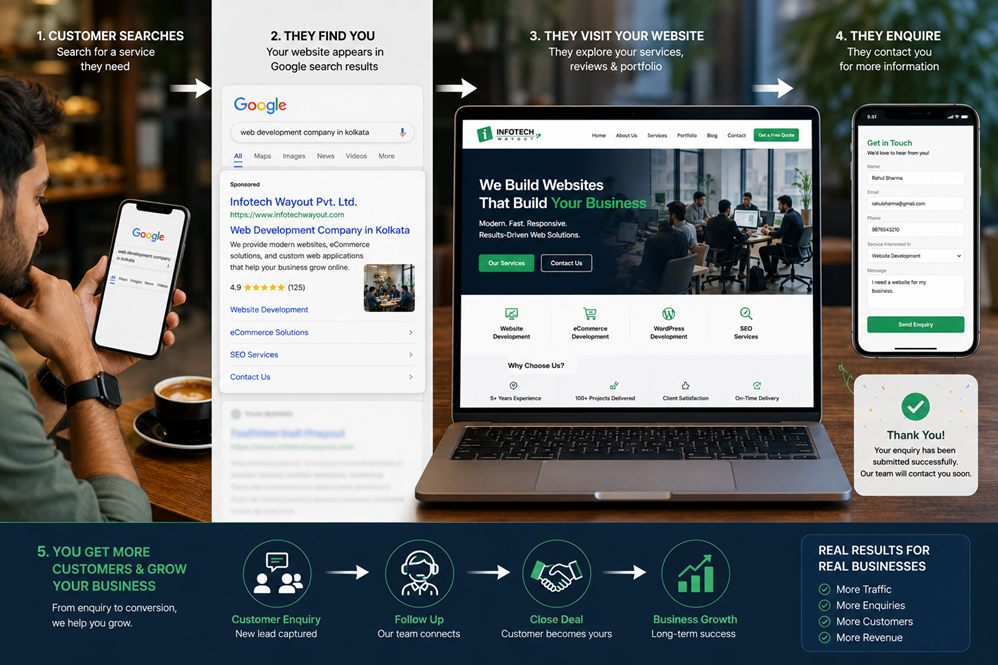
Imagine someone needs an interior designer. They search Google for “interior designer near me.” They find several companies. One company has a professional website showing completed projects, customer reviews, services, contact information, and an enquiry form. Another company only has a social media page with limited information.
Which company appears more established?
In many situations, the business with the professional website may have an advantage.
Therefore, while a website is not legally mandatory for every business, it has become an important competitive asset for many companies.
Why Do Businesses Need a Website?
There are several reasons businesses invest in websites. Some are directly related to sales, while others involve credibility, visibility, customer communication, and long-term growth.
Let’s examine the most important reasons.
1. A Website Builds Business Credibility
Trust is one of the biggest factors influencing purchasing decisions.
Before contacting a company, customers often want to know:
- Who are you?
- What do you offer?
- Where are you located?
- How long have you been operating?
- Can I see your previous work?
- Do other customers trust you?
- How can I contact you?
- Is this business legitimate?
A professional website can answer these questions quickly.
A well-designed website containing company information, service details, customer testimonials, project portfolios, certifications, contact information, and useful content can make a business appear more trustworthy.
This is especially important for businesses selling professional services.
A customer may be reluctant to pay a company they know nothing about. A website gives that customer an opportunity to learn about the business before making contact.
2. Your Business Can Be Found on Google
One of the biggest advantages of having a website is the opportunity to appear in search engine results.
When customers search for products or services, Google can display relevant websites based on search intent, content quality, location, authority, technical factors, and many other signals.
For example, a Kolkata-based web development company could target searches such as:
- Web development company in Kolkata
- Website design company in Kolkata
- Affordable website development
- eCommerce website development
- WordPress development company
- Mobile app development company in Kolkata
Without a website, it becomes much harder to build a long-term organic search presence for these kinds of queries.
This is where SEO becomes important.
A properly optimized website can attract visitors from search engines without requiring the company to pay for every individual click.
3. A Website Works 24/7
Your physical office may close at the end of the working day. Your sales team may not answer calls at midnight. Your shop may have fixed opening hours.
Your website, however, can remain available 24 hours a day.
A potential customer can visit your website at any time and learn about your services.
For example, someone may discover your business at 11:30 PM while searching online. They can read your services, look at your portfolio, submit an enquiry form, send a WhatsApp message, or schedule a consultation.
This creates opportunities outside traditional business hours.
4. A Website Gives You Control Over Your Online Presence
Social media platforms are useful, but they are third-party platforms.
Your business page exists according to the rules and systems of that platform.
The platform can change:
- Algorithms
- Advertising policies
- Content visibility
- Features
- Page layouts
- Organic reach
- Account restrictions
- Monetization rules
A website provides considerably more control.
You decide what information is displayed, how the website looks, which services are promoted, how visitors navigate the website, and what type of customer experience you want to create.
This is one of the most important reasons businesses should not rely exclusively on social media.
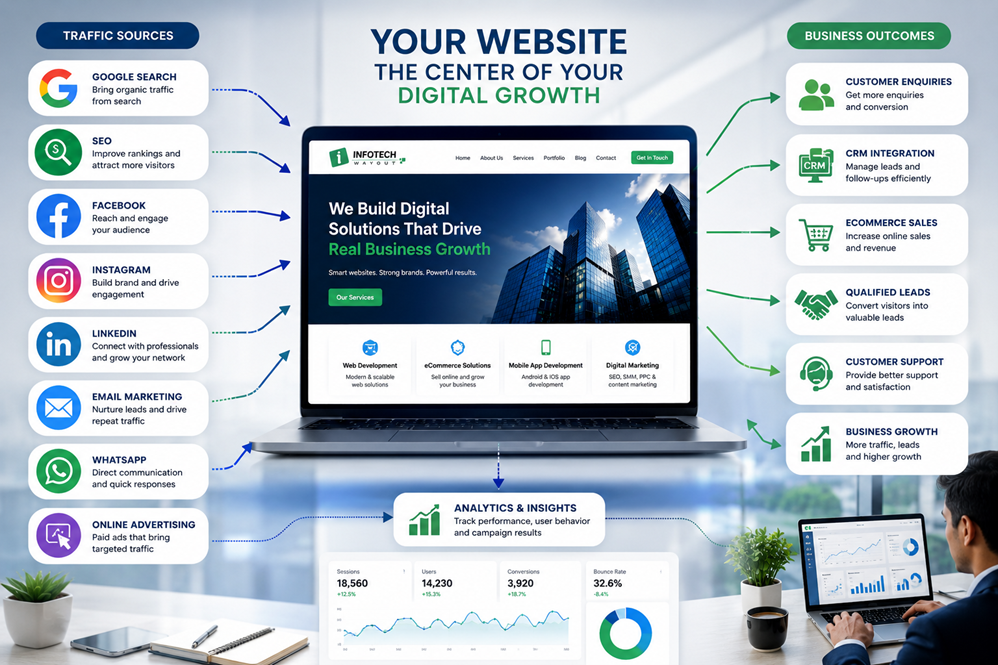
5. Your Website Becomes the Center of Digital Marketing
A modern digital marketing strategy often involves several channels.
These can include:
- Google Search
- SEO
- YouTube
- Email marketing
- Paid advertising
- WhatsApp marketing
- Content marketing
- Influencer marketing
Where should all these channels ultimately send interested customers?
In many cases, the answer is your website.
Your social media post can send people to your website.
Your Google advertisement can send visitors to a landing page.
Your email campaign can direct customers to a product page.
Your SEO strategy can bring visitors to your blog or service pages.
The website becomes the central destination where visitors can learn more and take action.
6. A Website Helps Generate Leads
A website can be designed specifically to generate leads.
For example, a service business can include:
- Request a Quote
- Book a Consultation
- Contact Us
- Get a Free Estimate
- Schedule a Call
- Download Brochure
- WhatsApp Us
Each of these actions gives visitors an opportunity to interact with the business.
Instead of simply displaying information, the website actively encourages visitors to become potential customers.
A good website should therefore have clear calls to action.
For example:
“Get Your Free Quote”
can be more effective than simply displaying:
“Contact Us.”
The first statement tells visitors exactly what they can expect.
7. Customers Expect Businesses to Be Online
Consumer behavior has changed dramatically.
People increasingly use their smartphones to research businesses before purchasing.
Even when a customer receives a recommendation from a friend, they may still search for the business online.
They may look for:
- Website
- Reviews
- Photos
- Location
- Pricing
- Services
- Portfolio
- Customer feedback
If they cannot find reliable information, they may move to another business.
This does not mean every customer expects a sophisticated website. However, having a professional and informative online presence can reduce uncertainty.
8. A Website Can Showcase Your Products and Services
Traditional advertising has limitations.
A printed advertisement has limited space. A business card contains only basic information. A newspaper advertisement disappears after publication.
A website can contain hundreds of pages if necessary.
A company can create separate pages for:
- Web design
- Web development
- Mobile app development
- SEO
- eCommerce
- WordPress
- CRM development
- Website maintenance
- Industry-specific solutions
Each page can target a specific customer need.
This is particularly useful for businesses with multiple services.
9. A Website Can Support Local Businesses
Some small business owners assume that websites are only useful for large companies.
That is not true.
Local businesses can benefit greatly from websites.
Examples include:
- Restaurants
- Salons
- Clinics
- Coaching centers
- Tuition providers
- Real estate agencies
- Travel agencies
- Repair services
- Photographers
- Wedding planners
- Interior designers
- Lawyers
- Accountants
- Consultants
- Local manufacturers
- Home service providers
A local business website can include location information, service areas, contact details, reviews, photographs, FAQs, booking options, and other useful information.
When combined with local SEO and Google Business Profile optimization, a website can support local customer acquisition.
10. Websites Help Businesses Compete With Larger Companies
A small business may not have the marketing budget of a large corporation.
However, a professionally designed website can help create a strong digital impression.
A small company can have:
- Professional branding
- Fast-loading pages
- Mobile-friendly design
- High-quality content
- Search engine optimization
- Customer testimonials
- Portfolio pages
- Online enquiry systems
These elements can make a small business appear professional and competitive.
A website does not automatically make a small company successful, but it can provide the digital foundation required to compete.
Do Small Businesses Really Need a Website?
This is one of the most common questions among entrepreneurs.
The answer is usually yes, especially if the business intends to grow.
A small business may start with Facebook, Instagram, WhatsApp, or Google Business Profile. These platforms can be excellent for generating initial visibility.
But as the business grows, it may need a central location where customers can find complete and reliable information.
A website also makes the business less dependent on one platform.
For example, if Instagram engagement decreases because of an algorithm change, the business can still attract customers through Google Search, SEO, email, referrals, advertising, and direct website traffic.
Can a Business Survive Without a Website?
Yes.
Some businesses operate successfully without websites.
For example, a local business may rely on:
- Word-of-mouth referrals
- Physical location
- Repeat customers
- Google Business Profile
- Online marketplaces
- Local directories
If these channels generate enough customers and revenue, the business may not immediately require a website.
However, surviving without a website is different from maximizing growth opportunities.
The question should therefore be:
Are you missing potential customers because you do not have a website?
If the answer is yes, building a website could be a valuable investment.
Businesses That Benefit Most From Having a Website
Some industries benefit more directly from professional websites than others.
Professional Service Businesses
Law firms, accountants, consultants, digital agencies, architects, designers, and business advisors often benefit from websites because customers need information before hiring them.
eCommerce Businesses
For an online store, a website can be the primary sales channel.
An eCommerce website can include:
- Product catalog
- Shopping cart
- Online payment
- Customer accounts
- Order tracking
- Discounts
- Inventory management
- Product reviews
- Shipping integration
Real Estate Businesses
Property businesses can use websites to showcase:
- Properties
- Photos
- Videos
- Location
- Property specifications
- Pricing
- Enquiry forms
- Agent information
Restaurants
Restaurants can use websites for:
- Digital menus
- Online reservations
- Food ordering
- Location information
- Reviews
- Special offers
- Event announcements
Educational Businesses
Coaching centers, training institutes, tutors, and educational organizations can use websites to display:
- Courses
- Fees
- Faculty information
- Admission details
- Class schedules
- Student testimonials
- Registration forms
Manufacturing Businesses
Manufacturers can use websites to reach distributors, wholesalers, business buyers, and international customers.
A manufacturing website can display product catalogs, specifications, certifications, industries served, facilities, and enquiry information.
Website vs Social Media: Which Is Better?
This is not necessarily an either-or decision.
A successful digital strategy can use both.
Social Media
Social media is excellent for:
- Engagement
- Brand awareness
- Short-form content
- Community building
- Customer conversations
- Visual marketing
- Promotions
Website
A website is better suited for:
- Detailed information
- SEO
- Lead generation
- Service pages
- Product catalogs
- eCommerce
- Long-form content
- Professional credibility
- Data and analytics
- Customer conversion
The strongest approach is often to use social media to attract attention and a website to convert that attention into business.
What Happens If You Depend Only on Social Media?
There are several potential risks.
First, you do not control the platform.
Second, organic reach can change.
Third, customers may have difficulty finding detailed information.
Fourth, your brand presence may look incomplete depending on the industry.
Fifth, search engine visibility may be limited compared with having your own website and optimized content.
This is why businesses should consider social media as part of their digital strategy rather than their entire digital strategy.
How Much Does a Business Website Cost?
Website costs vary significantly depending on requirements.
A simple informational website may cost considerably less than a custom eCommerce platform or business application.
Common factors affecting website development cost include:
- Number of pages
- Design complexity
- Custom functionality
- CMS requirements
- eCommerce features
- Payment gateway integration
- Third-party APIs
- Booking systems
- Database requirements
- User accounts
- Security requirements
- Hosting
- Domain
- Content creation
- SEO
- Maintenance
A small business may start with a simple website and gradually add advanced functionality as the company grows.
This approach can be more practical than trying to build a highly complex system from day one.
Is a Cheap Website Worth It?
A low-cost website is not automatically bad.
For a new business with a limited budget, a simple website can be a sensible starting point.
However, businesses should avoid choosing a website based solely on price.
A very cheap website may have problems such as:
- Poor design
- Slow loading speed
- Weak mobile responsiveness
- Security vulnerabilities
- Poor SEO structure
- Difficult maintenance
- Generic content
- Broken forms
- Poor user experience
The goal should be value rather than simply the lowest price.
A website should help the business achieve a measurable objective.
What Should a Business Website Include?
A basic business website may include:
Home Page
The homepage should immediately communicate who you are, what you offer, and why customers should choose you.
About Us
This page can introduce the company, team, experience, mission, and values.
Services or Products
Clearly explain what customers can buy or request.
Portfolio
For service businesses, showing previous work can significantly increase confidence.
Testimonials
Customer feedback can help establish trust.
Contact Page
Provide phone numbers, email addresses, location, enquiry forms, and other communication options.
FAQ
Frequently asked questions can help visitors find answers quickly.
Blog
A blog can support SEO, educate customers, and demonstrate expertise.
Mobile-Friendly Design Is Essential
A website is not truly effective if it only looks good on desktop computers.
Many customers access websites through smartphones.
Therefore, businesses should prioritize responsive design.
A mobile-friendly website should:
- Adjust to different screen sizes
- Have readable text
- Use easy-to-click buttons
- Load quickly
- Avoid unnecessary popups
- Provide simple navigation
- Make forms easy to complete
Poor mobile usability can cause visitors to leave before contacting the business.
Website Speed Matters
Website performance affects user experience.
If a page takes too long to load, visitors may leave.
Website speed can be affected by:
- Large images
- Poor hosting
- Excessive plugins
- Unoptimized code
- Too many scripts
- Poor caching
- Third-party integrations
A professional website development process should consider performance from the beginning rather than treating it as an afterthought.
Security Is Another Important Consideration
Businesses collect valuable information through websites.
Depending on the website, this could include:
- Customer names
- Email addresses
- Phone numbers
- Addresses
- Account credentials
- Order details
- Payment information
Therefore, website security is important.
Businesses should consider:
- SSL certificates
- Secure passwords
- Regular software updates
- Secure hosting
- Backups
- Security monitoring
- Protected forms
- Reliable payment gateways
The security requirements will vary depending on the type of website.
A Website Needs Maintenance
Building a website is not necessarily the end of the process.
Websites require ongoing attention.
Maintenance may include:
- Software updates
- Security checks
- Backups
- Content updates
- Broken link checks
- Performance monitoring
- Plugin updates
- Product updates
- SEO improvements
- Technical troubleshooting
A website that remains unchanged for years may eventually become outdated.

How a Website Supports SEO
Search engine optimization is one of the strongest long-term benefits of owning a website.
SEO helps businesses improve their visibility in search engines for relevant queries.
An effective SEO strategy can involve:
- Keyword research
- Search intent analysis
- Content creation
- On-page optimization
- Technical SEO
- Internal linking
- Local SEO
- Image optimization
- Page speed
- Mobile usability
- Link building
- Structured data
A website gives businesses a platform where these SEO strategies can be implemented.
For example, instead of relying entirely on paid advertising for “website development company in Kolkata,” a business can create a useful service page targeting that search intent and support it with relevant content.
Content Marketing and Blogging
A business website can also become a content publishing platform.
Businesses can publish articles answering customer questions.
For example, a web development company could publish articles about:
- Website development costs
- How to choose a web developer
- WordPress development
- eCommerce website features
- Website maintenance
- SEO
- Mobile app development
- Website security
- Responsive design
This content can attract people who are researching before purchasing.
Someone who reads a helpful article today may become a customer tomorrow.
How to Decide If Your Business Needs a Website
Ask yourself the following questions:
Do Customers Search for Your Services Online?
If yes, having a website is highly valuable.
Do You Want More Customers?
If you want to expand beyond referrals and existing customers, a website can become an important marketing asset.
Do Competitors Have Websites?
If your competitors are visible online while you are not, you may be losing potential customers.
Do You Need to Explain Your Services?
If customers frequently ask the same questions, a website can provide answers 24/7.
Do You Want to Build a Brand?
A website gives you greater control over your brand presentation.
Do You Want to Invest in SEO?
You need a website to build a strong long-term organic search presence.
Do You Want to Sell Online?
An eCommerce website can provide a direct sales channel.
If you answered yes to several of these questions, building a website may be a worthwhile investment.
What If You Have a Very Small Budget?
You do not necessarily need to build a massive website.
Start small.
A basic website with five to seven carefully designed pages can be enough for many businesses.
You can begin with:
- Home
- About
- Services
- Portfolio
- Testimonials
- Blog
- Contact
Later, you can add:
- Online booking
- eCommerce
- Customer accounts
- Payment gateways
- Advanced SEO
- CRM integration
- Chatbots
- Automation
This allows your online presence to grow alongside your business.
Should Every Business Have an eCommerce Website?
No.
Not every business needs eCommerce functionality.
If your company provides consulting, legal services, construction, accounting, or other professional services, you may only need a lead-generation website.
An eCommerce website is appropriate when customers need to browse and purchase products online.
The important thing is to build the website around the business model.
Common Mistakes Businesses Make With Websites
Having a website alone does not guarantee success.
Several common mistakes can reduce its effectiveness.
Poor Design
An outdated website can damage credibility.
Lack of Clear Information
Visitors should quickly understand what the company does.
No Call to Action
Customers should know what to do next.
Ignoring Mobile Users
A website must work well on smartphones.
Slow Loading
Performance problems can hurt user experience.
No SEO Strategy
A website may remain invisible to search engines without proper optimization.
Outdated Content
Old information can make a company look inactive.
No Maintenance
Security and technical issues can develop over time.
No Analytics
Without data, it is difficult to understand how visitors use the website.
Website Development Should Start With Business Goals
One of the biggest mistakes is starting website development by discussing colors, fonts, and animations before defining business objectives.
Instead, start with questions such as:
- Who are our customers?
- What problems do we solve?
- What services are most profitable?
- How do customers currently find us?
- What action should website visitors take?
- Which locations do we serve?
- What keywords are customers searching?
- How will we measure success?
Once these questions are answered, the design and technology choices become easier.
Professional Website Development vs DIY Website Builders
Businesses today have many options.
They can use:
- Website builders
- WordPress
- Custom HTML/CSS
- Custom web applications
- eCommerce platforms
- SaaS website platforms
DIY tools can be useful for entrepreneurs who want to create something quickly.
However, professional website development can provide advantages when a company requires:
- Custom design
- Advanced functionality
- SEO optimization
- Performance optimization
- API integrations
- Security
- Scalability
- Professional branding
- Ongoing support
The right solution depends on the business requirements and budget.
The Future of Business Websites
Websites are not disappearing.
Instead, they are becoming more integrated with other technologies.
Modern websites can connect with:
- Artificial intelligence
- Chatbots
- CRM systems
- Marketing automation
- Analytics
- Payment systems
- Inventory management
- Customer support
- Appointment systems
- Personalized content
AI-powered search and changing customer behavior may influence how websites are discovered, but businesses still need reliable digital destinations containing useful, authoritative information.
The role of a website is therefore evolving from a simple information page into a central business platform.
Final Verdict: Does Every Business Need a Website?
So, does every business need a website?
Not necessarily.
A business can operate without one, especially if it depends primarily on local customers, referrals, marketplaces, social media, or physical foot traffic.
However, for businesses that want to establish credibility, attract customers through Google, build a recognizable brand, generate leads, sell products online, publish useful content, or grow beyond their existing customer base, a website can be one of the most valuable digital investments they make.
The website does not have to be expensive or complicated.
The best website is not necessarily the one with the most features. It is the one that effectively supports the company’s goals and makes it easier for customers to understand, trust, and contact the business.
For a small company, this could mean a simple five-page website.
For an eCommerce brand, it could mean a complete online store.
For a growing company, it could mean a custom web application connected to CRM, analytics, payment, and automation systems.
At Infotech Wayout, we help businesses establish professional digital experiences through website design, web development, eCommerce development, mobile app development, SEO, WordPress development, and customized web solutions.
If your business is still relying entirely on social media or referrals, this may be the right time to evaluate whether a professional website could help you reach more customers and build a stronger online presence.
Your customers are already searching online.
The question is whether they can find you when they search.
Frequently Asked Questions
1. Does every small business need a website?
Not every small business is legally or operationally required to have a website. However, most small businesses can benefit from having one. A website can improve credibility, provide information, generate leads, support SEO, and help customers find the business online. Even a simple website can provide value without requiring a large investment.
2. Can I run a business without a website?
Yes, businesses can operate without websites. Many small businesses rely on referrals, social media, WhatsApp, marketplaces, Google Business Profile, or physical locations. However, relying exclusively on third-party platforms can limit control over your digital presence. A website provides a dedicated platform that the business owns and controls.
3. Is a website necessary if my business already has Facebook and Instagram?
A website may still be valuable. Facebook and Instagram are excellent for engagement and brand awareness, while a website provides a central location for detailed information, SEO, lead generation, product catalogs, services, portfolios, and customer enquiries. Using social media together with a website can create a stronger digital marketing strategy.
4. How much does it cost to build a business website?
The cost depends on the website’s size, design, functionality, technology, integrations, content requirements, and maintenance needs. A basic business website can be relatively affordable, while custom eCommerce platforms and web applications can cost considerably more. Businesses should focus on the value and expected return rather than choosing a developer solely based on the lowest price.
5. Does a website help a business get more customers?
A website can help generate more customers, but simply launching a website does not guarantee increased sales. The website needs to be optimized for search engines, designed around customer needs, mobile-friendly, fast, trustworthy, and equipped with clear calls to action. SEO, content marketing, advertising, and social media can then drive relevant visitors to the website.
6. Is a website important for local businesses?
Yes. Local businesses can benefit significantly from websites. A website can display services, location, opening hours, contact details, customer reviews, photographs, service areas, and booking information. When combined with local SEO and Google Business Profile optimization, it can help customers discover the business when searching for relevant local services.
7. Does a new business need a website from day one?
Not always. A new business with a very limited budget may initially use social media, WhatsApp, referrals, or marketplace platforms. However, creating a basic website early can help establish credibility and build a long-term digital presence. Starting with a simple website and expanding it as the business grows can be a practical strategy.
8. Should I hire a professional website development company?
If your business needs a simple website and you have the technical knowledge to build it, a DIY solution may work. However, professional website development can be beneficial when you need custom design, SEO, eCommerce, advanced functionality, integrations, security, performance optimization, or ongoing technical support. A professional development team can also help ensure that the website is designed around your actual business objectives.
Conclusion
A website is no longer simply an optional online brochure for many businesses. It can become a powerful business asset that supports marketing, sales, customer communication, branding, credibility, SEO, and long-term growth.
Not every business needs a complex website, and not every company needs to invest heavily from the beginning. But if customers are searching for your products or services online, having a professional digital presence can give your business a significant advantage.
The right approach is to understand your customers, define your goals, choose the appropriate website technology, create useful content, optimize the experience for search engines and mobile devices, and maintain the website over time.
If you are considering building a website for your business, Infotech Wayout can help you plan and develop a professional online presence tailored to your business requirements.
Your website should not simply exist.
It should work for your business.

