
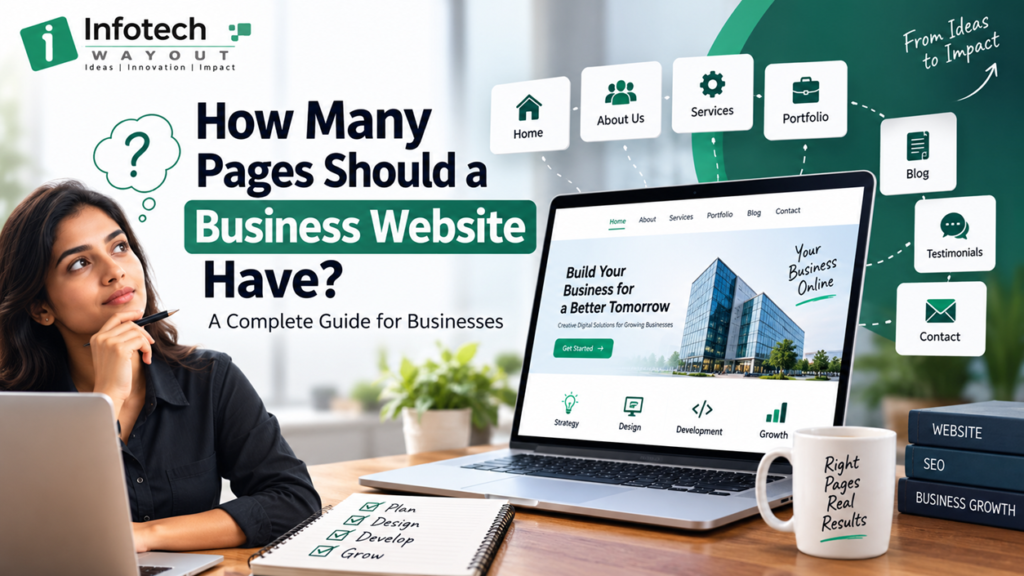
A business website is often the first place where potential customers learn about your company, explore your services, evaluate your credibility, and decide whether they should contact you. But one common question comes up whenever a new website is being planned: how many pages should a business website have?
There is no universal number that works for every business.
A local service provider may need only a few carefully planned pages, while a growing company offering multiple services, serving different locations, or targeting several customer segments may need a much larger website. The ideal number of pages depends on your business goals, services, target audience, SEO strategy, industry, and the amount of useful information your customers need before making a decision.
At Infotech Wayout, we believe that a successful business website should not be judged by the number of pages it contains. Instead, every page should have a clear purpose and provide value to visitors.
A website with 15 useful pages can perform far better than a website with 50 pages filled with repetitive or low-quality content.
In this comprehensive guide, we will explain how to determine the right number of pages for a business website, which pages are essential, when you need additional pages, how website pages influence SEO, and how to build a website structure that supports both customers and search engines.
Why Does the Number of Website Pages Matter?
Before deciding on the number of pages, it is important to understand why website structure matters in the first place.
Your website is more than an online brochure. It is a digital representation of your business. Each page can target a particular customer question, service, search query, or stage of the buying journey.
For example, a company providing web development services might have separate pages for:
- Website Development
- eCommerce Development
- WordPress Development
- Mobile App Development
- UI/UX Design
- Digital Marketing
Instead of placing all of this information on one generic “Services” page, individual service pages allow the business to explain each service in detail and target relevant search terms.
A well-planned website structure can help:
- Visitors find information quickly.
- Search engines understand what your business offers.
- Individual services rank for relevant searches.
- Customers build trust in your company.
- Visitors move naturally toward contacting or purchasing from you.
- Your business establishes stronger topical authority.
The objective is not to create as many pages as possible. The objective is to create the right pages for your audience and business goals.
So, How Many Pages Should a Business Website Have?
The answer depends on the type and size of your business.
For many small and local businesses, a professional website can start with approximately 5 to 10 core pages. A growing business with multiple services may need 10 to 25 pages. Larger companies, organizations, and businesses targeting several services, industries, or locations may require dozens or even hundreds of carefully optimized pages.
Here is a general guideline:
Small local business: 5 to 10 pages
Professional service business: 8 to 15 pages
Growing service company: 10 to 25 pages
Multi-service company: 20 to 50+ pages
Multi-location business: 30 to 100+ pages
Large organization: 50 to hundreds of pages
These figures are not strict rules.
A five-page website can be highly successful if it communicates the business clearly, provides useful information, generates leads, and satisfies the search intent of its target audience.
Similarly, a 100-page website can perform poorly if the pages contain duplicate, thin, irrelevant, or poorly organized content.
The Essential Pages Every Business Website Should Consider
Although every business is different, there are several pages that most professional business websites should consider.
1. Homepage
The homepage is usually the most important page on a business website.
It provides visitors with their first impression of your brand and should immediately communicate:
- Who you are
- What your business does
- Who you serve
- What makes your company different
- Why customers should trust you
- What action visitors should take next
A strong homepage should not attempt to explain absolutely everything.
Instead, it should provide a clear overview and guide visitors toward more detailed pages such as Services, About Us, Portfolio, Pricing, Blog, or Contact.
Your homepage can also include testimonials, important services, business benefits, certifications, client logos, frequently asked questions, and strong calls to action.
2. About Us Page
Customers want to know who they are dealing with before they spend money.
An About Us page gives your company an opportunity to explain your background, experience, values, team, mission, and approach.
For service-based businesses, this page can be particularly important because customers are often buying expertise and trust rather than a physical product.
A good About Us page might include:
- Company introduction
- Business history
- Mission and vision
- Team information
- Experience
- Certifications or achievements
- Company values
- Why customers choose you
Avoid turning the page into a generic corporate statement. Make it authentic and focused on what matters to your customers.
3. Services Page
A Services page is essential for most service-based companies.
It should provide an overview of the solutions your company offers and link visitors to detailed individual service pages when necessary.
For example, a technology company could list:
- Website Design and Development
- eCommerce Development
- Mobile App Development
- Software Development
- Digital Marketing
- SEO Services
If you provide several important services, creating a separate page for each major service can be beneficial.
This allows you to explain the service, process, benefits, pricing factors, use cases, frequently asked questions, and relevant examples in greater depth.
4. Individual Service Pages
Individual service pages are particularly valuable for SEO and lead generation.
Suppose a company offers website development, eCommerce development, and mobile app development. Putting everything on a single Services page limits the amount of useful information you can provide for each service.
Separate pages allow you to target specific search intent.
For example:
Website Development
eCommerce Development
Mobile App Development
Each page can focus on the customer’s specific requirements.
This is especially useful when people search for specific services rather than searching for the company itself.
5. Contact Us Page
Every business website should make it easy for customers to contact the company.
A Contact Us page may include:
- Contact form
- Phone number
- Email address
- Office address
- Business hours
- Google Maps location
- Social media links
- WhatsApp or other communication options
The page should be simple and convenient.
If someone has already decided they want to speak with your company, do not make them search through multiple pages to find your contact details.
6. Portfolio or Case Studies Page
For agencies, developers, designers, consultants, architects, marketing companies, and other professional service providers, a Portfolio page can be extremely valuable.
Customers often want proof before hiring a company.
A portfolio can demonstrate:
- Previous projects
- Design quality
- Technical expertise
- Industry experience
- Problem-solving ability
- Results achieved for clients
Whenever possible, consider creating individual case study pages for major projects.
Instead of simply saying “We built this website,” explain the customer’s challenge, your solution, technologies used, implementation process, and measurable outcome.
7. Testimonials or Reviews Page
Social proof can influence purchasing decisions.
A testimonials page gives prospective customers an opportunity to see what previous clients think about your company.
However, testimonials should not be limited to a standalone page.
Important reviews can also be displayed on relevant service pages and the homepage.
8. FAQ Page
A Frequently Asked Questions page can answer common customer concerns before they contact your business.
Questions might include:
- How much does your service cost?
- How long does a project take?
- What information do you need from the client?
- Do you provide ongoing support?
- What payment options are available?
- Do you work with businesses outside your local area?
FAQ content can also help identify topics that deserve their own pages or blog articles.
9. Blog or Resources Section
A blog is not mandatory for every business, but it can be extremely useful for SEO and content marketing.
A business blog allows you to answer questions your potential customers are already searching for.
For example, a web development company might publish articles such as:
- How Much Does It Cost to Build a Business Website?
- How Many Pages Should a Business Website Have?
- WordPress vs Custom Website Development
- How to Choose a Web Development Company
- How Long Does Website Development Take?
Each useful article can attract visitors through search engines and introduce them to your services.
How Many Pages Does a Small Business Website Need?
A small business does not necessarily need a large website.
For many small companies, a structure of approximately five to ten pages can be enough.
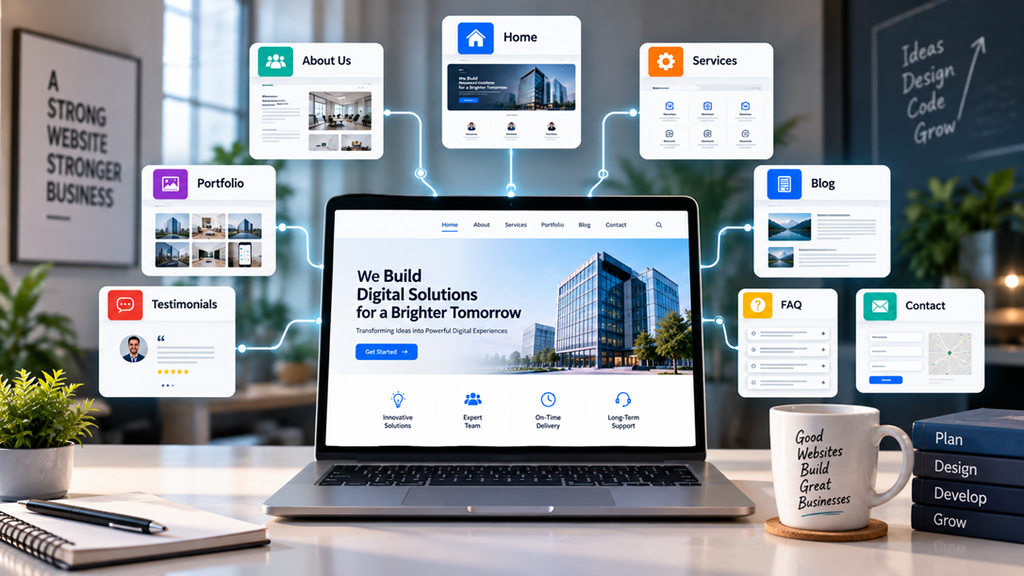
A basic structure could look like:
- Home
- About Us
- Services
- Individual Service Pages
- Portfolio or Testimonials
- FAQ
- Contact
The exact structure depends on what the business sells.
For example, a local electrician may need fewer pages than a software development company with multiple technical services.
The most important consideration is whether the website answers the questions customers have before contacting the business.
When Should You Create Separate Pages for Services?
One of the most important decisions in website planning is determining whether multiple services should appear on one page or have individual pages.
A separate service page is usually worthwhile when:
- The service is important to your revenue.
- Customers search for the service independently.
- The service has a different target audience.
- The service requires detailed explanation.
- The service has different pricing or processes.
- You want to rank for specific search terms.
- You have relevant case studies or examples.
For example, a digital agency offering SEO, social media marketing, Google Ads, and website development should generally consider dedicated pages for these services.
A customer searching specifically for “SEO services” is likely to prefer a page dedicated to SEO rather than a generic page containing ten unrelated services.
Does Having More Website Pages Improve SEO?
Not automatically.
This is one of the most common misunderstandings about website SEO.
Adding more pages does not guarantee higher rankings.
Search engines evaluate many factors, including content relevance, usefulness, quality, website structure, technical performance, authority, user experience, and search intent.
Creating 100 pages with thin or repetitive content is unlikely to provide the same benefit as creating 20 highly useful pages.
The better strategy is to create pages that answer real questions and serve clear search intent.
For example, instead of publishing ten almost identical articles about website development, a company could create genuinely useful resources covering:
- Website development costs
- Website development timelines
- Website technology options
- Website maintenance
- Website security
- Business website features
- Website redesign
Each topic can address a different customer need.
Quality Matters More Than Quantity
When deciding how many pages should a business website have, quality should always come before quantity.
Imagine two websites.
Website A has 40 pages, but many contain only a few paragraphs of generic content.
Website B has 15 pages, but each page provides detailed information, original insights, examples, images, clear calls to action, and answers to customer questions.
Website B can easily provide a better experience and stronger search visibility.
Every page should have a reason to exist.
Ask yourself:
“What purpose does this page serve?”
If you cannot answer that question clearly, the page may not be necessary.
Website Pages and the Customer Journey
A good website should support customers at different stages of the buying journey.
Someone visiting your website for the first time may not be ready to contact you immediately.
They may first want to understand your company.
Then they may investigate your services.
After that, they may look at previous work.
Finally, they may check reviews and contact you.
A website can support this journey through pages such as:
Awareness: Blog articles and educational resources.
Consideration: Service pages, comparison articles, guides, and case studies.
Trust: About Us, testimonials, certifications, portfolio, and reviews.
Conversion: Contact, consultation, quotation, booking, or enquiry pages.
This means website planning should be based on customer behavior rather than simply selecting an arbitrary number of pages.
Should Every Business Have a Pricing Page?
Not necessarily.
Some businesses benefit from transparent pricing because their services have standardized packages.
Others offer customized services where pricing depends on project complexity, requirements, technology, scope, or business size.
For example, a company selling fixed website packages may benefit from a dedicated Pricing page.
A custom software development company may instead explain the factors that influence cost and encourage potential clients to request a quotation.
The key is transparency.
Even if you do not publish exact prices, explain what influences the cost.
Should a Business Have Separate Location Pages?
Businesses serving multiple geographical areas may benefit from location-specific pages.
For example, a company serving customers across several cities could create useful pages describing its services in those locations.
However, location pages should contain genuinely useful, location-specific information.
Simply replacing a city name throughout the same template and publishing dozens of nearly identical pages can create a poor user experience.
A useful location page might include:
- Services available in that location
- Local customer requirements
- Relevant projects
- Service coverage
- Local contact information
- Frequently asked questions
- Directions or service-area information
The goal should be to help people in that location, not simply create pages for search engines.
How Many Pages Should a Business Website Have for SEO?
There is no fixed SEO page count.
Instead, think in terms of search intent and topical coverage.
Your website should have enough high-quality pages to comprehensively cover the subjects that matter to your customers.
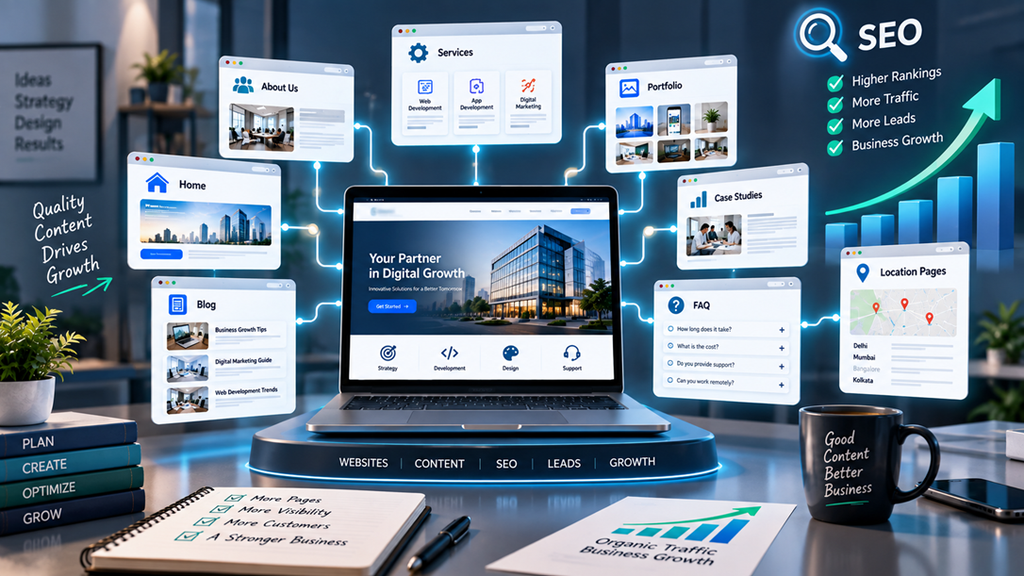
For example, a company specializing in web development may have a core service page for Website Development.
It could then create supporting pages and resources around topics such as:
- Business website development
- eCommerce website development
- Custom web applications
- WordPress development
- Website redesign
- Website maintenance
- Website security
- Website cost guides
- Website development comparisons
This creates a logical content ecosystem.
The main service page acts as a commercial destination, while supporting content answers informational questions.
These pages can be internally linked to one another, making it easier for both users and search engines to understand the relationship between topics.
The Role of Internal Linking
As your website grows, internal linking becomes increasingly important.
Internal links connect one page of your website to another.
For example, a blog article about website development costs could link to your Website Development service page.
A service page could link to relevant case studies.
A case study could link to the service used for that project.
This creates a logical network of information.
Internal linking can help visitors discover relevant content and can help search engines understand your website’s structure and the relationship between pages.
Common Website Page Structure for Different Businesses
Local Restaurant
A restaurant might need:
- Home
- Menu
- About
- Gallery
- Reservations
- Contact
Law Firm
A law firm may require:
- Home
- About
- Practice Areas
- Individual Practice Area Pages
- Attorneys
- Case Results
- Testimonials
- FAQ
- Blog
- Contact
IT Company
An IT company could require:
- Home
- About
- Services
- Individual Service Pages
- Industries
- Portfolio
- Case Studies
- Testimonials
- Blog
- FAQ
- Contact
eCommerce Business
An eCommerce website may have hundreds or thousands of pages because each product and category can have its own page.
In this situation, page count is naturally much higher than for a traditional business website.
The challenge becomes managing navigation, filtering, indexing, duplicate content, product variations, and technical SEO effectively.
Do You Need a Blog on Your Business Website?
A blog can be one of the most powerful additions to a business website when it is maintained properly.
However, creating a blog does not mean publishing random articles every week.
The content should be based on customer questions and business expertise.
For example, a web development company could target topics such as:
- Business website costs
- Website design trends
- Website security
- Mobile-friendly websites
- eCommerce development
- Website maintenance
- SEO basics
- Website conversion optimization
The best business blogs educate customers while naturally introducing the company’s products or services.
How to Avoid Creating Too Many Pages
More pages are not always better.
Businesses sometimes create unnecessary pages because they believe a larger website automatically looks more professional.
This can lead to:
- Duplicate content
- Thin content
- Confusing navigation
- Higher maintenance requirements
- Content management difficulties
- Poor user experience
- Keyword cannibalization
Before adding a page, consider whether it offers something substantially different from existing content.
If two pages target exactly the same audience and search intent, combining them may sometimes be better.
How to Decide Whether a Page Is Necessary
Use the following questions when planning your website:
- Does this page answer a real customer question?
- Does it target a meaningful search intent?
- Does it describe a distinct service or offering?
- Does it provide information that does not already exist elsewhere?
- Can visitors benefit from finding this page?
- Can we provide enough original and useful information for the page?
- Does this page support a business objective?
- Can we maintain and update it over time?
If the answer to most of these questions is yes, the page probably has a legitimate purpose.
Website Navigation Matters as Much as Page Count
A website with 20 pages can feel simple when those pages are organized properly.
A website with eight pages can feel confusing if navigation is poorly designed.
Your primary navigation should focus on the pages visitors are most likely to need.
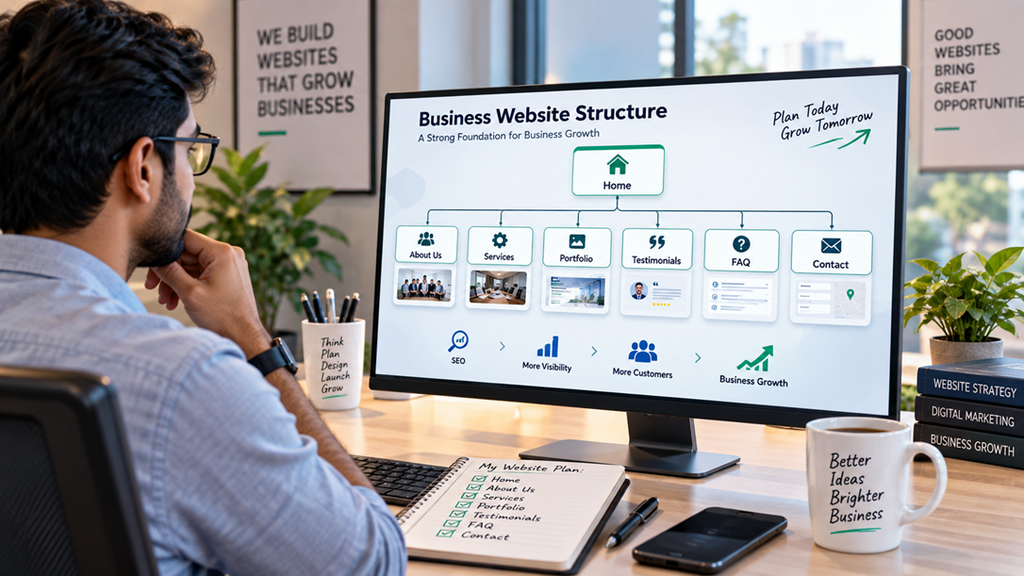
A typical structure might look like:
Home | About | Services | Portfolio | Blog | Contact
Service subpages can appear under Services.
Important conversion points should also be accessible from buttons throughout the website.
For example:
- Request a Quote
- Get Started
- Book a Consultation
- Contact Us
These calls to action can guide visitors toward the next step.
Mobile Users and Website Page Structure
A significant portion of website traffic can come from smartphones and tablets.
Therefore, website navigation should be designed for smaller screens.
Having many pages is not inherently a problem on mobile devices, but complicated navigation can be.
A responsive website should make it easy to:
- Open the navigation menu
- Find services
- Read content
- View images
- Submit forms
- Call the business
- Request information
Every page should also load efficiently and provide a good experience across different screen sizes.
Website Pages and Conversion Rates
The purpose of a business website is ultimately to support business growth.
That could mean:
- Generating enquiries
- Receiving phone calls
- Getting quotation requests
- Increasing bookings
- Generating online sales
- Building brand awareness
- Getting consultation requests
Therefore, website pages should contribute to the conversion journey.
For example, a service page can explain the solution, demonstrate expertise, show testimonials, answer FAQs, and finish with a clear call to action.
This is much more valuable than simply creating a page because a competitor has one.

Should You Start With a Small Website and Expand Later?
Yes, in many cases this is a smart approach.
A business does not have to launch with every possible page.
You can begin with the essential pages and expand based on customer questions, business growth, and SEO opportunities.
For example, the first version might include:
- Home
- About
- Services
- Portfolio
- Contact
Later, you could add:
- Individual service pages
- Case studies
- FAQ
- Blog
- Industry pages
- Location pages
- Resources
This approach allows your website to grow alongside your business.
What Happens If Your Website Has Too Few Pages?
A very small website can also create problems.
If everything is placed on one or two pages, visitors may not receive enough information to make an informed decision.
A single Services page containing a short description of 15 different services is a good example.
Visitors may struggle to understand:
- What each service includes
- Who the service is for
- How the process works
- What the service costs
- What results to expect
- Why they should choose your company
From an SEO perspective, combining too many unrelated topics on one page can also make it difficult to target specific search intent effectively.
What Happens If Your Website Has Too Many Pages?
The opposite problem is also possible.
An oversized website can become difficult to manage.
Businesses may end up with outdated pages, duplicate content, broken links, confusing navigation, and pages that receive little or no traffic.
A large website requires a clear content strategy.
Every page should have an owner, purpose, target audience, and maintenance plan.
A Practical Website Page Planning Formula
If you are starting a new business website, begin by creating three lists.
List 1: Core Business Information
Include:
- Home
- About
- Contact
- Testimonials
- Portfolio
List 2: Revenue-Generating Services
Write down every major service or product you want customers to discover.
List 3: Customer Questions
Write down questions customers ask before purchasing.
Now organize these topics into pages.
Major services should usually receive dedicated pages.
Frequently asked questions can be handled through an FAQ section or dedicated articles depending on their depth.
Educational topics can become blog posts or resource pages.
This method produces a website structure based on actual business needs rather than an arbitrary page count.
Final Answer: What Is the Ideal Number of Pages?
So, how many pages should a business website have?
For many small businesses, approximately 5 to 10 well-designed pages can provide a strong starting point.
For businesses with several services, 10 to 25 pages may be more appropriate.
Companies with multiple services, locations, industries, customer segments, or extensive content strategies may require 25, 50, 100, or even hundreds of pages.
But there is no magic number.
The ideal website is one where every page has a clear purpose, provides genuine value, supports the customer journey, and contributes to a larger business objective.
At Infotech Wayout, we recommend planning website architecture around your business goals instead of simply trying to increase page count.
A successful business website should be:
- Easy to navigate
- Mobile-friendly
- Fast and technically sound
- Search-engine friendly
- Focused on customer needs
- Built around useful content
- Designed to generate conversions
- Easy to expand as the business grows
The right number of pages is the number required to explain your business properly without adding unnecessary complexity.
How Infotech Wayout Can Help Build the Right Business Website
Planning website pages is only one part of creating a successful online presence.
The website also needs professional design, clear content, responsive development, technical SEO, intuitive navigation, strong calls to action, security, performance optimization, and ongoing maintenance.
At Infotech Wayout, we can help businesses plan and develop websites based on their specific objectives.
Whether you need a simple company website, a service-based business website, an eCommerce website, or a larger custom web solution, the structure should be designed around your customers and business goals.
Instead of asking only how many pages your website needs, ask a more important question:
“What information does my customer need to trust my business and take the next step?”
Once you answer that question, determining the right website structure becomes much easier.
Frequently Asked Questions
1. How many pages should a small business website have?
A small business website can often start with 5 to 10 pages. A typical structure includes Home, About Us, Services, Portfolio or Testimonials, FAQ, and Contact. If the business provides multiple important services, individual service pages can be added. The exact number should depend on what customers need to know before contacting or purchasing from the business.
2. Is a 5-page website enough for a business?
Yes. A five-page website can be sufficient for a small business if those pages clearly communicate the company’s services, expertise, credibility, and contact information. A simple website with high-quality content can be more effective than a larger website filled with unnecessary pages. However, businesses with multiple services or strong SEO goals may benefit from expanding beyond five pages.
3. Does having more pages help a website rank higher on Google?
Not necessarily. Search engine rankings are not determined simply by the number of pages on a website. Useful, relevant, original, well-structured content is more important than publishing large quantities of low-quality pages. Additional pages can create more opportunities to target relevant searches, but only when those pages provide genuine value.
4. Should every service have its own page?
Not every service requires a separate page. However, a dedicated page is generally useful when a service is an important part of the business, has a distinct target audience, requires detailed explanation, or is searched independently online. Individual service pages can also provide opportunities to create focused content and improve the customer experience.
5. How many pages does an SEO-friendly business website need?
There is no specific page count required for an SEO-friendly website. Instead, the website should contain enough high-quality pages to cover the important topics, services, products, and questions relevant to its target audience. The website should also have strong internal linking, clear navigation, technically sound development, useful content, and appropriate keyword targeting.
6. Should a business website have a blog?
A blog can be highly beneficial, particularly for businesses that want to attract organic search traffic and demonstrate expertise. Blog articles can answer customer questions, explain industry topics, address common problems, and support service pages. However, businesses should prioritize quality over publishing frequency. A small collection of genuinely useful articles can be more valuable than dozens of low-quality posts.
7. Can I add more pages to my website later?
Yes. A business website should ideally be designed so that it can grow over time. You can launch with core pages and later add service pages, case studies, blog articles, FAQs, location pages, industry pages, and other resources. Planning a scalable website structure from the beginning makes future expansion easier.
8. What is more important, website design or the number of pages?
Both matter, but neither should be considered in isolation. A website needs an effective structure, useful content, professional design, fast performance, mobile responsiveness, clear navigation, and strong calls to action. The number of pages is only one part of the overall website strategy. A smaller website with excellent content and user experience can outperform a larger website that is poorly organized.
Conclusion
There is no universal answer to the question, how many pages should a business website have?
The right number depends on your business model, services, audience, geographic reach, competition, content strategy, and goals.
For many businesses, 5 to 10 pages provide a solid foundation. Growing companies may need 10 to 25 pages, while larger businesses may require significantly more.
The most important principle is simple: every page should have a purpose.
Do not create pages simply to increase the page count. Create them because they help customers, answer questions, explain your services, establish trust, target meaningful search intent, or support conversions.
A strategically planned website can become much more than an online business card. It can become a powerful tool for generating leads, building credibility, educating customers, and growing your business.
Need help planning the right website structure for your business?
Infotech Wayout can help you plan, design, develop, and optimize a professional business website based on your goals and target audience.

