
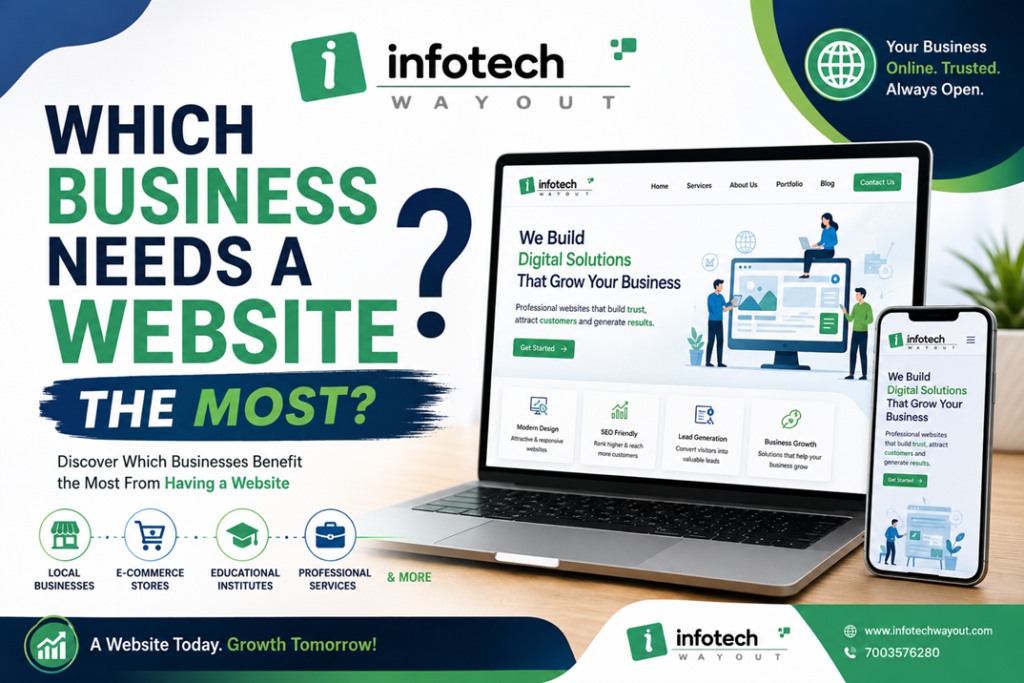
Introduction: Does Every Business Really Need a Website?
A few years ago, having a website was often considered an advantage for a business. Today, it is becoming much closer to a necessity.
When customers hear about a company, discover a local service provider, see an advertisement, receive a recommendation, or come across a business on social media, one of the first things they often do is search online. They want to know who the business is, what it offers, where it is located, whether it is trustworthy, what customers think about it, and how they can get in touch.
In many cases, the customer’s first impression is formed before they ever speak to the business.
This is where a professional website becomes extremely valuable.
A website is not simply an online brochure. A well-planned business website can work as a digital storefront, sales assistant, information center, lead generation system, customer support resource, portfolio, booking platform, and credibility-building tool.
But does every business need the same type of website?
Absolutely not.
A local restaurant may need a menu, location, reservation information, photographs, reviews, and an ordering system. A construction company may need project galleries, service pages, testimonials, enquiry forms, and quotation requests. An eCommerce company needs product listings, shopping carts, payment integration, order management, and customer accounts. A consultant may primarily need a professional profile, service information, case studies, and a lead generation form.
So, which business needs a website the most?
The short answer is this:
Businesses that depend on customer discovery, trust, enquiries, bookings, reputation, or repeated purchases can benefit enormously from having a professional website.
Some businesses, however, have an even greater need because their growth depends heavily on being found online.
In this comprehensive guide, Infotech Wayout explores which businesses need websites the most, why websites matter, what types of businesses benefit from them, common mistakes to avoid, and how the right website can contribute to long-term business growth.
Why Is a Website Important for a Business?
Before identifying the businesses that need websites most, it is important to understand what a website actually does for a company.
A professional website gives your business a permanent digital presence that you control.
Social media platforms are useful, but your business does not control their algorithms, layouts, policies, or reach. Your website gives you a dedicated digital property where you can present your brand exactly the way you want.
A website can help a business:
- Establish credibility
- Explain products and services
- Generate enquiries
- Capture leads
- Display portfolios and previous work
- Provide contact information
- Receive bookings
- Sell products online
- Share customer reviews
- Improve search visibility
- Answer frequently asked questions
- Provide business information 24/7
- Support digital advertising campaigns
- Build long-term brand authority
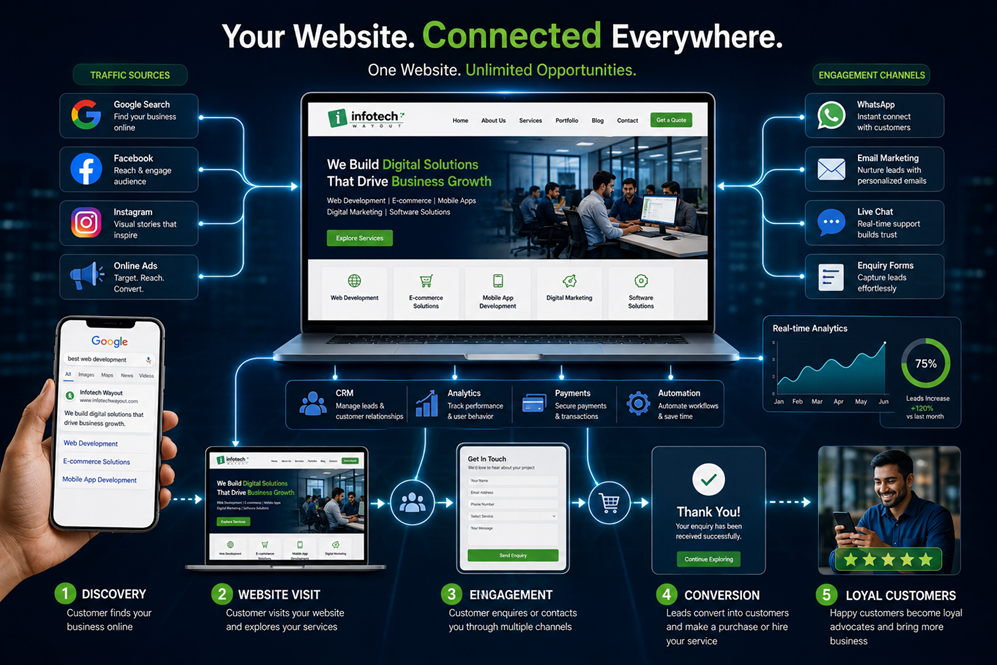
Most importantly, a website can connect multiple marketing channels together.
For example, a potential customer may discover your business through Facebook, search for your company on Google, visit your website, view your services, read testimonials, and submit an enquiry.
The website becomes the central point of that customer journey.
Which Business Needs a Website the Most?
There is no single industry that owns the answer. However, some types of businesses have a particularly strong need for a website because customers frequently search for their services online.
Below are some of the businesses that can benefit most from having a professional website.
1. Local Service Businesses
Local service businesses are among the biggest beneficiaries of a professional website.
Examples include:
- Plumbers
- Electricians
- Interior designers
- Cleaning services
- Pest control companies
- AC repair services
- Home renovation companies
- Car repair workshops
- Beauty salons
- Fitness trainers
- Photographers
- Event decorators
- Security services
- Moving companies
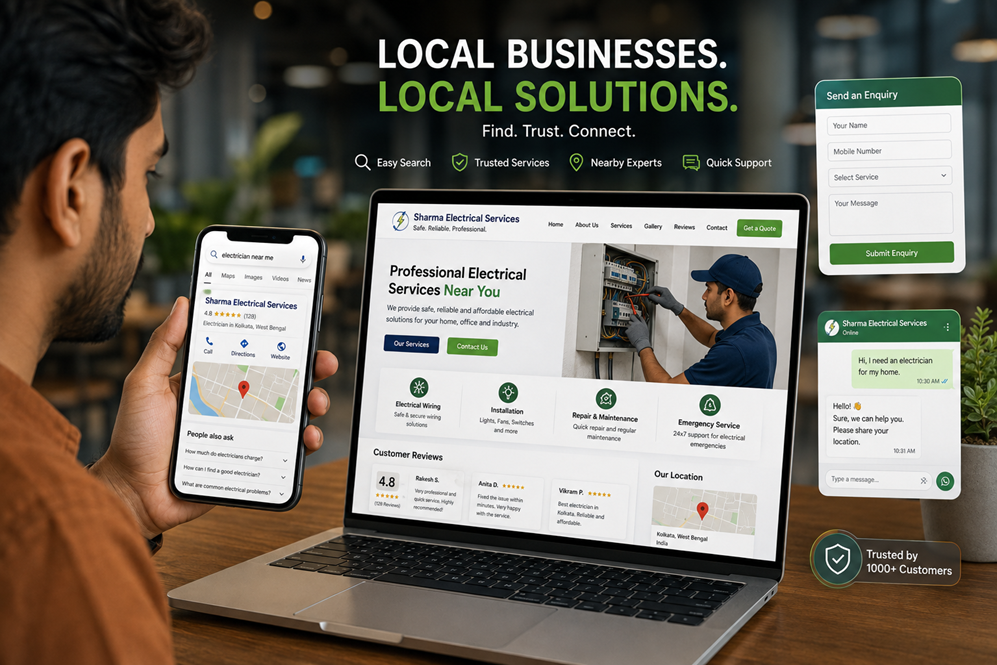
Imagine someone searching for an electrician in their city.
They may search for phrases such as “electrician near me,” “best electrician in Kolkata,” or “emergency electrician.”
If your business has a properly optimized website, it can potentially appear in relevant search results and provide the customer with useful information.
Your website could include your services, service areas, phone number, WhatsApp contact, customer reviews, photographs, pricing guidance, FAQs, and enquiry form.
Without a website, a potential customer may have to depend entirely on social media pages, directory listings, or recommendations.
A website gives them a reliable place to learn about your business.
Why local businesses need websites
Local customers usually want information quickly.
They want to know:
- What services do you provide?
- Do you serve my area?
- How can I contact you?
- Are you experienced?
- What do previous customers say?
- How much might the service cost?
- Can I book an appointment?
A website can answer these questions before the customer makes a phone call.
2. Restaurants, Cafes, Bakeries, and Food Businesses
Food businesses are another category where websites can provide significant value.
Restaurants and cafes often rely on customers discovering them online. Before visiting a restaurant, customers may search for the menu, location, photographs, opening hours, reviews, reservation options, or delivery information.
A restaurant website can display:
- Digital menu
- Food photographs
- Restaurant location
- Opening hours
- Reservation options
- Online ordering
- Delivery information
- Customer reviews
- Special offers
- Events
- Contact information
A website can also help restaurants reduce dependency on third-party platforms for basic information.
For example, instead of answering the same questions repeatedly through phone calls or messages, the restaurant can direct customers to its website.
A good restaurant website should also be mobile-friendly because many customers search for restaurants using smartphones.
3. ECommerce Businesses
If a business sells products, an eCommerce website can become one of its most important business assets.
Online shoppers expect to find detailed product information, images, pricing, availability, payment options, delivery details, and return policies.
An eCommerce website can provide all of these functions in one place.
Typical features include:
- Product catalogue
- Product search
- Categories and filters
- Shopping cart
- Customer accounts
- Online payments
- Order tracking
- Discount coupons
- Inventory management
- Wishlist
- Product reviews
- Shipping integration
- Automated notifications
- Admin dashboard
For an eCommerce business, the website is not merely a marketing tool. It can be the core sales platform.
This is particularly important for businesses that want to build a long-term digital sales channel instead of depending entirely on marketplaces.
A well-designed eCommerce website can also provide valuable information about customer behavior, including popular products, abandoned carts, repeat purchases, and conversion rates.
4. Professional Service Providers
Professionals such as lawyers, accountants, architects, consultants, financial advisors, designers, engineers, and business coaches can benefit greatly from websites.
For professional service providers, trust is extremely important.
A customer may not purchase a physical product immediately. Instead, they are evaluating expertise.
A professional website can showcase:
- Professional background
- Qualifications
- Areas of expertise
- Services
- Experience
- Case studies
- Client testimonials
- Portfolio
- Articles
- Frequently asked questions
- Contact information
Publishing useful educational content can also help professionals demonstrate their knowledge.
For example, an accounting firm could publish articles explaining tax-related concepts. An architect could publish articles about home design. A legal professional could create educational content about common legal processes.
Over time, useful content can strengthen online visibility and authority.
5. Real Estate Businesses
Real estate is highly visual and information-driven, making websites particularly valuable.
A real estate website can display:
- Available properties
- Property photographs
- Videos
- Property specifications
- Location details
- Price information
- Amenities
- Search filters
- Property enquiry forms
- Agent profiles
- Contact information
Customers can browse properties before contacting an agent.
Real estate businesses can also create separate pages for different locations, property categories, and services.
For example:
- Residential properties
- Commercial properties
- Apartments
- Villas
- Land
- Rental properties
- New developments
A professional website can make the property search process easier and more organized.
6. Schools, Coaching Centers, and Educational Businesses
Educational institutions increasingly need strong digital communication.
Parents and students often search online before choosing a school, coaching center, training institute, or professional course.
A website can provide:
- Course information
- Faculty profiles
- Admission information
- Class schedules
- Fee information
- Student achievements
- Facilities
- Testimonials
- Results
- Events
- Contact information
- Online enquiry forms
For coaching centers and training businesses, a website can also support online course sales and registration.
Educational websites can become particularly valuable when combined with regularly published educational content.
7. Healthcare and Wellness Businesses
Doctors, clinics, diagnostic centers, dental practices, physiotherapy centers, fitness businesses, and wellness providers can benefit from professional websites.
Patients often want to find basic information before visiting.
A website can provide:
- Doctor profiles
- Services
- Clinic information
- Appointment options
- Opening hours
- Location
- Frequently asked questions
- Facilities
- Contact information
For healthcare-related businesses, accuracy and trust are especially important. Website content should be professional, clear, responsible, and easy to understand.
The website should not replace professional medical advice, but it can make it easier for patients to find legitimate information and contact the appropriate provider.
8. Construction, Architecture, and Interior Design Companies
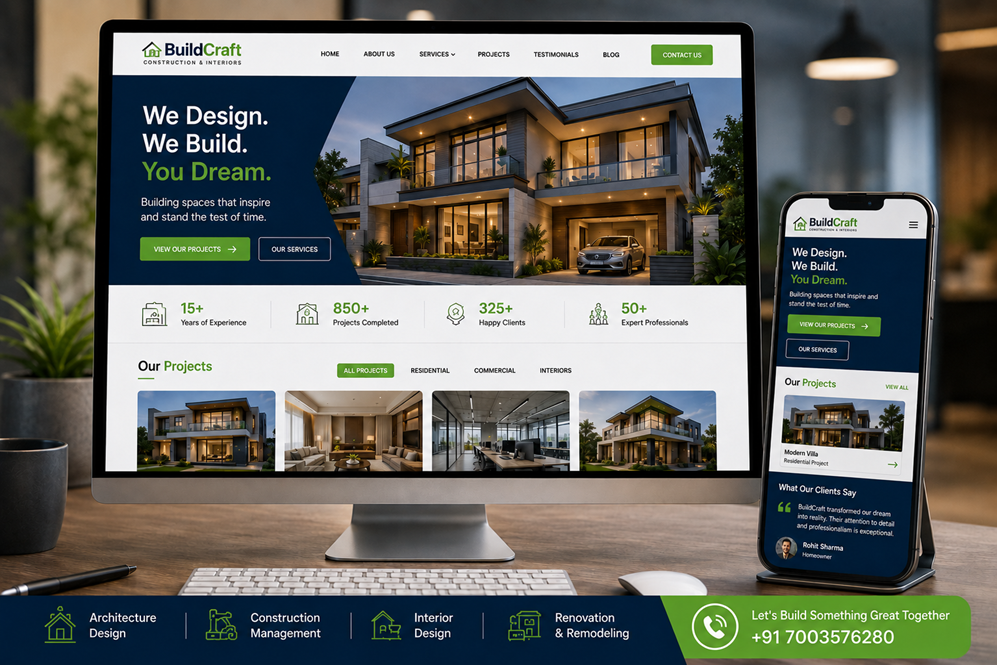
For businesses where previous work matters, a website can function as a digital portfolio.
Construction companies, architects, interior designers, and renovation businesses can use websites to showcase completed projects.
A project portfolio might include:
- Project photographs
- Project descriptions
- Location
- Scope of work
- Design approach
- Materials used
- Before-and-after images
- Client testimonials
Visual presentation can make a major difference.
A potential customer may compare several companies before choosing one. A well-organized portfolio can communicate experience and professionalism much more effectively than a simple text description.
9. Travel Agencies and Tour Operators
Travel decisions are heavily influenced by online research.
Customers often search for destinations, packages, hotels, itineraries, prices, reviews, and travel experiences before making a decision.
A travel agency website can showcase:
- Tour packages
- Destinations
- Itineraries
- Hotel options
- Transportation
- Travel guides
- Customer reviews
- Photo galleries
- Booking forms
- Contact information
Travel businesses can also create destination-specific content to attract people searching for travel information.
For example, an agency could publish guides covering popular destinations, travel seasons, attractions, local transportation, and suggested itineraries.
This content can bring potential customers to the website even before they are ready to book.
10. Manufacturers and B2B Companies
Some businesses mistakenly believe that websites are only useful for consumer-facing companies.
That is not true.
Manufacturers, wholesalers, suppliers, distributors, and B2B companies can benefit significantly from having a professional website.
B2B customers may use a website to research:
- Products
- Technical specifications
- Manufacturing capabilities
- Certifications
- Industries served
- Quality standards
- Company history
- Production capacity
- Contact information
A website can also help sales teams by giving prospects a central location to understand the company.
For manufacturers, the website can function as a digital company profile available to potential buyers around the world.
11. Freelancers and Independent Professionals
Freelancers often depend heavily on personal branding.
Whether someone is a graphic designer, developer, photographer, writer, video editor, consultant, or marketing specialist, a website can make their professional identity more credible.
A freelancer website can include:
- Introduction
- Skills
- Services
- Portfolio
- Client testimonials
- Case studies
- Pricing guidance
- Contact form
- Social media links
A personal website also gives freelancers more control over their professional image.
Instead of sending potential clients to multiple platforms, they can send one website link containing their complete professional profile.
12. Startups and New Businesses
New businesses may need websites even more than established businesses.
Why?
Because they have not yet built a reputation.
A new company needs to answer the customer’s basic question:
“Why should I trust you?”
A professional website can communicate:
- Who you are
- What you do
- Who you serve
- What makes you different
- What products or services you offer
- How customers can contact you
- What previous customers think
For startups, the website can also become the foundation for future digital marketing.
As the company grows, the website can evolve with it.
13. Event Management Businesses
Event planners, wedding planners, decorators, photographers, caterers, and entertainment companies can use websites to showcase their work and generate enquiries.
Event businesses are visual businesses.
Customers want to see examples before hiring someone.
A website can showcase:
- Weddings
- Corporate events
- Birthday parties
- Decorations
- Stage setups
- Photography
- Catering
- Event packages
- Testimonials
A strong visual portfolio can help potential customers understand the quality and style of the company’s work.
14. Beauty Salons, Spas, and Fitness Businesses
Beauty and fitness businesses often depend on local customers and repeat visits.
A website can provide information about:
- Services
- Packages
- Memberships
- Trainers
- Staff
- Pricing
- Appointment booking
- Location
- Opening hours
- Offers
It can also help establish a more professional brand image.
For businesses competing in a crowded local market, having a well-designed website can make the difference between looking established and looking difficult to verify.
Why Some Businesses Need a Website More Than Others
Although almost any legitimate business can benefit from a website, the urgency depends on several factors.
Customer Search Behavior
If customers frequently search online before making a purchase, having a website becomes more important.
Competition
If competitors already have professional websites, businesses without one may lose potential customers during the research stage.
Trust Requirements
Businesses involving significant spending, personal services, professional expertise, or long-term contracts usually require more trust.
A professional website can support that trust.
Geographic Reach
A business serving customers across cities, states, countries, or globally can benefit significantly from a website.
Lead Generation
If the business depends on enquiries, consultations, quotations, bookings, or demonstrations, a website can act as a 24/7 lead generation channel.
Product Information
Businesses with complex products or services need somewhere to explain their offerings properly.
Social media posts are not always suitable for detailed information.
Website vs Social Media: Do You Really Need Both?
A common question is:
“If my business has Facebook and Instagram, why do I need a website?”
The answer is that social media and websites serve different purposes.
Social media is excellent for:
- Engagement
- Brand awareness
- Community building
- Short-form content
- Customer interaction
- Promotions
- Visual content
A website is excellent for:
- Detailed information
- Search visibility
- Lead generation
- Product catalogues
- Online sales
- Professional credibility
- Long-form content
- Service explanations
- Direct customer journeys
The strongest strategy is often to use both.
For example, a Facebook advertisement can introduce your business to a customer. The advertisement can send the customer to a landing page on your website. The website can then explain the offer and collect the customer’s enquiry.
This creates a connected digital marketing system.
What Happens When a Business Does Not Have a Website?
Not having a website does not automatically mean a business will fail.
However, it can create several disadvantages.
Customers May Struggle to Verify the Business
People increasingly expect businesses to have some form of online presence.
If they cannot find reliable information, they may hesitate.
Competitors Can Capture the Customer
If a customer searches online and finds three competitors but not your company, your competitors have an advantage.
Advertising Can Become Less Effective
Paid advertisements work better when customers are sent to a strong destination.
A professional landing page can provide more information and a clear next step.
You Miss Long-Term Search Traffic
A website can build search visibility over time.
Useful pages and articles can continue attracting visitors long after they are published.
Your Brand Has Less Control
Depending entirely on third-party platforms means your digital presence is controlled by those platforms.
A website gives your business more ownership over its online identity.
What Makes a Business Website Effective?
Simply having a website is not enough.
A poorly designed website can create almost as many problems as having no website.
An effective business website should focus on the customer.
1. Mobile-Friendly Design
A large percentage of internet users browse through smartphones.
Your website must work properly on mobile devices.
2. Fast Loading Speed
Visitors do not want to wait for slow pages.
Performance is important for both user experience and search visibility.
3. Clear Navigation
Customers should be able to find important information easily.
Your primary navigation might include:
- Home
- About
- Services
- Products
- Portfolio
- Blog
- Contact
4. Strong Calls to Action
Tell visitors what to do next.
Examples include:
- Contact Us
- Request a Quote
- Book an Appointment
- Call Now
- WhatsApp Us
- Get Started
- Buy Now
5. Professional Content
Your website should clearly explain what your business does and why customers should choose you.
Avoid excessive technical language unless your audience needs it.
6. Trust Signals
Useful trust elements include:
- Testimonials
- Reviews
- Certifications
- Client logos
- Case studies
- Project photographs
- Business address
- Contact details
7. Search Engine Optimization
SEO helps search engines understand your website.
Important elements include:
- Relevant page titles
- Meta descriptions
- Proper headings
- Useful content
- Internal links
- Image optimization
- Mobile responsiveness
- Fast performance
- Search-focused service pages
How Much Does a Business Website Cost?
Website development costs vary considerably.
A basic business website may have only a few pages. An eCommerce website may contain hundreds or thousands of products. A custom web application can involve complex features and integrations.
The final cost depends on:
- Number of pages
- Design requirements
- Custom development
- Content requirements
- Database functionality
- Payment gateway
- Booking system
- User accounts
- Third-party integrations
- Admin dashboard
- Hosting
- Security
- Maintenance
Instead of choosing a website solely based on the lowest price, businesses should consider the value the website is expected to create.
A website that generates qualified leads or online sales can become an investment rather than simply an expense.
Common Website Mistakes Businesses Should Avoid
Building a Website Without a Clear Goal
Before development begins, determine what the website should accomplish.
Is the goal to generate leads, sell products, receive bookings, build trust, showcase projects, or provide information?
Using Generic Content
Your website should explain what makes your business different.
Generic statements such as “We provide the best quality services” do not communicate much.
Ignoring Mobile Users
A website that works well only on desktop computers can lose a significant portion of its audience.
Making Contact Information Difficult to Find
Your phone number, email address, location, and enquiry options should be easy to find.
Not Updating the Website
An outdated website can create a poor impression.
Businesses should periodically update services, portfolios, products, contact details, announcements, and other important information.
Focusing Only on Appearance
A beautiful website is useful, but design alone does not guarantee results.
The website also needs good content, clear navigation, strong calls to action, performance, SEO, and a logical customer journey.

How Infotech Wayout Helps Businesses Build Their Online Presence
At Infotech Wayout, we understand that a website should be built around the business, not simply around a template.
Different businesses have different objectives.
A restaurant may need online ordering.
A service company may need enquiry generation.
An eCommerce business may need secure payments and inventory management.
A professional may need a strong portfolio.
A startup may need a website that establishes credibility.
Our approach focuses on understanding the business first and then developing a website that supports its goals.
Depending on the project, a business website may include:
- Responsive web design
- Custom UI design
- Business information pages
- Service pages
- Product catalogues
- Contact forms
- WhatsApp integration
- Google Maps integration
- Social media integration
- SEO-friendly structure
- Blog functionality
- Portfolio galleries
- Customer testimonials
- Payment gateway integration
- Booking functionality
- Admin panels
- eCommerce functionality
- Analytics integration
The goal is to create a website that is useful for both the business and its customers.
A Website Should Grow With Your Business
One of the biggest mistakes is thinking about a website as a one-time project.
A good website should have room to evolve.
A small business might begin with five pages:
- Home
- About
- Services
- Portfolio
- Contact
As the business grows, it may add:
- Blog
- Online booking
- Customer accounts
- Online payments
- eCommerce
- CRM integration
- Marketing automation
- Advanced analytics
This means the initial website should be developed with future growth in mind.
Website and SEO: A Long-Term Opportunity
Search engine optimization is one of the most important long-term benefits of having a website.
Consider a local service provider that creates useful pages targeting different services.
Over time, those pages can potentially appear for relevant search queries.
For example, a business could create dedicated pages for:
- Website development
- eCommerce development
- Mobile application development
- Custom software
- Local business websites
- Business website design
The objective is not to repeat keywords excessively.
Instead, each page should provide genuinely useful information for the visitor.
Search engines increasingly focus on content quality, relevance, usefulness, page experience, and overall website quality.
Therefore, businesses should think beyond simply “getting a website.”
They should build a useful digital resource.
How a Website Supports Other Marketing Channels
A website becomes much more powerful when connected to other marketing activities.
Social Media
Social posts can direct interested users to website pages.
Google Search
SEO can help customers discover the business when searching for relevant products or services.
Paid Advertising
Google and Meta advertisements can direct users to dedicated landing pages.
Email Marketing
Email campaigns can link to product pages, service pages, articles, or offers.
WhatsApp Marketing
Customers can move from website information to direct conversation.
Offline Marketing
Business cards, brochures, banners, packaging, and advertisements can include the website address.
This makes the website the central hub of a broader marketing ecosystem.
How to Decide Whether Your Business Needs a Website
Ask yourself these questions:
- Do customers search for my products or services online?
- Do I need more enquiries?
- Do customers need information before contacting me?
- Do my competitors have websites?
- Do I want customers outside my immediate network?
- Do I want to build a stronger brand?
- Do I run online advertisements?
- Do I need to showcase previous work?
- Do I want to sell products online?
- Do I want to build long-term online visibility?
If you answered “yes” to several of these questions, a professional website could be highly valuable for your business.
Frequently Asked Questions
1. Which type of business needs a website the most?
Businesses that depend heavily on online discovery, customer trust, enquiries, bookings, or product sales generally need websites the most. Local service providers, eCommerce businesses, professional service providers, restaurants, real estate companies, travel agencies, educational businesses, construction companies, and startups can all benefit significantly from a professional website.
The more customers research a business online before making a decision, the more important the website becomes.
2. Does a small business really need a website?
Yes. In many cases, a small business can benefit enormously from having a website.
A website allows a small company to establish credibility, explain its services, display customer reviews, generate enquiries, and compete for online visibility.
A small business does not necessarily need a complicated website. A simple, professional, mobile-friendly website with strong content and clear contact options can be enough to establish a solid digital presence.
3. Is social media enough for a business?
Social media is valuable, but it should not necessarily be considered a replacement for a website.
Social platforms are controlled by third-party companies and their algorithms can change. A website gives the business a dedicated digital property where it can control its branding, content, navigation, customer journey, and business information.
The best strategy for many businesses is to use social media and a website together.
4. Can a website help a local business get more customers?
Yes, a website can support local customer acquisition.
A properly structured website can provide service information, location details, contact options, reviews, FAQs, and other useful information. When combined with local SEO and other marketing activities, it can help potential customers discover and evaluate the business.
However, simply launching a website does not guarantee traffic. The website needs useful content, good technical performance, appropriate SEO, and effective marketing.
5. How many pages should a business website have?
There is no universal number.
A basic business website may need five to seven important pages, while larger companies may need dozens or hundreds.
The pages should be based on customer needs and business objectives.
Common pages include Home, About, Services, Products, Portfolio, Blog, FAQs, and Contact.
The priority should be useful information rather than creating a large number of unnecessary pages.
6. How long does it take to build a business website?
The development time depends on the complexity of the project.
A basic informational website can generally be developed much faster than an eCommerce platform or custom web application.
Factors such as design, number of pages, content availability, custom functionality, payment integration, booking systems, database requirements, and revisions can affect the timeline.
The best approach is to define the project scope before development begins.
7. What should a business website include?
A professional business website should clearly explain what the company does, who it serves, what it offers, and how customers can contact it.
Depending on the business, useful features may include service pages, product information, portfolio, testimonials, FAQs, contact forms, phone and WhatsApp buttons, location maps, booking functionality, payment integration, and a blog.
The exact features should depend on the business model.
8. Is a website an expense or an investment?
A website can be either, depending on how it is developed and used.
If a business builds a website simply because everyone else has one and never updates or promotes it, it may become an expense.
If the website is designed to generate leads, sell products, support advertising, improve search visibility, establish trust, and provide customer information, it can become a valuable business asset.
The key is to build the website around measurable business objectives.
Final Thoughts: Your Customers Are Already Online
The question is no longer simply whether a business can survive without a website.
The more important question is whether the business is comfortable allowing potential customers to search for it online and find limited, outdated, or incomplete information.
For some businesses, a website is essential because it directly supports sales and bookings.
For others, it is a powerful credibility and marketing tool.
For many small businesses, it can be the difference between being discovered by a new customer and being overlooked.
A professional website gives your business a place where customers can learn about you, evaluate your services, see your previous work, contact you, and take the next step.
The businesses that benefit the most are those that treat their website as more than an online brochure.
They treat it as a business asset.
At Infotech Wayout, we believe a successful website should be designed around your customers, your brand, and your business goals. Whether you are starting a new business, modernizing an existing company, launching an eCommerce store, or trying to generate more enquiries, the right website can become an important part of your growth strategy.

