
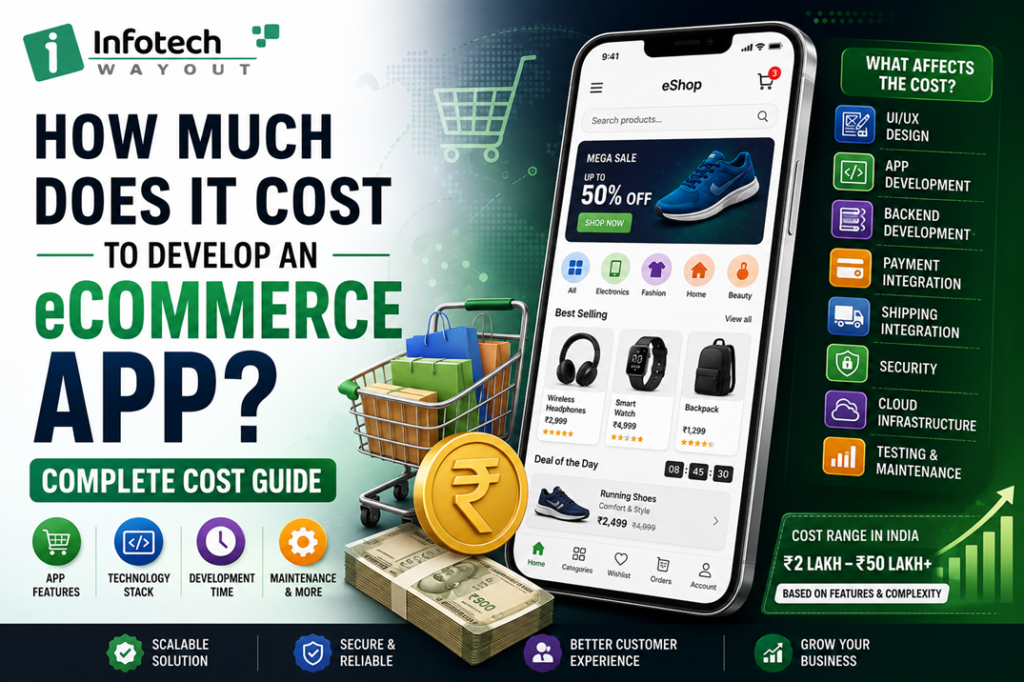
The eCommerce industry has changed dramatically over the last few years. Customers no longer depend only on physical stores or desktop websites to purchase products. Smartphones have become one of the most important shopping channels, allowing customers to browse products, compare prices, place orders, make payments, track deliveries, and contact sellers from virtually anywhere.
For businesses planning to enter the online marketplace, developing an eCommerce mobile application can be an excellent investment. However, one of the first questions business owners usually ask is: How much does it cost to develop an eCommerce app?
The answer is not a fixed number. The total eCommerce app development cost depends on several factors, including the type of application, number of features, UI/UX design, technology stack, backend infrastructure, payment integration, third-party services, security requirements, development team, testing, and ongoing maintenance.
For businesses in India, a basic eCommerce application may start from around ₹20,000 to ₹5 lakh, while a feature-rich application can cost ₹5 lakh to ₹15 lakh or more. Large-scale marketplace applications with advanced functionality, custom integrations, sophisticated admin systems, and high scalability requirements can exceed ₹15 lakh to ₹30 lakh+.
At Infotech Wayout, we help businesses plan and develop customized eCommerce applications based on their business model, target customers, required features, and budget. This guide explains the major cost factors so that you can make an informed decision before starting your app development project.
What Is an eCommerce App?
An eCommerce app is a mobile application that allows customers to purchase products or services through smartphones and tablets. Depending on the business model, the application can support product browsing, user registration, shopping carts, online payments, order management, delivery tracking, customer reviews, notifications, offers, and much more.
An eCommerce application usually consists of several interconnected components:
- Customer mobile application
- Admin panel
- Backend server
- Database
- Payment gateway
- Product management system
- Order management system
- Delivery or shipping integration
- Customer support functionality
- Notification system
- Analytics and reporting
- Security infrastructure
For a small business, not every feature is necessary from day one. A startup may begin with a simple application containing essential shopping features and gradually introduce advanced functionality as the customer base grows.
This approach can significantly reduce the initial cost to develop an eCommerce app while allowing the business to validate its concept before investing heavily in advanced technology.
How Much Does It Cost to Develop an eCommerce App in India?
The cost varies according to the complexity of the application.
| eCommerce App Type | Approximate Development Cost in India |
|---|---|
| Basic eCommerce App | ₹20,000 to ₹5 lakh |
| Standard eCommerce App | ₹2 lakh to ₹10 lakh |
| Advanced eCommerce App | ₹10 lakh to ₹15 lakh+ |
| Multi-Vendor Marketplace | ₹1 lakh to ₹25 lakh+ |
| Enterprise eCommerce Platform | ₹20 lakh to ₹50 lakh+ |
These figures are approximate because every project has different requirements.
A basic application may include product listings, registration, search, cart, checkout, payment gateway, order tracking, and a simple admin panel.
A standard application may additionally include coupons, wishlists, product reviews, push notifications, multiple payment methods, shipping integrations, customer support, and analytics.
An advanced eCommerce platform may require personalization, AI-based recommendations, advanced search, multiple vendors, sophisticated reporting, loyalty programs, multiple languages, multiple currencies, warehouse management, ERP integration, CRM integration, and high-performance infrastructure.
Therefore, instead of asking only for a fixed development price, businesses should first define what they actually need from the application.
Major Factors That Affect eCommerce App Development Cost
Several factors influence the final development budget. Understanding these factors can help you estimate your project more accurately.
1. Type of eCommerce Business
The business model is one of the first things that affects development cost.
A single-vendor online store is comparatively straightforward. The business owns the products and manages inventory, pricing, orders, and customers.
A multi-vendor marketplace is more complex because several sellers use the same platform. The application may require:
- Vendor registration
- Vendor verification
- Seller dashboards
- Product approval
- Vendor commissions
- Seller payouts
- Vendor order management
- Vendor analytics
- Seller ratings
- Tax management
- Vendor-specific shipping
- Dispute management
Because of these additional requirements, a marketplace application generally costs more than a traditional single-store eCommerce app.
2. Mobile Platforms
Another major factor is the number of platforms you want to support.
You can develop an application for:
- Android
- iOS
- Android and iOS
- Web
- Progressive Web App
Developing separate native applications for Android and iOS can increase the budget because different development environments, programming languages, testing processes, and platform-specific requirements may be involved.
Alternatively, businesses can consider cross-platform technologies such as Flutter or React Native.
A cross-platform solution can allow businesses to develop applications for both Android and iOS using a shared codebase, potentially reducing development time and cost.
At Infotech Wayout, we evaluate the project requirements before recommending a technology approach rather than automatically choosing one platform or framework for every business.
3. UI/UX Design
The user interface has a direct impact on the success of an eCommerce application.
Customers expect modern shopping apps to be:
- Fast
- Easy to navigate
- Visually appealing
- Mobile-friendly
- Simple to understand
- Convenient during checkout
UI/UX design involves much more than choosing colors and creating attractive screens.
A professional design process may include:
- User research
- Information architecture
- User flow planning
- Wireframing
- UI design
- Prototype creation
- Usability testing
- Design revisions
An application with a simple interface may require fewer design hours, while a highly customized shopping experience can require considerably more work.
A poor user experience can also negatively affect conversion rates. Therefore, saving too much money on UI/UX design can ultimately become expensive if customers abandon the application during shopping or checkout.
4. Features and Functionality
Features are among the biggest contributors to eCommerce app development cost.
The more complex the functionality, the more development and testing time is required.
Essential eCommerce Features
A basic application generally needs:
- User registration and login
- Product categories
- Product listings
- Product details
- Product images
- Product search
- Shopping cart
- Wishlist
- Checkout
- Address management
- Payment gateway
- Order confirmation
- Order history
- Order tracking
- Push notifications
- Admin panel
Advanced Features
Businesses may also require:
- Multiple vendors
- Product recommendations
- AI-powered search
- Personalized shopping
- Loyalty programs
- Referral programs
- Subscription products
- Flash sales
- Dynamic pricing
- Multiple currencies
- Multiple languages
- Voice search
- Social login
- Live chat
- Customer support
- Advanced analytics
- Inventory synchronization
- Warehouse management
- CRM integration
- ERP integration
Each additional feature increases development effort and therefore affects the total project budget.
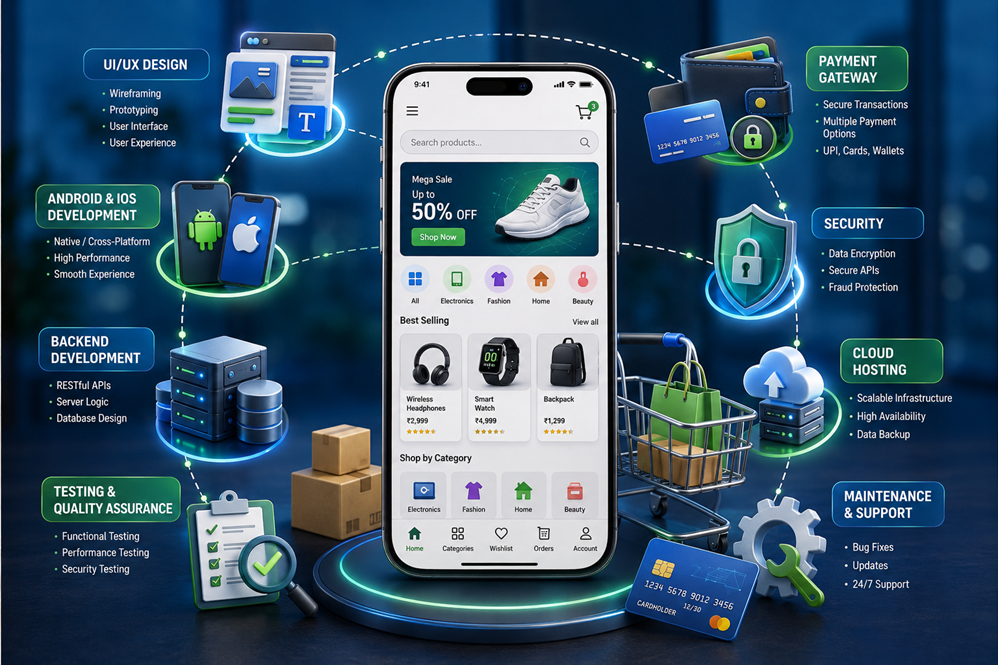
5. Backend Development
The mobile application is only one part of an eCommerce system.
Behind the application is a backend infrastructure responsible for handling:
- User accounts
- Products
- Categories
- Inventory
- Orders
- Payments
- Coupons
- Shipping
- Notifications
- Reviews
- Vendor information
- Analytics
The backend communicates with the mobile application through APIs.
A well-designed backend should be secure, scalable, reliable, and capable of handling increasing traffic.
For example, an application may work perfectly when it has 1,000 customers but experience performance problems when hundreds of thousands of users access it simultaneously.
Therefore, businesses expecting rapid growth should consider scalability during the initial development stage.
6. Admin Panel
An eCommerce app requires an administration system through which business owners can manage their operations.
A typical admin dashboard may include:
- Dashboard
- Product management
- Category management
- Inventory management
- Customer management
- Order management
- Payment management
- Coupon management
- Banner management
- Review management
- Delivery management
- Vendor management
- Reports
- Notifications
- Settings
A simple admin panel can be relatively affordable, while a sophisticated enterprise dashboard with real-time analytics and integrations can significantly increase the overall budget.
7. Payment Gateway Integration
Online payment is one of the most important components of an eCommerce application.
Depending on the target market, businesses may integrate:
- Credit cards
- Debit cards
- UPI
- Net banking
- Digital wallets
- Cash on delivery
- International payment methods
In India, UPI has become particularly important for digital commerce.
Payment integration requires secure communication between the application, backend, and payment service provider. Developers also need to handle payment success, failure, cancellation, refunds, and transaction verification.
Payment gateway charges are usually separate from the application development cost and depend on the payment provider and transaction structure.
8. Shipping and Delivery Integration
If you sell physical products, delivery functionality becomes another important consideration.
Businesses may integrate third-party shipping providers for:
- Shipping rate calculation
- Delivery availability
- Shipment creation
- Tracking
- Estimated delivery dates
- Delivery status
- Return shipments
Alternatively, businesses with their own logistics network may require a customized delivery management system.
Advanced delivery systems may include delivery executive applications, GPS tracking, route optimization, delivery confirmation, and automated status notifications.
9. Security Requirements
Security should never be treated as an optional feature in an eCommerce application.
The application may handle:
- Customer information
- Addresses
- Order history
- Payment-related information
- Business information
- Login credentials
- Transaction data
Security measures can include:
- Secure authentication
- Encryption
- HTTPS
- API security
- Role-based access control
- Secure password storage
- Input validation
- Session management
- Secure payment processing
- Regular security updates
A strong security architecture may increase the initial development budget, but it can protect the business from potentially serious financial and reputational damage.
10. Third-Party Integrations
Modern eCommerce applications often need to communicate with other systems.
Common integrations include:
- Payment gateways
- Shipping providers
- SMS services
- Email services
- WhatsApp communication
- CRM systems
- ERP software
- Accounting systems
- Marketing platforms
- Analytics platforms
- Social media
- Customer support tools
The complexity of these integrations can significantly influence the development timeline and budget.
Native vs Cross-Platform eCommerce App Development
One important decision is whether to develop native applications or use cross-platform technology.
Native Development
Native Android and iOS development provides platform-specific optimization.
Advantages include:
- Excellent performance
- Strong platform integration
- Better access to native functionality
- Platform-specific user experience
However, developing and maintaining separate applications can increase the overall cost.
Cross-Platform Development
Technologies such as Flutter allow businesses to create applications for multiple platforms using a shared development approach.
Advantages may include:
- Faster development
- Shared codebase
- Lower development effort
- Easier maintenance
- Android and iOS support
Cross-platform development can be especially attractive for startups and small businesses that need to control their initial budget.
However, the best solution depends on the application’s requirements, integrations, expected scale, and long-term strategy.
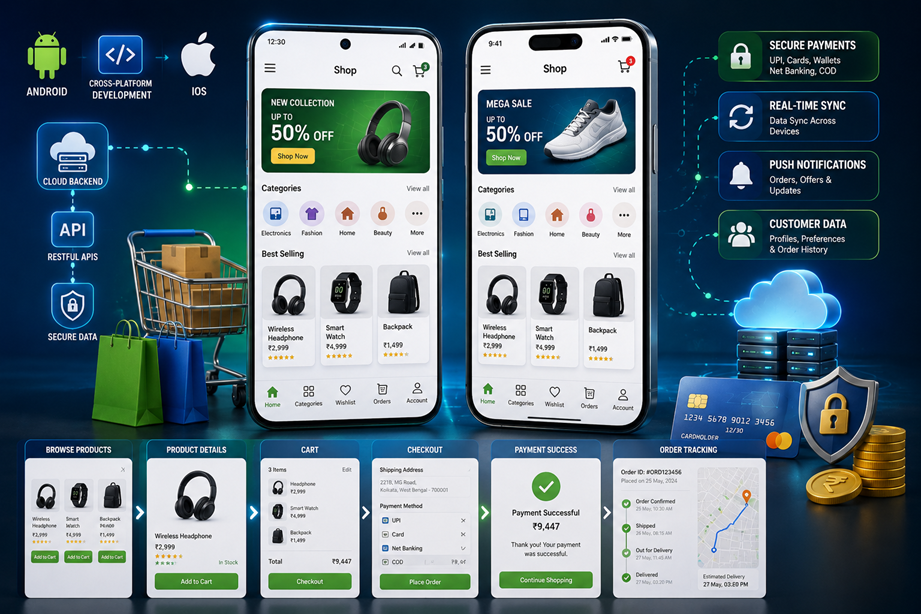
eCommerce App Development Cost Based on Complexity
A practical way to estimate your budget is to divide the application into three categories.
Basic eCommerce App
Estimated cost: ₹20,000 to ₹5 lakh
Suitable for:
- Small businesses
- New online stores
- Local retailers
- Startups
- Businesses testing an eCommerce idea
Possible features include:
- Registration
- Product catalog
- Search
- Cart
- Checkout
- Payment gateway
- Order tracking
- Notifications
- Basic admin panel
Medium-Level eCommerce App
Estimated cost: ₹1 lakh to ₹10 lakh
Suitable for growing businesses.
Possible features include:
- Advanced product management
- Customer accounts
- Wishlist
- Coupons
- Reviews
- Multiple payment methods
- Shipping integration
- Push notifications
- Analytics
- Offers
- Loyalty functionality
- Advanced admin panel
Advanced eCommerce App
Estimated cost: ₹10 lakh to ₹15 lakh or more
Suitable for established businesses and large online retailers.
Features may include:
- AI recommendations
- Advanced search
- Personalization
- Multi-vendor functionality
- Advanced analytics
- CRM integration
- ERP integration
- Warehouse management
- Loyalty systems
- Subscription functionality
- Multiple languages
- Multiple currencies
- Advanced security
- High scalability
Large enterprise applications can require substantially higher investment depending on infrastructure, integrations, traffic expectations, and customization.
How Long Does It Take to Develop an eCommerce App?
Development time depends on complexity.
A basic eCommerce application may take approximately 1 to 4 months.
A standard application may require around 4 to 6 months.
A sophisticated marketplace or enterprise application may take 6 to 12 months or more.
The development process usually involves:
- Requirement analysis
- Business model planning
- UI/UX design
- Technology selection
- Frontend development
- Backend development
- API integration
- Payment integration
- Testing
- Security testing
- Deployment
- Post-launch support
Trying to rush development without sufficient testing can create serious problems after launch.
Hidden Costs You Should Consider
When calculating the cost of an eCommerce application, many businesses focus only on development.
However, there can be additional expenses.
Domain and Hosting
You need hosting infrastructure for the backend, database, APIs, images, and other services.
The cost depends on traffic and infrastructure requirements.
App Store and Play Store Accounts
Publishing applications may require developer accounts and platform-specific fees.
Payment Gateway Charges
Payment providers generally charge transaction-related fees.
SMS and Email Services
OTP authentication, order notifications, marketing messages, and transactional emails may generate recurring costs.
Cloud Services
Cloud hosting, storage, database usage, backups, bandwidth, and other services can generate monthly expenses.
Maintenance
Applications require ongoing updates, bug fixes, security improvements, operating system compatibility updates, and feature enhancements.
Marketing
A great application cannot succeed if customers do not know it exists.
Businesses should budget separately for:
- Search engine optimization
- Social media marketing
- Paid advertising
- Influencer marketing
- Content marketing
- Email marketing
- App Store Optimization
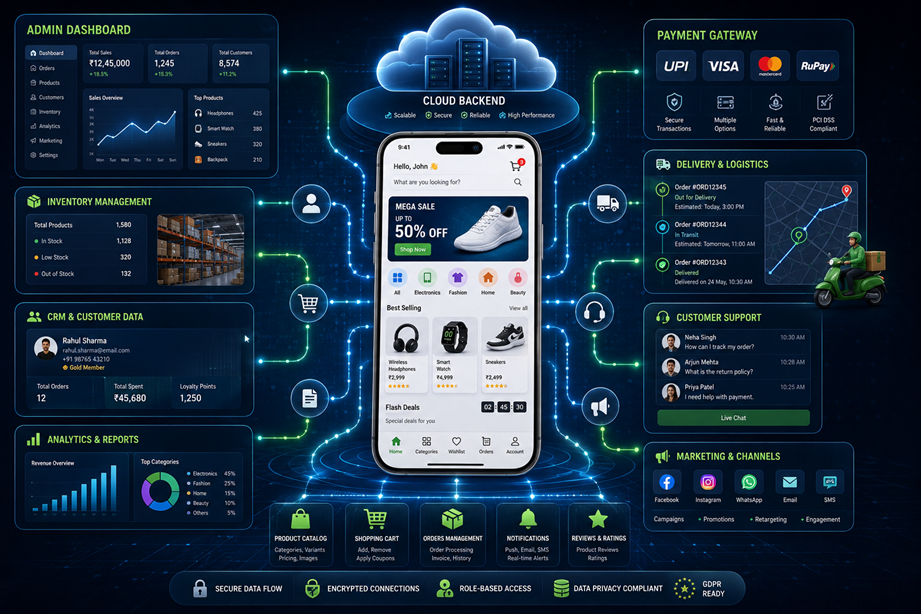
How to Reduce eCommerce App Development Cost
Developing an eCommerce application does not necessarily mean spending a huge amount at the beginning.
There are several practical ways to control the budget.
Start With an MVP
An MVP, or Minimum Viable Product, contains the essential features required to launch the application.
Instead of building 50 features immediately, you can start with:
- Product catalog
- Search
- Cart
- Checkout
- Payment
- Orders
- Customer accounts
- Admin panel
After receiving feedback from real customers, you can introduce additional features.
This approach reduces initial investment and helps businesses understand what customers actually need.
Prioritize Features
Create three categories:
Must Have: Required for launch.
Should Have: Important but can be introduced later.
Nice to Have: Useful advanced features that can wait.
This prevents unnecessary spending.
Use Cross-Platform Development
If your business needs Android and iOS applications, cross-platform development can potentially reduce development effort compared with building two completely separate applications.
Use Established APIs
Instead of building every service from scratch, businesses can use reliable third-party services for:
- Payments
- Maps
- SMS
- Shipping
- Analytics
- Authentication
This can reduce development time.
Plan the Project Properly
Frequent changes during development can increase costs.
Before development starts, clearly define:
- Features
- User roles
- Design requirements
- Technology
- Integrations
- Launch platform
- Budget
- Timeline
Good planning can reduce unnecessary development cycles.
Benefits of Developing an eCommerce Mobile App
An eCommerce application can provide several advantages over relying exclusively on a website.
Direct Customer Access
An app remains available on a customer’s smartphone, providing a direct communication channel.
Push Notifications
Businesses can notify customers about:
- New products
- Discounts
- Flash sales
- Order status
- Abandoned carts
- Personalized offers
Improved Customer Experience
A dedicated app can provide a streamlined shopping experience designed specifically for mobile users.
Customer Loyalty
Features such as loyalty points, rewards, personalized offers, and memberships can encourage repeat purchases.
Better Personalization
Applications can provide personalized product recommendations based on customer behavior and preferences.
Faster Shopping
A well-designed application can remember addresses, preferences, wishlists, and other customer information, making repeat purchases easier.
Challenges of eCommerce App Development
While eCommerce apps provide significant opportunities, businesses should also understand the challenges.
High Competition
The online marketplace is highly competitive. Developing an application is only the beginning. Businesses need a strong marketing and customer acquisition strategy.
Security
Customer trust can be damaged by security breaches or payment-related problems.
Performance
Slow loading screens, crashes, or checkout problems can result in abandoned purchases.
Scalability
The application must be capable of handling increasing traffic, product catalogs, orders, and customers.
Maintenance
Mobile operating systems, devices, APIs, and security standards change regularly. Applications require continuous maintenance.
Customer Retention
Getting customers to download an application is not enough. Businesses need to provide enough value to encourage customers to continue using it.
Why Choose Infotech Wayout for eCommerce App Development?
At Infotech Wayout, we understand that every eCommerce business has different goals.
A local retailer launching its first online store does not need the same application architecture as a large marketplace.
Our approach focuses on developing solutions according to the actual requirements of the business.
Our eCommerce development services can include:
- eCommerce mobile app development
- Android app development
- iOS app development
- Flutter app development
- Custom UI/UX design
- Backend development
- Admin panel development
- Payment gateway integration
- Shipping integration
- API development
- Database development
- Testing
- App deployment
- Maintenance and support
We can help businesses move from an initial idea to a working eCommerce platform by planning the application architecture, features, user experience, and technology according to the project’s objectives.
The goal should not simply be to build an application. The goal should be to build an eCommerce solution that is secure, scalable, easy to use, and capable of supporting long-term business growth.
What Should You Discuss With an eCommerce App Development Company?
Before hiring a development company, ask detailed questions about the project.
Important questions include:
- What technology will be used?
- Will Android and iOS be supported?
- Is the application custom-built?
- Who owns the source code?
- What features are included?
- Is UI/UX design included?
- Is the admin panel included?
- Which payment gateways can be integrated?
- Can the application integrate with existing software?
- How will security be handled?
- What testing process will be followed?
- What is included in post-launch support?
- How will future updates be handled?
- What are the expected development milestones?
A transparent development process can help avoid misunderstandings about budget and functionality.
How to Plan Your eCommerce App Budget
A simple budgeting framework can make the process easier.
Start with your business requirements.
For example:
Stage 1: Business Planning
Determine:
- Target audience
- Products
- Business model
- Geographic market
- Revenue model
- Competitors
Stage 2: Feature Planning
Identify essential and advanced features.
Stage 3: Design
Plan the user journey and UI/UX.
Stage 4: Development
Build the mobile application, backend, database, APIs, and admin panel.
Stage 5: Testing
Perform functional, usability, security, compatibility, and performance testing.
Stage 6: Launch
Publish the application and configure production infrastructure.
Stage 7: Marketing and Maintenance
Continue improving the product based on customer feedback and business data.
This approach provides a more realistic view of the total investment rather than focusing only on the initial coding cost.
Is an eCommerce App Worth the Investment?
For businesses with a strong online sales strategy, an eCommerce application can be a valuable investment.
However, an application should not be developed simply because competitors have one.
You should consider an app if:
- Your customers frequently shop through smartphones.
- You have repeat customers.
- You want direct communication with customers.
- You want personalized offers.
- You want loyalty features.
- You expect your online sales to grow.
- You want to build a stronger digital brand.
- Your business can support ongoing app maintenance and marketing.
For a new business with limited resources, starting with a responsive eCommerce website and later introducing a mobile application may sometimes be a more practical strategy.
The right decision depends on your business model and customer behavior.
Final Thoughts
So, how much does it cost to develop an eCommerce app?
There is no single price that applies to every business. A basic eCommerce application in India may cost around ₹20,000 to ₹5 lakh, while a standard application can range from ₹5 lakh to ₹10 lakh. Advanced applications can cost ₹10 lakh to ₹15 lakh or more, while complex multi-vendor and enterprise platforms may require investments of ₹15 lakh to ₹50 lakh+, depending on the features and technical requirements.
The most important thing is to avoid choosing a development company based solely on the lowest quotation. A cheap application that is poorly designed, insecure, difficult to maintain, or unable to scale can ultimately cost more than a properly planned solution.
Instead, focus on creating a reliable product with the right features, strong UI/UX, secure payment processing, scalable backend architecture, and a clear roadmap for future growth.
At Infotech Wayout, we help businesses evaluate their requirements and build customized web and mobile solutions according to their business objectives and budget.
If you are planning to launch an online store, marketplace, or mobile commerce platform, the first step is to define what your customers need and what your business needs to achieve. Once those requirements are clear, the development cost, technology, timeline, and roadmap become much easier to estimate.
Frequently Asked Questions
1. How much does it cost to develop an eCommerce app in India?
The cost can range from approximately ₹20,000 for a basic application to ₹15 lakh or more for an advanced application. A multi-vendor or enterprise platform may cost considerably more. The final price depends on features, platforms, UI/UX complexity, backend requirements, integrations, security, and development time.
2. How long does it take to build an eCommerce app?
A basic eCommerce app can take approximately 1 to 2 months. A standard application may take 4 to 6 months, while a complex marketplace or enterprise application can take 6 to 12 months or longer. The timeline depends on the number of features, design complexity, integrations, testing requirements, and client feedback cycles.
3. What features should a basic eCommerce app have?
A basic application should generally include customer registration, product listings, categories, search, product details, shopping cart, checkout, address management, payment gateway, order history, order tracking, notifications, and an admin panel.
4. Is Flutter suitable for eCommerce app development?
Yes. Flutter can be a suitable choice for many eCommerce projects, particularly when a business wants to support both Android and iOS. A shared codebase can help reduce development effort and simplify maintenance. However, the final technology choice should depend on the application’s requirements, integrations, performance expectations, and long-term business strategy.
5. How much does a multi-vendor eCommerce app cost?
A multi-vendor eCommerce application may start around ₹1 lakh and can go significantly higher depending on functionality. Vendor dashboards, commissions, seller verification, product approval, seller payouts, order management, shipping, analytics, reviews, and dispute management can increase development complexity.
6. What are the additional costs after developing an eCommerce app?
Additional costs can include cloud hosting, domain and infrastructure, payment gateway charges, SMS and email services, app store fees, third-party API charges, security services, maintenance, updates, marketing, and customer support. These recurring expenses should be included in the overall business budget.
7. Can I reduce eCommerce app development costs?
Yes. Starting with an MVP is one of the most effective ways to control the initial budget. You can launch essential shopping functionality first and introduce advanced features later. Cross-platform development, established third-party APIs, careful feature prioritization, and proper project planning can also reduce unnecessary development costs.
8. Should I develop an eCommerce website or mobile app first?
It depends on your business and customers. For many startups, a responsive eCommerce website can be a cost-effective starting point. Once the business develops a customer base and identifies strong mobile demand, a dedicated app can provide additional benefits such as push notifications, loyalty programs, personalization, and faster repeat purchases. Businesses with an established customer base may benefit from launching a mobile application earlier.

