
If you are planning to build a mobile application for your business, startup, online store, service, or personal project, one of the first questions you are likely to ask is: How much money is required to make an app in India?
The answer depends on several factors, including the type of application, number of features, design complexity, technology, development platform, backend requirements, third-party integrations, security requirements, testing, and ongoing maintenance.
In India, app development can range from a relatively affordable solution for a simple business app to several lakhs of rupees for a complex application with advanced functionality. A basic application may cost around ₹30,000 to ₹80,000, while a medium-complexity application can cost approximately ₹80,000 to ₹2,50,000 or more. Advanced applications such as eCommerce platforms, marketplace apps, food delivery apps, booking platforms, fintech applications, and custom enterprise solutions can cost ₹2,50,000 to ₹10,00,000 or significantly more depending on their requirements.
At Infotech Wayout, we understand that every business has different requirements and budgets. Instead of looking at app development as a single fixed-price service, it is more useful to understand what contributes to the overall cost.
This guide explains the major factors that influence the cost of app development in India, different types of apps and their estimated budgets, technology choices, development stages, hidden expenses, maintenance costs, and practical ways to build an app without unnecessarily increasing your budget.
Understanding App Development Cost in India
The cost of app development in India is not determined by one fixed rate. Two applications may appear similar from the outside but have completely different development requirements behind the scenes.
For example, a simple company profile app containing five or six informational screens is significantly easier to develop than an eCommerce app that requires product management, shopping carts, online payments, order tracking, customer accounts, inventory management, notifications, and an administrator panel.
Several important factors determine the final development budget.
These include:
- Number of screens
- Number and complexity of features
- Android, iOS, or both
- Native or cross-platform development
- UI/UX design requirements
- Backend development
- Admin panel
- Database requirements
- Payment gateway integration
- Third-party API integration
- User authentication
- Push notifications
- Location and GPS functionality
- Real-time communication
- Security requirements
- Testing requirements
- App Store and Play Store publishing
- Post-launch maintenance
Therefore, asking only “What is the price of an app?” is not enough. The more useful question is what type of app you want to build and what features it needs.
Estimated App Development Cost in India
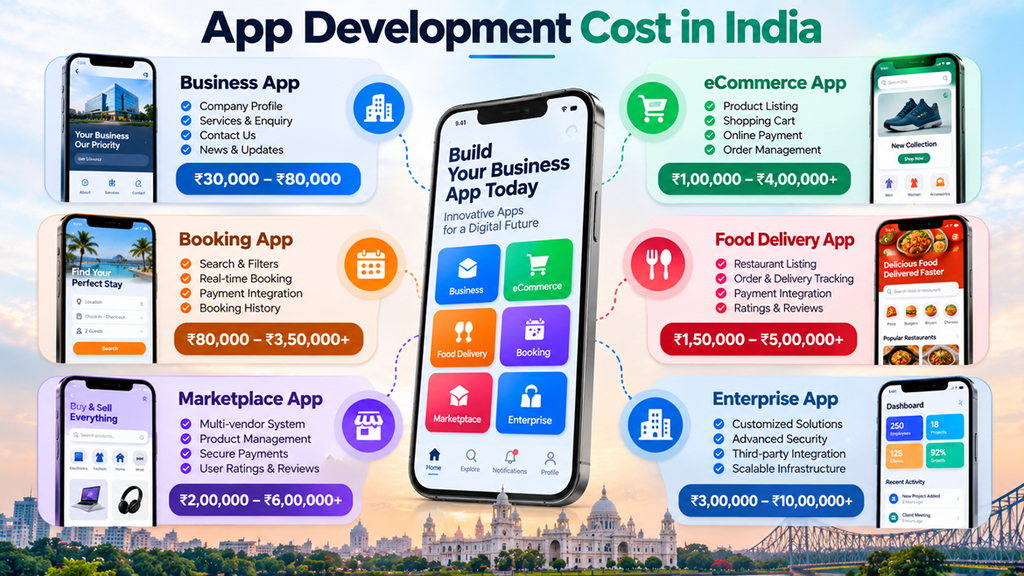
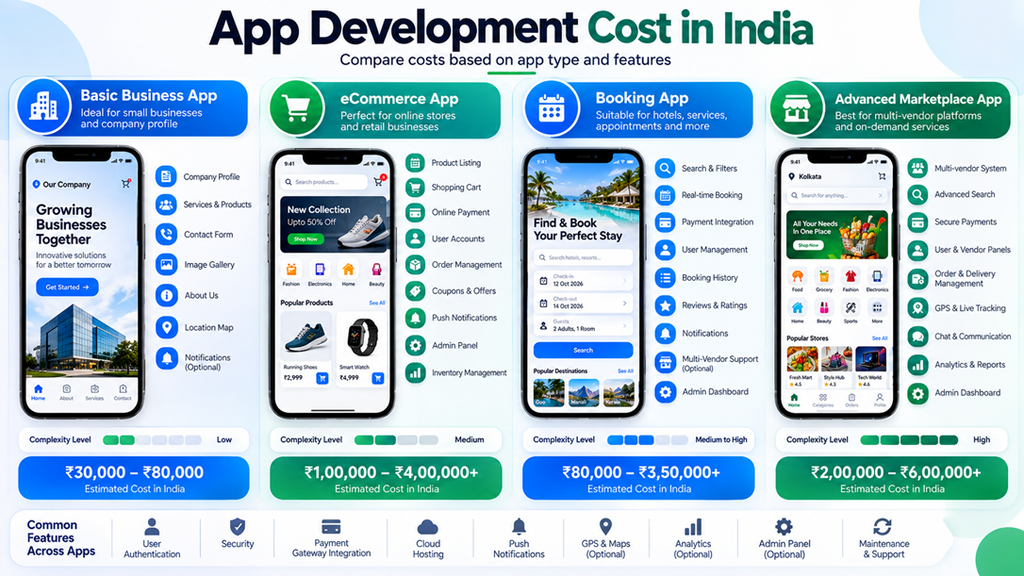
The following ranges provide a general idea of what businesses may budget for different types of applications.
| App Type | Approximate Development Cost |
|---|---|
| Basic informational app | ₹30,000 to ₹80,000 |
| Small business app | ₹40,000 to ₹1,00,000 |
| Custom utility app | ₹60,000 to ₹1,50,000 |
| Medium-complexity app | ₹80,000 to ₹2,50,000 |
| eCommerce app | ₹1,00,000 to ₹4,00,000+ |
| Food delivery app | ₹1,50,000 to ₹5,00,000+ |
| Booking app | ₹1,00,000 to ₹3,50,000+ |
| Marketplace app | ₹2,00,000 to ₹6,00,000+ |
| On-demand service app | ₹1,50,000 to ₹5,00,000+ |
| Enterprise application | ₹3,00,000 to ₹10,00,000+ |
| Highly customized platform | ₹5,00,000 to ₹15,00,000+ |
These are indicative ranges rather than fixed quotations. The actual price can be lower or higher depending on the functionality, technology, design, development approach, integrations, and project scope.
What Determines How Much Money Is Required to Make an App in India?
Understanding the individual components of app development can help you estimate your budget more accurately.
1. Type of Application
The type of application has one of the biggest effects on development cost.
A simple informational application may only require a few pages, contact information, service descriptions, images, and basic navigation.
On the other hand, an eCommerce application requires considerably more functionality.
For example, an eCommerce application may require:
- User registration
- Login
- Product categories
- Product search
- Product filters
- Product details
- Shopping cart
- Wishlist
- Checkout
- Online payment
- Address management
- Order management
- Order tracking
- Coupons
- Push notifications
- Customer support
- Admin dashboard
- Inventory management
Every additional feature increases development time and testing requirements.
2. Number of Platforms
Another major factor is whether you want the application for Android, iOS, or both.
If you develop separate native applications for Android and iOS, you may need two development environments and potentially two separate codebases.
A business targeting both platforms can instead consider cross-platform technologies such as Flutter.
Cross-platform development can reduce development duplication because a significant portion of the application can be built from a shared codebase.
For startups and small businesses, this can be an attractive approach when the project requirements are suitable for cross-platform development.
Android App Development Cost
Android is one of the most widely used mobile platforms in India, making Android applications particularly relevant for Indian businesses.
A basic Android application may cost approximately ₹30,000 to ₹80,000 depending on its functionality.
Medium-complexity applications may fall within the ₹80,000 to ₹2,50,000 range.
More advanced applications can cost several lakhs.
Factors that can increase Android development cost include:
- Multiple user roles
- Complex backend systems
- Real-time features
- GPS
- Payment integration
- Video functionality
- Chat
- Custom animations
- Advanced security
- External API integration
- Large databases
iOS App Development Cost
iOS applications can also require significant investment, especially when they involve complex functionality or integrations.
A basic iOS application may start around ₹40,000 to ₹1,00,000, while more sophisticated applications can cost several lakhs.
Businesses targeting premium customers or international markets may consider iOS development as an important part of their mobile strategy.
If you need both Android and iOS applications, discussing cross-platform development with your development company can help determine whether a shared technology stack is appropriate.
Flutter App Development Cost
Flutter is a popular cross-platform framework that allows developers to create applications for multiple platforms using a shared codebase.
The Flutter app development cost depends mainly on the complexity of the application rather than simply the technology itself.
A basic Flutter application may cost approximately ₹40,000 to ₹1,00,000.
A medium-complexity Flutter application may cost around ₹80,000 to ₹2,50,000.
Advanced applications with complex backend systems, payments, real-time functionality, APIs, and custom interfaces can cost several lakhs.
Flutter can be particularly useful for startups and businesses that want to launch on both Android and iOS while managing development resources efficiently.
However, choosing Flutter should not be based only on price. The technology should also match the long-term technical and business requirements of the application.
Cost Based on App Complexity
One of the easiest ways to estimate app development cost is to divide applications into three categories.
Basic Applications
Basic applications generally have limited functionality.
Examples include:
- Company profile apps
- Portfolio apps
- Informational apps
- Simple calculators
- Basic utility apps
- Small business applications
These applications may contain 5 to 15 screens and limited backend functionality.
Estimated budget:
₹30,000 to ₹80,000
Medium-Complexity Applications
Medium applications include more interactive features and often require a backend system.
Examples include:
- Appointment booking apps
- Restaurant applications
- Small eCommerce apps
- Education applications
- Service booking platforms
- Membership applications
- Content platforms
Estimated budget:
₹80,000 to ₹2,50,000
Advanced Applications
Advanced applications require extensive backend development and sophisticated features.
Examples include:
- Large eCommerce applications
- Multi-vendor marketplaces
- Food delivery platforms
- Taxi booking platforms
- Financial applications
- Social networking platforms
- Enterprise applications
- Logistics platforms
Estimated budget:
₹2,50,000 to ₹10,00,000+
Highly customized applications can exceed this range depending on the technical architecture and business requirements.
How UI/UX Design Affects App Development Cost
Design is another important component of app development.
A simple application with a standard interface may require less design work than a highly customized application with animations, interactive components, illustrations, complex navigation, and personalized user experiences.
UI/UX design usually includes:
- User flow planning
- Wireframes
- Screen layouts
- Color selection
- Typography
- Buttons
- Forms
- Navigation
- Interactive components
- Responsive layouts
- Prototypes
Professional UI/UX design can improve the usability and perceived quality of an application.
However, businesses should avoid adding unnecessary visual complexity simply to make an app look expensive.
A good application should be easy to understand and use.
Backend Development Cost
The mobile application is only one part of many modern apps.
Behind the application, there may be a backend system responsible for managing:
- Users
- Products
- Orders
- Payments
- Content
- Notifications
- Transactions
- Reports
- Customer information
- Authentication
- Database operations
For example, when a customer places an order through an eCommerce application, the app communicates with the backend server. The backend processes the order and stores relevant information in the database.
A simple app may require a relatively small backend.
A marketplace or enterprise application may require a much more sophisticated architecture.
Consequently, backend requirements can significantly affect how much money is required to make an app in India.
Admin Panel Development Cost
Many businesses overlook the administrator dashboard when estimating development costs.
An admin panel allows the business owner or staff to control the application.
Depending on the project, it may include:
- User management
- Product management
- Order management
- Payment records
- Content management
- Reports
- Notifications
- Customer support
- Offers and coupons
- Inventory management
- Employee management
A simple admin panel may add a relatively small amount to the project.
A sophisticated enterprise dashboard can become a major part of the overall development budget.
Third-Party Integrations
Modern applications rarely operate independently.
They often connect with external services.
Common integrations include:
- Payment gateways
- Google Maps
- SMS services
- Email services
- WhatsApp APIs
- Social login
- Shipping APIs
- CRM systems
- Accounting software
- Analytics tools
- Cloud storage
- AI APIs
Some third-party services have their own subscription or usage charges.
These costs are generally separate from the development company’s development fee.
Payment Gateway Integration
If your app accepts online payments, payment gateway integration becomes important.
Indian businesses may integrate payment solutions that support methods such as:
- UPI
- Credit cards
- Debit cards
- Net banking
- Wallets
The development cost can include the technical integration, testing, transaction handling, and payment status management.
The payment provider may also charge transaction fees or other commercial charges separately.
Push Notifications
Push notifications are useful for keeping users informed.
An eCommerce app might send notifications about:
- New orders
- Order confirmation
- Shipping updates
- Delivery updates
- Discounts
- New products
A booking application may send:
- Booking confirmation
- Appointment reminders
- Schedule changes
Notification functionality may be relatively inexpensive for a basic implementation, but complex notification systems involving segmentation and personalized campaigns require additional development.
Location and GPS Features
Applications that depend on physical locations often require mapping and GPS functionality.
Examples include:
- Taxi applications
- Food delivery apps
- Courier platforms
- Real estate applications
- Travel applications
- Service booking apps
Location features can include:
- Current location detection
- Distance calculation
- Route mapping
- Driver tracking
- Nearby service providers
- Delivery tracking
The complexity of these features directly affects development time.
Real-Time Chat and Communication
If your application needs communication between users, additional development may be required.
Examples include:
- Customer support chat
- Buyer-seller communication
- Doctor-patient communication
- Driver-customer communication
- Employee communication
A basic messaging system is simpler than a platform requiring:
- Online status
- Typing indicators
- Media sharing
- Voice calls
- Video calls
- Message delivery status
- Message encryption
Therefore, communication requirements should be clearly defined before estimating the project.
Security and Data Protection
Security should not be treated as an optional feature.
Applications handling customer information, payments, business data, or sensitive information need appropriate security practices.
Security considerations can include:
- Secure authentication
- Password protection
- API security
- Database security
- Access control
- Secure payment processing
- Session management
- Data encryption
- Backup systems
- Server security
The level of security required depends on the application and the type of information it processes.
App Testing Costs
Testing is an essential stage of professional app development.
An application should be tested across different scenarios before launch.
Testing may include:
Functional Testing
Checks whether individual features work correctly.
UI Testing
Checks whether screens and interfaces behave correctly.
Device Testing
Tests the app across different screen sizes and devices.
Performance Testing
Checks loading speed, responsiveness, and resource consumption.
Security Testing
Identifies potential security vulnerabilities.
Compatibility Testing
Ensures that the application works with supported operating system versions.
Skipping testing may reduce the initial development budget but can create expensive problems after launch.
App Publishing Costs
After development, your application needs to be published through the appropriate app store.
For Android, the application is generally distributed through Google Play.
For iOS, applications are distributed through Apple’s App Store.
Developer accounts and platform policies should be considered separately from development charges.
Your development team can generally help with:
- App store configuration
- App icons
- Screenshots
- App descriptions
- Privacy information
- Build generation
- Submission
- Technical corrections
Publishing itself is only one part of launching the application.
App Maintenance Cost in India
One common mistake businesses make is assuming that app development ends after launch.
In reality, mobile applications require ongoing maintenance.
Maintenance may include:
- Bug fixing
- Security updates
- Operating system compatibility
- Server management
- Performance improvements
- Database maintenance
- API updates
- Minor feature updates
- Backup management
- Technical monitoring
A common approach is to budget approximately 10% to 20% of the initial development cost annually for maintenance, although the actual amount varies significantly depending on the application.
An application that receives frequent feature updates may require a much larger maintenance budget.
Hidden Costs You Should Consider
When calculating your budget, do not focus only on the developer’s quotation.
There can be additional expenses.
Server and Hosting
Your application may require cloud hosting or dedicated server resources.
Domain
If your backend or API uses a dedicated domain, domain registration needs to be considered.
SSL Certificate
Secure communication requires HTTPS and appropriate SSL/TLS configuration.
Database
Large applications may require additional database resources as the number of users grows.
SMS
OTP authentication may generate SMS costs.
Transactional emails can involve third-party email service charges.
Maps
Location-based applications may incur charges depending on API usage.
Payment Gateway
Payment providers may have transaction-based fees.
App Store Accounts
Platform developer accounts can involve separate fees and requirements.
Marketing
An app can be technically excellent but still fail to attract users if there is no marketing strategy.
Marketing may include:
- Google Ads
- Social media advertising
- SEO
- App Store Optimization
- Influencer marketing
- Content marketing
- Email marketing
These expenses are generally separate from app development.
How to Reduce App Development Cost
Businesses often want to control development costs without sacrificing quality.
There are several practical ways to do this.
Start With an MVP
An MVP, or Minimum Viable Product, contains the core features required to launch the product.
Instead of building 30 features immediately, you can start with the 8 to 10 features that are essential.
Once customers start using the application, you can introduce additional functionality based on real feedback.
Choose Features Carefully
Every feature has a cost.
Before adding a feature, ask:
- Is this necessary for launch?
- Will customers use it regularly?
- Does it generate revenue?
- Does it improve retention?
- Can it be introduced later?
This approach can significantly improve budget management.
Consider Cross-Platform Development
If you require both Android and iOS, cross-platform development may reduce duplicated development work.
Flutter is one option worth discussing with your development team.
Use a Clear Scope
Unclear requirements often cause project costs to increase.
Before development begins, prepare a clear document covering:
- Features
- Screens
- User roles
- Integrations
- Admin functionality
- Design expectations
- Platform requirements
A clear scope makes it easier for both the client and development company to estimate the project.
Avoid Unnecessary Customization
Custom features can be valuable, but not every feature needs to be completely custom-built.
Where appropriate, proven third-party services can sometimes reduce development time.
The right choice depends on security, scalability, licensing, reliability, and long-term requirements.
Choosing an App Development Company in India
Choosing the development company is an important decision.
Do not select a company based only on the lowest quotation.
Instead, evaluate:
- Previous projects
- Technical expertise
- Portfolio
- Development methodology
- Communication
- Testing process
- Support policy
- Maintenance options
- Technology expertise
- Project documentation
- Delivery timeline
A very low quotation may exclude important components such as backend development, testing, deployment, or maintenance.
Always compare quotations based on what is actually included.
Why Choose Infotech Wayout for App Development?
At Infotech Wayout, we work with businesses that want to build practical, scalable, and user-friendly digital products.
Our development approach focuses on understanding the business requirement before deciding the technology and development process.
Depending on the project, we can work on:
- Android applications
- iOS applications
- Flutter applications
- Business applications
- eCommerce applications
- Custom mobile applications
- Booking applications
- Service applications
- Customer management applications
- Backend systems
- Admin dashboards
- API integrations
Our goal is not simply to create an application that works.
The objective is to create an application that supports the business process and provides a useful experience for customers.
If your project has a limited budget, we can also help identify the essential features for an MVP and plan additional features for future phases.
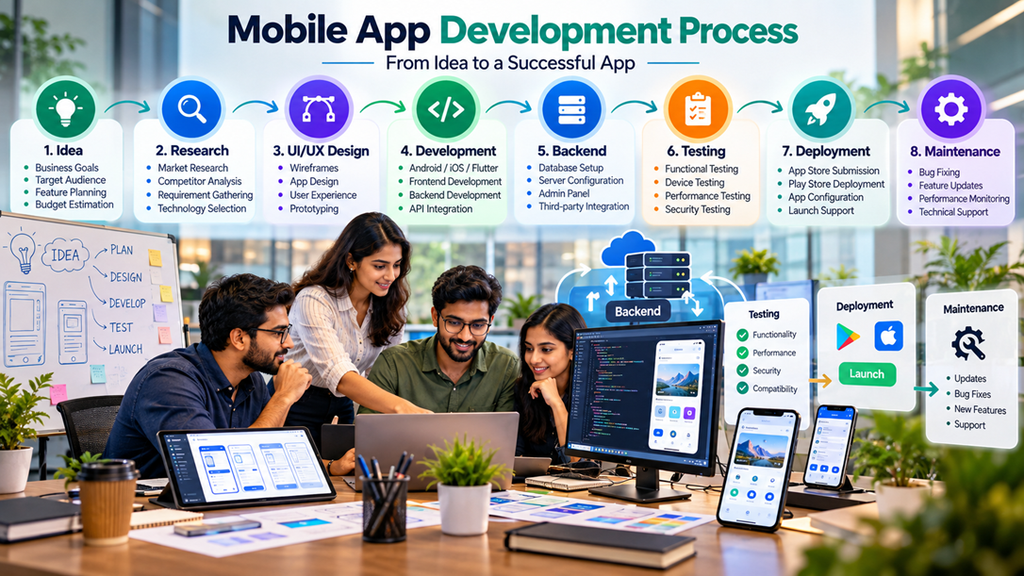
How Infotech Wayout Estimates App Development Cost
Before providing an estimate, it is useful to understand the complete project.
The process can include:
Step 1: Requirement Discussion
We understand your business, target audience, objectives, and application concept.
Step 2: Feature Planning
We identify essential and optional features.
Step 3: Platform Selection
We determine whether Android, iOS, Flutter, or another technology is suitable.
Step 4: UI/UX Planning
We plan the screens and user experience.
Step 5: Backend Planning
We determine server, database, API, authentication, and admin requirements.
Step 6: Development Estimate
The project is divided into development components and an estimated budget is prepared.
Step 7: Development
The application is developed according to the approved scope.
Step 8: Testing
The application is tested across relevant devices and scenarios.
Step 9: Deployment
The application is prepared for app store publication.
Step 10: Maintenance
After launch, ongoing technical support and improvements can be planned.
This structured process makes the development budget easier to understand.
Example: Estimated Budget for a Small eCommerce App
Suppose a small business wants to build an eCommerce application.
The application may include:
- Customer registration
- Login
- Product categories
- Product listing
- Product details
- Search
- Cart
- Checkout
- Address management
- Payment gateway
- Order history
- Push notifications
- Admin panel
A project like this may require a budget of approximately ₹1,00,000 to ₹3,00,000 or more depending on the exact requirements.
If advanced functionality such as multi-vendor selling, real-time delivery tracking, advanced inventory management, loyalty programs, AI recommendations, or sophisticated analytics is added, the budget can increase substantially.
Example: Estimated Budget for a Booking App
A booking application may include:
- User registration
- Service listings
- Provider profiles
- Calendar
- Availability
- Booking
- Payment
- Notifications
- Booking history
- Cancellation
- Admin dashboard
A basic booking application may fall within ₹80,000 to ₹2,00,000.
More advanced booking platforms with multiple vendors, real-time availability, complex scheduling, payment automation, and provider management can cost considerably more.
Example: Estimated Budget for a Food Delivery App
A food delivery platform generally requires multiple components.
These may include:
- Customer application
- Restaurant/vendor system
- Delivery partner application
- Admin panel
- Restaurant management
- Menu management
- Order management
- Payment
- GPS
- Delivery tracking
- Notifications
- Coupons
- Ratings and reviews
Because of this multi-user architecture, food delivery platforms can require several lakhs of rupees for a complete customized solution.
How Long Does It Take to Develop an App?
Cost and development time are closely related.
A simple application may take approximately 2 to 6 weeks.
A medium-complexity application may require around 2 to 4 months.
A complex application can take 4 to 8 months or longer.
The timeline depends on:
- Number of features
- Design complexity
- Backend requirements
- Number of platforms
- API integrations
- Testing
- Client feedback
- Content availability
- Scope changes
Adding new features during development can increase both the budget and timeline.
Why the Cheapest App Development Quote May Not Always Be the Cheapest Option
When comparing development companies, it is tempting to select the lowest quotation.
However, you should check what the quotation actually includes.
For example, one company may quote ₹50,000 but exclude:
- UI/UX design
- Backend development
- Admin panel
- Testing
- Deployment
- Source code
- Maintenance
Another company may quote ₹1,00,000 and include all of these components.
The second quotation may therefore represent a very different project.
Always compare the scope rather than comparing only the final number.
What Should You Tell an App Development Company Before Asking for a Quote?
To receive a more accurate estimate, prepare information about:
- What the application does
- Who will use it
- Android, iOS, or both
- Number of user types
- Required features
- Payment requirements
- Admin panel requirements
- Location/GPS requirements
- Chat requirements
- Third-party integrations
- Expected number of users
- Design preferences
- Target launch date
- Approximate budget
The more clearly you communicate your requirements, the easier it becomes for a development company to provide a meaningful estimate.
Is It Possible to Build an App With a Small Budget?
Yes.
A smaller budget does not necessarily mean that you cannot launch an application.
The key is to control the initial scope.
Instead of building a complete platform immediately, consider launching an MVP.
For example, an eCommerce startup could initially focus on:
- Product catalog
- Customer login
- Cart
- Checkout
- Payment
- Order management
- Admin panel
Advanced features such as loyalty programs, AI recommendations, advanced analytics, subscriptions, and multi-vendor functionality can be added later.
This approach allows a business to validate the idea before investing heavily in additional development.
Final Thoughts: How Much Money Is Required to Make an App in India?
So, how much money is required to make an app in India?
There is no single price that applies to every application.
A simple app can potentially be developed with a budget of around ₹30,000 to ₹80,000. A medium-complexity application may require ₹80,000 to ₹2,50,000 or more, while complex applications such as eCommerce platforms, marketplaces, delivery applications, and enterprise solutions can require several lakhs.
The most important factor is not simply the development price.
You should consider the application’s features, usability, scalability, security, backend architecture, maintenance, and long-term business objectives.
A well-planned MVP can be an effective way for startups and small businesses to control their initial investment while leaving room for future expansion.
At Infotech Wayout, we help businesses transform application ideas into practical digital products. Whether you need a basic business app, eCommerce application, Flutter app, booking platform, or customized mobile solution, the right approach starts with understanding your requirements.
If you are planning an app and want to understand your expected budget, prepare a list of your required features and discuss them with a professional development team. A detailed requirement analysis will give you a much more realistic estimate than a generic per-app price.
Frequently Asked Questions
1. How much does it cost to develop an app in India?
The cost can vary considerably depending on the type and complexity of the application. A basic app may cost approximately ₹30,000 to ₹80,000, while medium-complexity applications may cost ₹80,000 to ₹2,50,000 or more. Advanced applications can cost several lakhs.
2. What is the minimum budget required to make an app in India?
A simple application with limited features may potentially be developed from around ₹30,000, depending on the requirements. However, the actual minimum budget depends on design, backend functionality, platform, integrations, testing, and other project requirements.
3. How much does an eCommerce app cost in India?
A basic eCommerce app can potentially start around ₹1,00,000, while more advanced applications may cost ₹3,00,000, ₹5,00,000, or more. Multi-vendor functionality, payment systems, inventory, delivery tracking, coupons, advanced analytics, and other features can increase the overall budget.
4. Is Flutter cheaper than native Android and iOS development?
Flutter can reduce duplicated development work when an application needs to support both Android and iOS because a significant portion of the codebase can be shared. However, the final cost depends on the features, design, backend, integrations, testing, and technical requirements.
5. How much does it cost to maintain a mobile application?
Maintenance costs depend on the size and complexity of the application. Businesses may commonly budget around 10% to 20% of the initial development cost annually as a starting point, but applications requiring frequent updates, extensive server resources, or continuous development may cost more.
6. Can I develop an app with ₹50,000?
A basic application with limited functionality may be possible within or around a ₹50,000 budget depending on the requirements. However, complex applications such as complete eCommerce, food delivery, marketplace, or enterprise platforms generally require a larger investment.
7. How long does it take to build a mobile application?
A simple application may take several weeks, while a medium-complexity application may require a few months. Complex applications can take four months or longer. The timeline depends on the number of features, design, backend, integrations, testing, and changes during development.
8. How can I reduce the cost of app development?
The most effective approach is to clearly define your requirements and launch with an MVP. Prioritize essential features, avoid unnecessary customization, consider suitable cross-platform technologies, prepare content and designs on time, and avoid frequent changes to the project scope during development.

