
Introduction
Social media has completely changed how businesses communicate with customers. Today, even a very small business can create a Facebook page, upload its products or services, communicate with customers, publish promotional content, and build an online following without making a significant initial investment.
This convenience leads many entrepreneurs to ask an important question: Can I use Facebook as a business website?
The short answer is yes, you can use a Facebook Business Page as part of your online presence. For a new or very small business, it can even act as a temporary online destination where customers can find basic information.
However, using Facebook as your only business website is usually not the best long-term strategy.
A Facebook page and a professional business website serve different purposes. Facebook gives your business access to a massive social audience and provides useful communication and marketing tools. A website, on the other hand, gives your company greater control over its brand, content, customer experience, search engine visibility, functionality, and digital assets.
At Infotech Wayout, we work with businesses that want to establish and strengthen their digital presence through professional web design, web development, eCommerce solutions, mobile applications, SEO, and other digital services. One thing we often notice is that business owners sometimes underestimate how important it is to own their primary digital platform.
In this comprehensive guide, we will explore whether Facebook can replace a website, the advantages and disadvantages of relying on a Facebook Business Page, the difference between a website and Facebook page, and how businesses can use both platforms together.
What Is a Facebook Business Page?
A Facebook Business Page is a public profile created specifically for a business, brand, organization, public figure, or other commercial entity.
Unlike a personal Facebook profile, a business page provides features designed to help organizations communicate with their audiences and promote their products or services.
Depending on the features available to your business and region, you may be able to display important information such as your:
- Business name
- Business category
- Description
- Contact information
- Opening hours
- Location
- Products or services
- Photos and videos
- Customer reviews or recommendations
- Promotional posts
- Events
- Calls to action
Businesses can also use Facebook advertising and other Meta business tools to reach potential customers beyond their existing followers.
For a local shop, freelancer, consultant, home-based business, restaurant, service provider, or newly established company, this makes Facebook a convenient place to begin creating a business online presence.
But convenience should not be confused with ownership.
Your Facebook Business Page exists inside Facebook’s ecosystem. You can manage the page, but you do not own or control the platform itself. This distinction becomes extremely important as your business grows.
Can I Use Facebook as a Business Website?
Technically, yes. A Facebook page can perform some of the basic functions that people expect from a simple business website.
For example, potential customers can discover your business, read your description, see photos, find contact details, send messages, and interact with your latest updates.
If you are launching a small business with almost no digital marketing budget, creating a Facebook page can therefore be a reasonable starting point.
Imagine someone has just started a local home cleaning service. They may initially need somewhere to publish:
- Services offered
- Service areas
- Contact details
- Before and after photographs
- Customer feedback
- Promotional offers
- Availability updates
A Facebook page can handle many of these basic requirements.
The problem begins when the business starts treating Facebook as a permanent replacement for its own website.
A professional website can provide capabilities that a social media page was never designed to fully replace. These include advanced SEO, custom landing pages, detailed service pages, eCommerce functionality, lead-generation systems, integrations, customer portals, booking systems, custom forms, content marketing, and complete control over branding and user experience.
Therefore, a better question is not simply, “Can Facebook work as my website?”
The more useful question is:
“Should Facebook be the primary digital platform for my business?”
For most established businesses, the answer is no.
Why Do Small Businesses Consider Facebook Instead of a Website?
There are several understandable reasons why entrepreneurs initially consider using Facebook for business instead of investing in a website.
1. Facebook Is Easy to Set Up
Creating a Facebook Business Page can be relatively straightforward.
You do not need to understand programming, website hosting, databases, responsive web design, or content management systems simply to establish a basic page.
A business owner can create a page, add information, upload a profile picture and cover image, and begin publishing content.
This simplicity is particularly attractive to entrepreneurs who are launching their first business.
2. The Initial Cost Can Be Very Low
Cost is another major consideration.
Many small businesses operate with limited budgets during their early stages. Creating a basic Facebook Business Page does not require the same initial development process as building a custom website.
This makes social media appealing to businesses that are testing a new idea or have not yet allocated a dedicated digital marketing budget.
However, the absence of an initial website development cost does not necessarily make Facebook the most economical solution over the long term.
Businesses should consider the potential value of organic search traffic, lead generation, professional credibility, automation, online sales, and customer acquisition that a well-designed website can provide.
3. Your Customers May Already Be on Facebook
Facebook gives businesses access to an existing social network.
Instead of trying to convince people to join a completely new platform, businesses can communicate with customers where many of them already spend time online.
Users can react to posts, comment, share content, send messages, and recommend businesses to other people.
This makes Facebook particularly useful for community engagement.
4. Content Publishing Is Simple
Publishing updates through a Facebook page is easy.
A business can quickly share:
- New products
- Special offers
- Company news
- Photos
- Videos
- Customer stories
- Events
- Seasonal promotions
This immediacy is one of the biggest advantages of social media.
However, the same content has a different lifespan compared with evergreen website content.
A detailed article published on your website can potentially attract visitors through search engines for months or even years when properly optimized and maintained. A social media post usually depends much more heavily on immediate distribution and engagement.
5. Direct Customer Communication
Social media is designed around communication.
Customers can comment on posts and contact businesses through messaging features. This can help companies answer simple questions quickly and maintain relationships with their audience.
But this communication functionality should complement your website rather than necessarily replace it.
Facebook Business Page vs Website: What Is the Difference?
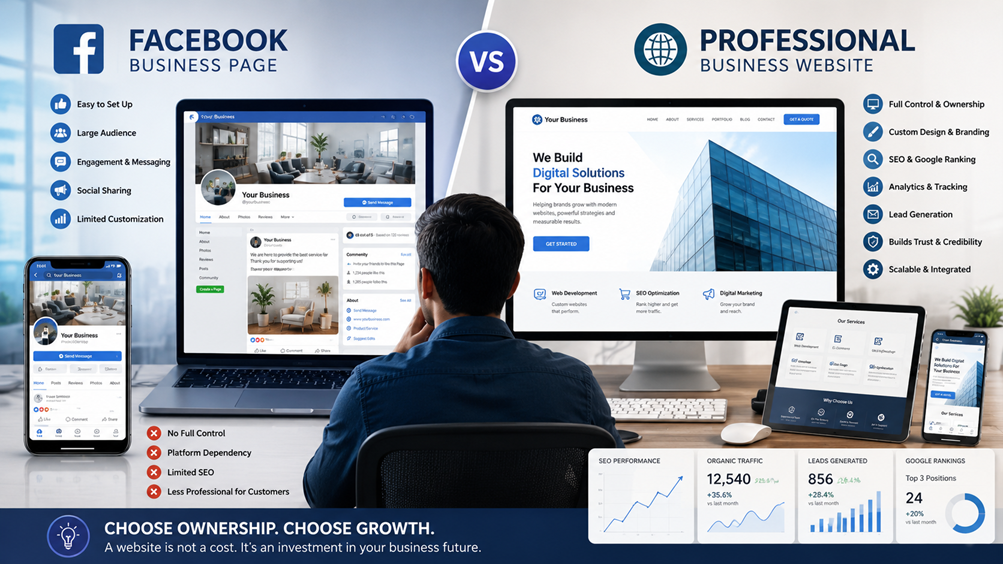
Understanding the website vs Facebook page debate becomes much easier when you recognize that these platforms were built for different purposes.
Facebook is fundamentally a social networking and communication platform.
Your business website is your company’s independent digital property.
Consider a physical-world comparison.
A Facebook page is somewhat like operating a branded space inside a large shopping center. The shopping center provides visitors, infrastructure, and rules. You can decorate parts of your space and interact with customers, but the shopping center ultimately controls the environment.
Your own website is more like having your own dedicated business premises.
You have significantly more control over the appearance, structure, customer journey, functionality, branding, and information presented.
Ownership and Control
This is perhaps the biggest difference.
With your own website, your business can control important elements such as:
- Domain name
- Hosting environment
- Website structure
- Branding
- Page layouts
- Content
- Calls to action
- Lead-generation forms
- Integrations
- Analytics
- Customer journeys
- Search optimization
On Facebook, your business operates according to the platform’s features, policies, design, and technical limitations.
Facebook can change its interface, functionality, policies, or distribution systems.
Your ability to customize the platform is therefore limited compared with your own website.
The Advantages of Using Facebook for Your Business
Although Facebook should not usually replace a professional website, it remains an extremely useful marketing channel.
A strong digital strategy should recognize these advantages rather than treating Facebook and websites as competitors.
Access to a Large Audience
One of Facebook’s biggest strengths is its existing user base.
Businesses can create content that followers can interact with and share. Paid advertising can also help companies reach audiences based on targeting options available through the platform.
This makes Facebook valuable for brand awareness and customer acquisition campaigns.
Social Engagement
Websites are excellent for presenting information, generating leads, ranking in search engines, and completing transactions.
Social media is particularly strong at encouraging conversation.
Customers can interact with your content and sometimes help distribute it through sharing and recommendations.
This creates opportunities to build a community around your brand.
Customer Feedback and Social Proof
People often want evidence that other customers trust a business before making a purchase.
Facebook can help businesses display customer interactions, comments, recommendations, and other forms of social proof.
A company can then strengthen this strategy further by featuring verified testimonials, case studies, portfolio projects, and customer success stories on its own website.
Effective Promotional Channel
Facebook marketing can be particularly useful for promotions.
For example, a web development company could publish an offer through Facebook and direct interested users to a dedicated landing page on its website.
That landing page could provide:
- Complete service information
- Portfolio examples
- Testimonials
- Pricing information
- Frequently asked questions
- Inquiry form
- WhatsApp or phone contact
- Strong call-to-action buttons
This demonstrates how Facebook and a website can work together.
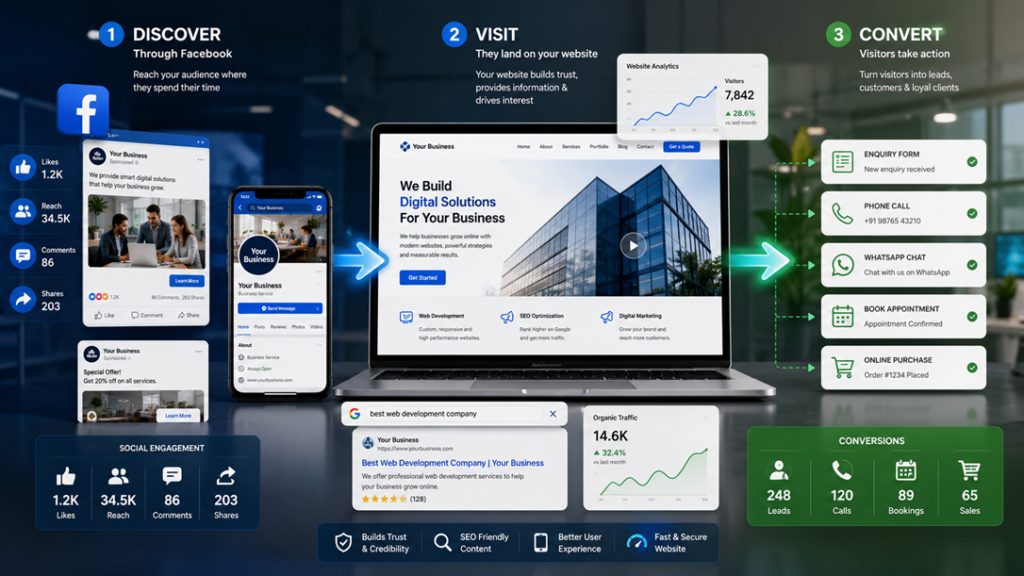
Facebook generates attention. The website provides the controlled environment needed to convert that attention into enquiries or customers.
What Are the Problems With Using Only Facebook for Business?
This is where business owners need to look beyond the convenience of social media.
Using Facebook is not the problem. Depending entirely on Facebook can be.
You Do Not Fully Control the Platform
When you build your entire online presence on another company’s platform, your business becomes dependent on that platform.
The platform determines what features are available and how users interact with business pages.
By contrast, a custom business website provides significantly greater control.
Your development team can create functionality according to your business requirements rather than being restricted to the tools provided by a social network.
Your Account or Page Can Face Restrictions
This is another reason businesses should avoid relying entirely on one digital platform.
Accounts and pages can potentially face restrictions, security incidents, access problems, policy enforcement, administrative mistakes, or other unexpected issues.
Even if a problem is eventually resolved, temporarily losing access to your primary online business presence can be disruptive.
A company should therefore build a diversified digital ecosystem.
Your website can act as the central hub, while Facebook, Instagram, LinkedIn, YouTube, Google Business Profile, email marketing, and other appropriate channels can support it.
If one marketing channel experiences a problem, customers can still find your business elsewhere.
Limited Customization
Every serious business eventually develops unique requirements.
Perhaps you want visitors to request customized quotations.
Maybe customers need to book appointments.
An eCommerce company may require product filtering, inventory management, payment integration, shipping calculations, and order tracking.
A real estate company might need searchable property listings.
A travel company might require booking functionality.
An educational organization may need student registration and online course functionality.
A Facebook page cannot provide the same degree of customization as a professionally developed website.
This is one of the biggest reasons growing businesses eventually need their own digital platform.
Facebook Is Not a Complete Replacement for SEO
Search engine visibility is another major consideration when answering the question, Can I use Facebook as a business website?
Customers do not search only through social media.
They also use search engines to find answers, products, services, reviews, comparisons, prices, local companies, tutorials, and solutions to specific problems.
A professionally optimized website allows businesses to build pages around those search intentions.
For example, a web development company could create individual pages targeting services such as:
- Business website development
- WordPress development
- eCommerce website development
- Mobile app development
- SEO services
- Website maintenance
- Custom web applications
The company could then publish useful blog content answering questions its potential customers search for.
Over time, this creates an expanding library of searchable content.
Websites Give You More SEO Opportunities
A website allows you to optimize individual pages using elements such as:
- Page titles
- Meta descriptions
- Heading structures
- Internal links
- Image optimization
- Structured content
- Schema markup
- Page speed optimization
- Mobile responsiveness
- Service-specific content
- Location-specific pages
- Blog articles
- Frequently asked questions
These elements can contribute to a broader SEO strategy.
A Facebook Business Page does not provide the same level of technical and content control.
Does a Professional Website Make a Business Look More Credible?
For many customers, yes.
Think about your own behavior when researching an unfamiliar company.
You might discover the business through Facebook, Instagram, or another social platform. But before making a substantial purchase or submitting personal information, you may search for the company’s website.
A professional website can provide additional credibility because customers can examine the company in greater detail.
They may look for:
- About the company
- Detailed service information
- Portfolio
- Previous projects
- Testimonials
- Contact details
- Business address
- Terms and policies
- Frequently asked questions
- Blog articles
- Case studies
The quality of the website also influences perception.
An outdated, slow, confusing, or poorly designed website can hurt credibility. Simply owning a domain is not enough.
A professional business website should communicate reliability through good design, useful information, fast performance, mobile responsiveness, security, and clear navigation.
Why Your Website Should Be the Center of Your Online Presence
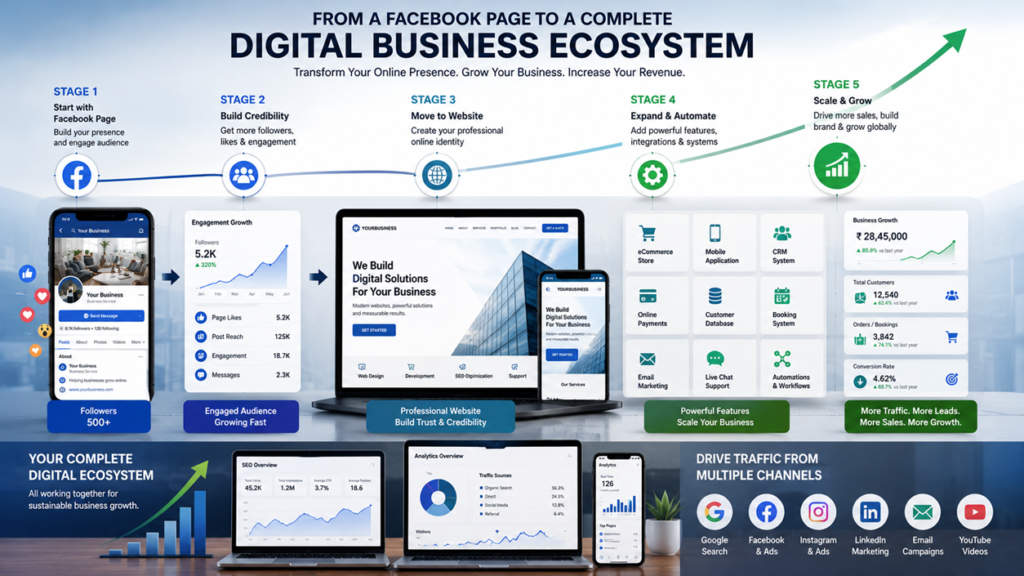
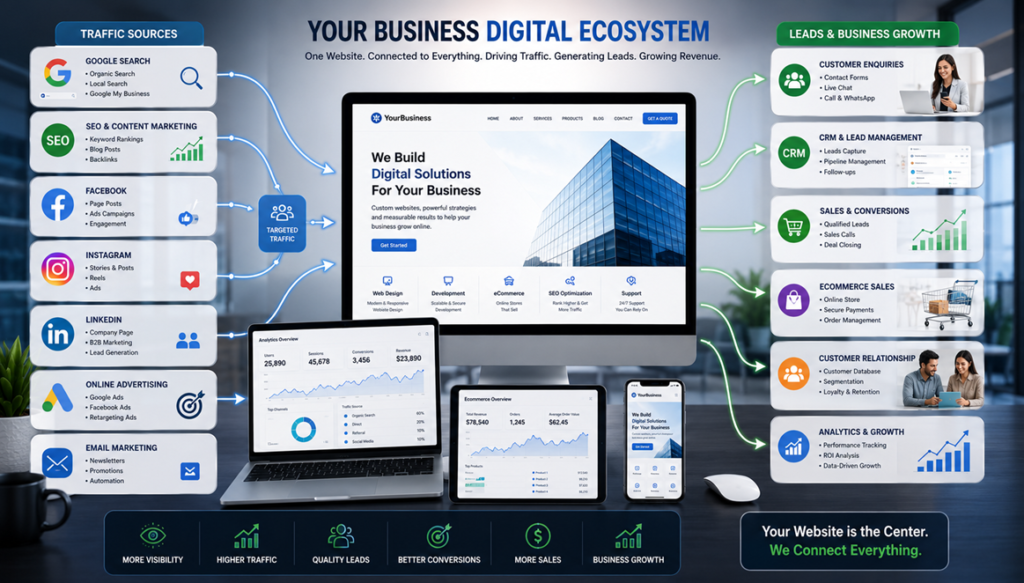
Instead of thinking about Facebook versus a website, businesses should consider creating an interconnected digital ecosystem.
At the center is your website.
Other marketing platforms can then direct audiences toward it.
For example:
Google Search → Website
Facebook → Website
Instagram → Website
LinkedIn → Website
YouTube → Website
Email Campaign → Website
Online Advertisement → Landing Page
This model gives businesses more control over what happens after a customer clicks.
You can design dedicated landing pages for different campaigns, track website activity, collect enquiries, display relevant services, provide detailed information, and guide visitors toward specific actions.
The website therefore becomes your digital headquarters, while social media platforms operate as communication and customer acquisition channels.
What Happens When Your Business Grows?
A simple Facebook page may feel sufficient when you have only a handful of customers.
Growth changes the situation.
As enquiries increase, you may need more organized systems for handling customers, payments, bookings, products, support requests, content, and marketing.
For example, a growing business may eventually need:
- Online quotation forms
- Appointment booking
- Online payments
- Product catalogues
- Customer accounts
- Order management
- CRM integration
- Email marketing integration
- Automated notifications
- Customer support systems
- Advanced analytics
- Multiple landing pages
- Search engine optimization
- Multilingual content
- Custom dashboards
This is where a scalable website becomes particularly valuable.
A professional website development company can build a digital platform around the actual workflow of your business.
Instead of forcing your company to operate within the limitations of a social media platform, the technology can be designed around how your company works.
Can a Small Business Survive Without a Website?
Some businesses certainly operate successfully without their own websites.
A local business may receive customers primarily through referrals, social media, marketplaces, or offline channels.
But the important question is not whether survival is possible.
The question is whether not having a website is limiting potential growth.
When customers search online for services, businesses with useful and optimized websites have opportunities to appear in those searches.
Without your own website, you lose the ability to build a substantial independent source of organic search traffic.
You may also find it more difficult to present complex services, build dedicated advertising landing pages, publish long-form educational content, create custom conversion funnels, or integrate advanced business systems.
For a company that intends to build a recognizable and scalable brand, investing in a website for small business can therefore be an important long-term decision.
Facebook vs Website: It Should Not Be Either-Or
Perhaps the biggest misconception surrounding this topic is the idea that businesses need to choose between Facebook and a website.
They do not.
Facebook and websites perform different functions and can be significantly more effective when used together.
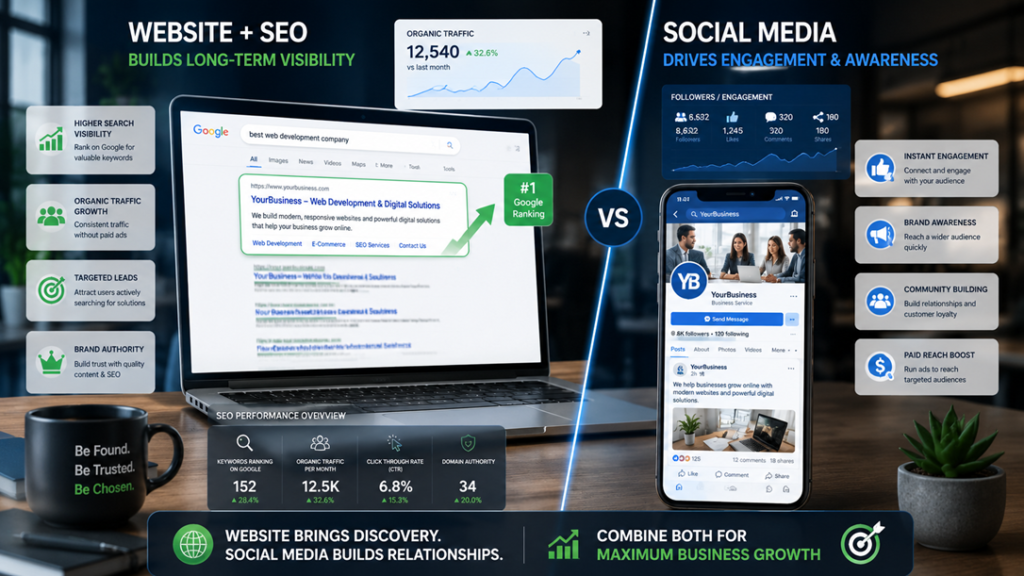
Your website can provide depth, control, SEO visibility, credibility, and conversion opportunities.
Your Facebook page can provide reach, engagement, community interaction, content distribution, and advertising opportunities.
For example, imagine you publish an informative article on your company website.
You can then promote that article through Facebook.
Someone discovers the post while browsing Facebook, clicks through to your website, reads the article, explores your services, checks your portfolio, and submits an enquiry.
In this example, Facebook contributed to discovery while the website supported education and conversion.
That is a much stronger strategy than expecting either platform to perform every digital marketing function by itself.
Is Facebook or a Website Better for a Small Business?
For most small businesses, the strongest strategy is not choosing one and ignoring the other. A professional website and a Facebook Business Page can serve different purposes within the same digital marketing strategy.
If you have to decide which platform should become the foundation of your long-term online presence, however, a professional website generally provides greater control and flexibility.
Facebook is particularly useful for social engagement, content distribution, community building, advertising, and communicating with customers. A website is better suited to becoming the central digital destination for your company.
Your website can contain detailed information about your business, services, products, portfolio, testimonials, contact information, policies, articles, FAQs, and other resources.
More importantly, you decide how visitors navigate through that information.
For example, imagine that you operate an interior design company. A Facebook page could help you share photographs of completed projects and interact with potential customers.
Your website could take the experience much further.
A visitor could:
- Read about your interior design services
- Browse projects by category
- View detailed case studies
- Read customer testimonials
- Learn about your process
- Explore frequently asked questions
- Request a consultation
- Submit project requirements
This structured customer journey is difficult to reproduce completely through a social media profile.
Therefore, Facebook can be an excellent marketing channel, but your website can become the digital foundation supporting your broader marketing strategy.
Facebook vs Website for Local Businesses
Local businesses sometimes assume they do not need websites because most of their customers come from nearby areas.
This may apply to businesses such as:
- Restaurants
- Salons
- Repair services
- Home service providers
- Local retailers
- Consultants
- Tutors
- Fitness centers
- Real estate agencies
- Small professional firms
Facebook can certainly help these businesses build local communities and promote offers.
However, local customers also use search engines when they need products and services.
Someone might search for a nearby web designer, plumber, restaurant, photographer, interior designer, repair company, or other service provider.
Having a professionally developed and properly optimized website gives your company another opportunity to appear when potential customers are actively looking for what you provide.
Local Search Intent Can Be Highly Valuable
There is an important difference between someone casually seeing your social media post and someone actively searching for a service.
A person scrolling through Facebook may notice an advertisement without currently needing the service.
Someone searching Google for a specific service is often expressing much clearer intent.
This is one reason search engine optimization can be valuable for local businesses.
Your website can contain dedicated service and location pages that explain exactly what you provide and where you operate.
The goal should not be to abandon social media. It should be to create multiple ways for customers to discover your business.
Why Owning Your Domain Name Matters
One of the biggest advantages of having a professional website is establishing your own domain.
Your domain becomes part of your company’s digital identity.
For example:
yourbusiness.com
is much easier to associate directly with your brand than relying entirely on a profile located inside another company’s platform.
Your domain can be used across:
- Business cards
- Brochures
- Email signatures
- Advertisements
- Social media profiles
- Google Business Profile
- Invoices
- Packaging
- Offline marketing materials
- Promotional campaigns
You can also create professional email addresses associated with your domain.
For example:
or
This can make business communication appear more professional than using a generic personal email account.
More importantly, your domain can remain a consistent destination even when your marketing strategy changes.
Today, Facebook might generate significant engagement for your business. Tomorrow, another platform could become more important.
Your website can remain at the center while individual marketing channels change around it.
What Can a Website Do That Facebook Cannot?
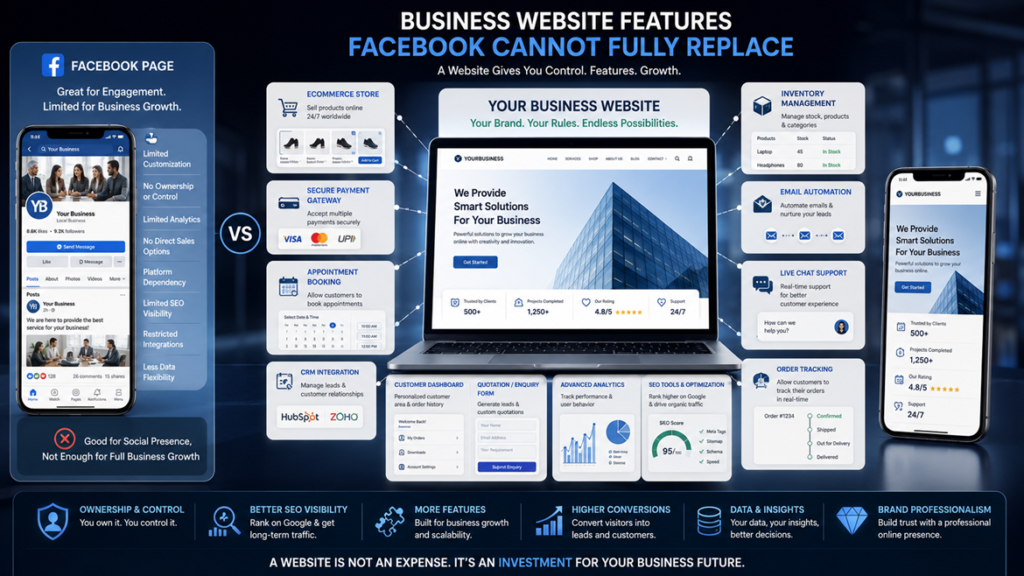
This is one of the most important areas to understand when comparing a Facebook business website with a professionally developed website.
A Facebook page provides predefined functionality.
A custom website can be designed around specific business requirements.
Advanced Lead Generation
A professional website can contain multiple types of lead-generation forms.
For example:
Quick Contact Form
Name, phone number, email, and message.
Request a Quote Form
Customers can provide project requirements, budgets, timelines, and other information.
Consultation Booking Form
Visitors can select a preferred date or request an appointment.
Service-Specific Form
A customer interested in website development could answer questions about required pages, eCommerce functionality, payment gateways, content, and other project requirements.
This structured information can help businesses qualify enquiries more effectively.
Online Booking Systems
Businesses such as hotels, consultants, doctors, salons, trainers, and service providers may require appointment or booking functionality.
A website can potentially integrate booking systems that allow visitors to choose dates, services, time slots, and other relevant options.
eCommerce Functionality
If you sell products online, a dedicated eCommerce website can provide capabilities such as:
- Product categories
- Search and filtering
- Shopping cart
- Checkout
- Payment gateway integration
- Shipping options
- Coupon systems
- Customer accounts
- Order tracking
- Inventory management
- Product recommendations
The level of control available through a dedicated eCommerce platform is significantly different from simply promoting products through social media.
Custom Calculators and Tools
Some businesses can generate leads by providing interactive tools.
Examples include:
- Price estimators
- EMI calculators
- Cost calculators
- Eligibility tools
- Quotation systems
- Product configurators
- Comparison tools
These features can provide genuine value to potential customers while helping the business generate qualified leads.
Customer Portals
Certain businesses require secure areas where customers can log in to access information.
Depending on the project, a website or web application could provide:
- Customer dashboards
- Project status
- Documents
- Invoices
- Order information
- Support requests
- Account details
Facebook was not built to replace these types of custom business systems.
Integration With Business Software
Modern websites can also connect with external services and business systems.
Depending on your requirements, integrations could include:
- CRM software
- Payment gateways
- Email marketing platforms
- Analytics tools
- Accounting systems
- Customer support tools
- Inventory systems
- Shipping services
- Marketing automation platforms
This is where custom web development becomes especially valuable.
How Can a Website Help Generate More Business Leads?
A website should not simply be an online brochure.
When planned correctly, it can become a lead-generation system.
Suppose a potential customer searches for information about developing an eCommerce website.
They discover a useful article published by your company.
After reading the article, they see a call to action inviting them to discuss their project.
They click the button and reach your service page.
That page explains:
- What you provide
- Your development process
- Important features
- Technologies
- Previous projects
- Frequently asked questions
- How to request a quotation
The visitor then submits an enquiry.
This journey might look like:
Google Search → Blog Article → Service Page → Enquiry
Another customer journey could be:
Facebook Advertisement → Landing Page → WhatsApp Conversation
Another could be:
Instagram Post → Website Portfolio → Contact Form
This demonstrates why a professional website can become the central conversion point for multiple marketing channels.
Why Landing Pages Matter for Advertising
Businesses spending money on digital advertising should pay particular attention to landing pages.
Imagine you are advertising one specific service.
Sending every visitor to a general social media profile may require them to search through posts and other information before finding what they need.
A dedicated landing page can focus entirely on the advertisement’s offer.
For example, if Infotech Wayout runs an advertisement for eCommerce website development, the landing page could contain:
- Clear headline
- Key benefits
- Website features
- Development process
- Portfolio examples
- Customer testimonials
- Frequently asked questions
- Contact form
- WhatsApp button
- Request-a-quote CTA
Everything on the page can be designed around one goal.
This can create a clearer journey between the advertisement and the desired customer action.
Should I Build a Website If My Facebook Page Is Already Successful?
Yes, a successful Facebook presence can actually be a strong reason to consider building a website.
If you already have an engaged audience, you have something extremely valuable: existing attention.
You can gradually direct part of that audience toward your website.
For example, you can share:
- Blog articles
- Product pages
- Service pages
- Portfolio projects
- Special landing pages
- Case studies
- New website features
- Online booking pages
This helps transform social media followers into website visitors.
Instead of replacing your Facebook strategy, the website expands what you can do with the audience you have already built.
How to Move From Facebook-Only Marketing to a Complete Digital Presence
If your business currently depends heavily on Facebook, you do not need to abandon what is already working.
The transition can be gradual.
Step 1: Register Your Business Domain
Choose a domain that is easy to remember and closely associated with your company name.
Avoid unnecessarily complicated spellings and excessively long domain names where possible.
Step 2: Identify Your Website Goals
Before starting development, determine what you want the website to achieve.
Do you want to:
- Generate enquiries?
- Sell products?
- Accept bookings?
- Showcase projects?
- Build credibility?
- Rank on Google?
- Publish educational content?
- Provide customer support?
Your goals should influence the structure of the website.
Step 3: Build the Essential Pages
A standard business website may begin with pages such as:
Home
Introduce the company and guide visitors toward important services or products.
About
Explain who you are, your experience, values, and what differentiates your business.
Services
Provide detailed information about what you offer.
Portfolio or Projects
Show examples of your previous work where appropriate.
Contact
Provide clear methods for visitors to reach you.
Additional pages can be added according to business requirements.
Step 4: Make the Website Mobile-Friendly
Mobile usability is essential.
Many customers discover businesses through smartphones, particularly when moving between social media, messaging apps, and websites.
Your website should adapt properly to different screen sizes.
Buttons should be easy to tap, text should be readable, menus should be simple to navigate, and forms should work smoothly on mobile devices.
Step 5: Connect Your Social Media Profiles
Your Facebook page should link to your website, and your website can link to relevant social media profiles.
This creates a connected digital presence.
Step 6: Install Analytics and Tracking
Once your website starts receiving visitors, analytics can help you understand how people use it.
Depending on the tools and consent requirements applicable to your business, you may be able to measure:
- Traffic sources
- Popular pages
- User journeys
- Conversions
- Campaign performance
- Device usage
- Engagement
These insights can help improve your marketing strategy.
Step 7: Start Building SEO Content
SEO is generally a long-term strategy.
Begin developing high-quality pages and articles that genuinely answer the questions potential customers are searching for.
Avoid publishing thin articles simply to insert keywords.
Useful content should solve problems, explain topics clearly, and help readers make better decisions.
Common Mistakes Businesses Make When Depending on Facebook
Facebook can be a powerful business tool, but several mistakes can reduce its effectiveness.
Mistake 1: Treating Facebook as an Asset You Completely Control
A Facebook Business Page is part of another platform.
Businesses should avoid building their entire digital identity around a platform they do not fully control.
Mistake 2: Ignoring Search Engine Traffic
Social media visibility and search visibility are different.
A business relying exclusively on Facebook may miss customers who use search engines to research products and services.
Mistake 3: Not Building an Independent Brand
Your website gives you much greater freedom to communicate your visual identity.
Colors, typography, layout, photography, animations, navigation, messaging, and user experience can all be designed around your brand.
On Facebook, every business operates within broadly the same interface.
Mistake 4: Publishing Everything Only on Social Media
Important educational content deserves a permanent home.
Instead of publishing all useful information exclusively as social posts, consider developing detailed website articles and then using Facebook to distribute them.
This can support both your content marketing and SEO strategies.
Mistake 5: Depending on One Source of Customers
A business that receives almost all enquiries from one platform faces concentration risk.
A healthier digital strategy can include several channels such as:
Website + SEO + Facebook + Instagram + Email + Relevant Advertising + Other Appropriate Channels
The right combination will vary depending on the business.
Website vs Facebook Page: Quick Comparison
Here is a simple comparison to understand the differences.
| Feature | Facebook Business Page | Professional Website |
|---|---|---|
| Initial setup | Usually simple | Requires planning and development |
| Custom domain | No | Yes |
| Branding control | Limited | Extensive |
| Layout customization | Limited | Extensive |
| SEO control | Limited | Extensive |
| Blog system | Not equivalent to a dedicated website blog | Yes |
| Custom landing pages | Limited | Yes |
| Advanced forms | Limited | Yes |
| eCommerce customization | Limited compared with a dedicated store | Extensive |
| Booking systems | Depends on available tools | Can be customized |
| CRM integration | Depends on supported integrations | Broad integration possibilities |
| Customer portal | Limited | Can be developed |
| Content ownership/control | Platform-dependent | Greater control |
| Social engagement | Excellent | Usually more limited |
| Community interaction | Excellent | Depends on functionality |
| Paid social advertising | Excellent | Usually acts as the destination |
| Long-term digital hub | Less suitable | Highly suitable |
This comparison illustrates why the two platforms should usually complement rather than replace one another.
How Should Facebook and Your Website Work Together?
A strong strategy can be surprisingly simple.
Use Facebook for Discovery and Engagement
Publish useful social content such as:
- Tips
- Industry news
- Offers
- Project updates
- Behind-the-scenes content
- Customer stories
- Videos
- Blog previews
Engage with your followers and build relationships.
Use Your Website for Detailed Information
When someone wants to understand your company properly, send them to your website.
Your website can provide comprehensive information that would be difficult to communicate through individual social posts.
Use Your Website for Conversion
Create clear calls to action.
Examples include:
Get a Free Quote
Discuss Your Project
Book an Appointment
Call Now
Send an Enquiry
Shop Now
The CTA should match the visitor’s intention.
Use Facebook to Redistribute Website Content
Every time you publish valuable website content, consider whether it can also become social media content.
One comprehensive blog article could potentially be repurposed into several social posts, graphics, short videos, FAQs, or tips.
This makes your content investment work harder.
Do I Need Both Facebook and a Website?
For many businesses, having both is beneficial.
Your exact digital marketing mix should depend on where your customers spend their time and how they search for your services.
A B2B company may prioritize its website and LinkedIn.
A visually driven consumer brand might invest heavily in Instagram.
A local community-oriented business might find Facebook particularly useful.
An eCommerce company may rely heavily on its website, search engines, social advertising, email marketing, and product feeds.
There is no universal marketing formula.
However, owning a professional website gives your business an independent foundation that can support many of these channels.
How Infotech Wayout Can Help Build Your Business Website
If you currently depend primarily on Facebook or other social media platforms, Infotech Wayout can help you establish a more complete online presence.
We develop professional websites based on the actual needs of businesses rather than treating every project the same.
Depending on your requirements, your website can include features such as:
- Responsive web design
- Business website development
- WordPress development
- eCommerce development
- Custom web development
- Contact and quotation forms
- Payment gateway integration
- Product management
- Booking functionality
- Blog development
- SEO-friendly website structure
- Social media integration
- WhatsApp integration
- Analytics integration
- Website maintenance
- Performance optimization
Our goal is not simply to put your company information online.
A business website should support your broader objectives, whether that means generating enquiries, building credibility, showcasing your work, selling products, or improving your digital visibility.
If your Facebook page already generates engagement, we can help you connect that audience with a professional website designed to support the next stage of your business growth.
Frequently Asked Questions
1. Can I use Facebook as a business website?
Yes, you can use a Facebook Business Page as a basic online presence, particularly when your business is new. It can display business information, posts, photographs, contact details, and customer interactions.
However, using Facebook as your only long-term business platform has limitations. You have less control over design, functionality, SEO, content structure, and the overall customer experience than you would with your own website.
For an established or growing company, Facebook is generally better used alongside a professional website.
2. Is a Facebook Business Page enough for a small business?
It depends on your business model and goals.
A very small local business that receives customers mainly through referrals or social media may initially operate without a website.
However, if you want to improve search visibility, establish stronger credibility, generate leads, run dedicated advertising campaigns, publish detailed content, or add advanced functionality, a website becomes much more valuable.
Think of a Facebook page as a marketing channel rather than a complete replacement for your digital infrastructure.
3. Which is better, a Facebook page or website?
Neither platform is universally “better” because they perform different functions.
Facebook is excellent for social engagement, audience interaction, content distribution, and social advertising.
A professional website provides greater control over branding, content, SEO, functionality, integrations, and conversions.
For many businesses, the best approach is to maintain both.
4. Can a Facebook page rank on Google?
Public social media pages can appear in search engine results in some circumstances. However, this does not provide the same SEO opportunities as operating your own website.
With a website, you can develop individual pages and articles around different services, products, locations, and customer questions.
You also have much greater control over technical and on-page SEO elements.
Therefore, if organic search visibility is an important part of your growth strategy, building your own website is generally the stronger long-term approach.
5. Do I need a website if I already get customers from Facebook?
Not necessarily for immediate survival, but a website can help diversify and strengthen your digital presence.
If Facebook is already generating customers, you can continue using it while gradually directing users toward your website.
Your website can provide detailed information, collect leads, showcase your portfolio, publish content, support SEO, and create dedicated landing pages for advertising campaigns.
This allows Facebook to remain a successful acquisition channel without making your company completely dependent on it.
6. Can I sell products using Facebook without a website?
Businesses can use social media to promote products and, depending on available regional features and integrations, may have access to commerce-related functionality.
However, a dedicated eCommerce website generally provides much greater control over your online store.
You can customize product categories, checkout experiences, payment options, shipping, customer accounts, promotions, analytics, inventory workflows, and other functionality according to your requirements.
For businesses planning serious long-term eCommerce growth, having an independent online store can be particularly valuable.
7. How much does a professional business website cost?
Website development cost varies considerably because websites differ in size, design complexity, functionality, technology, content requirements, integrations, and ongoing support.
A basic informational website will generally cost less than an eCommerce platform or custom web application.
Rather than selecting a website based solely on the lowest price, businesses should consider what they actually need the website to accomplish.
A properly planned website should be treated as a business investment that supports marketing, credibility, customer acquisition, and operations.
For an accurate quotation, Infotech Wayout can evaluate your specific requirements and recommend an appropriate development approach.
8. Should a new business create Facebook first or a website first?
If resources are extremely limited, creating your essential social profiles can be a quick way to establish an initial presence.
However, you should consider registering your preferred domain early and planning your professional website as soon as practical.
Ideally, businesses should develop their website and relevant social channels as parts of the same digital strategy.
The website becomes the central platform, while Facebook and other social networks help attract and engage audiences.
Final Verdict: Can Facebook Replace a Business Website?
So, Can I use Facebook as a business website?
Yes, but there is an important distinction between can and should.
Facebook can provide a useful starting point for a new business. You can establish a basic presence, communicate with customers, publish content, promote products or services, and build an audience.
But Facebook was built primarily as a social platform, not as a complete replacement for an independently controlled business website.
A professional website gives your company greater control over branding, functionality, content, SEO, customer journeys, lead generation, integrations, and long-term digital development.
Most importantly, your business is not forced to choose between them.
The stronger approach is often:
Website + Facebook + Search Engines + Other Relevant Digital Channels
Your website becomes your digital headquarters.
Facebook helps people discover and interact with your brand.
Search engines help potential customers find you when they are actively looking for information, products, or services.
Other marketing channels can then connect back to the same central digital platform.
Build a Professional Online Presence With Infotech Wayout
If your business currently relies only on Facebook, it may be time to think about the next stage of your digital presence.
At Infotech Wayout, we help startups, small businesses, growing companies, and established organizations build professional digital solutions designed around their goals.
Whether you need a simple professional business website, WordPress website, eCommerce store, custom web solution, mobile application, SEO support, or ongoing website maintenance, our team can help you develop a platform that supports long-term growth.
Your social media audience is valuable.
Your brand is valuable.
And your online presence deserves a digital home that you can shape around your business.
Ready to move beyond a Facebook-only presence?
Contact Infotech Wayout to discuss your website requirements and start building a professional online presence that connects your social media marketing, search visibility, brand credibility, and customer acquisition strategy in one place.

