
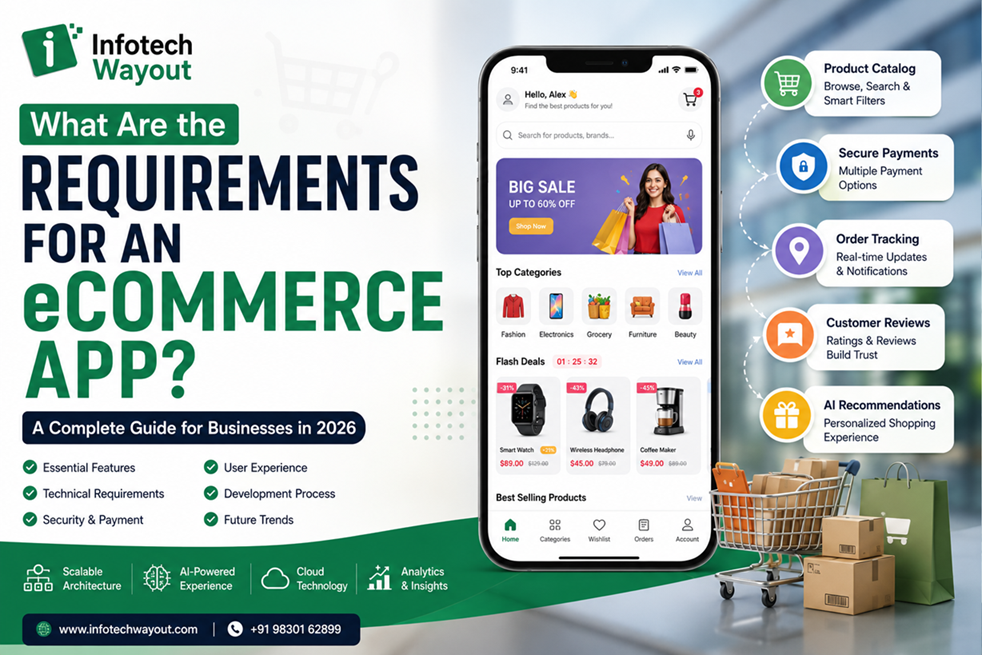
The eCommerce industry has transformed the way people shop. Today, customers expect to browse products, compare prices, make secure payments, and track their orders directly from their smartphones. Whether they are ordering groceries, electronics, fashion, furniture, or digital products, convenience is now the deciding factor.
For businesses, having only a website is no longer enough. A professionally developed eCommerce mobile application provides faster performance, personalized shopping experiences, better customer engagement, and higher conversion rates.
If you are planning to launch your own online shopping platform, understanding what are the requirements for an eCommerce app is the first step toward building a successful digital business.
An eCommerce app is much more than a digital storefront. It is a complete ecosystem that connects customers, administrators, inventory, payment systems, logistics partners, and marketing tools into one seamless platform.
In this comprehensive guide, Infotech Wayout explains everything you need to know before developing an eCommerce application, from business planning and essential features to technical requirements, security, and user experience.
Why Every Business Needs an eCommerce App
Consumer behavior has changed dramatically over the last few years. Mobile shopping has become the preferred choice for millions of users because it is quick, convenient, and available 24 hours a day.
Businesses that invest in mobile commerce applications enjoy several advantages:
Better Customer Experience
A mobile app provides a faster and smoother shopping experience compared to mobile websites. Customers can browse products with fewer clicks, save their favorite items, and complete purchases quickly.
Higher Sales
Push notifications, personalized recommendations, and exclusive app offers encourage repeat purchases and increase customer retention.
Stronger Brand Identity
Having your own application creates trust and improves brand recognition. Customers remember businesses that provide a professional shopping experience.
Improved Customer Loyalty
Reward programs, coupons, wishlists, and loyalty points encourage customers to return regularly.
Valuable Customer Insights
An eCommerce app helps businesses understand customer behavior, purchasing patterns, product preferences, and marketing effectiveness through advanced analytics.
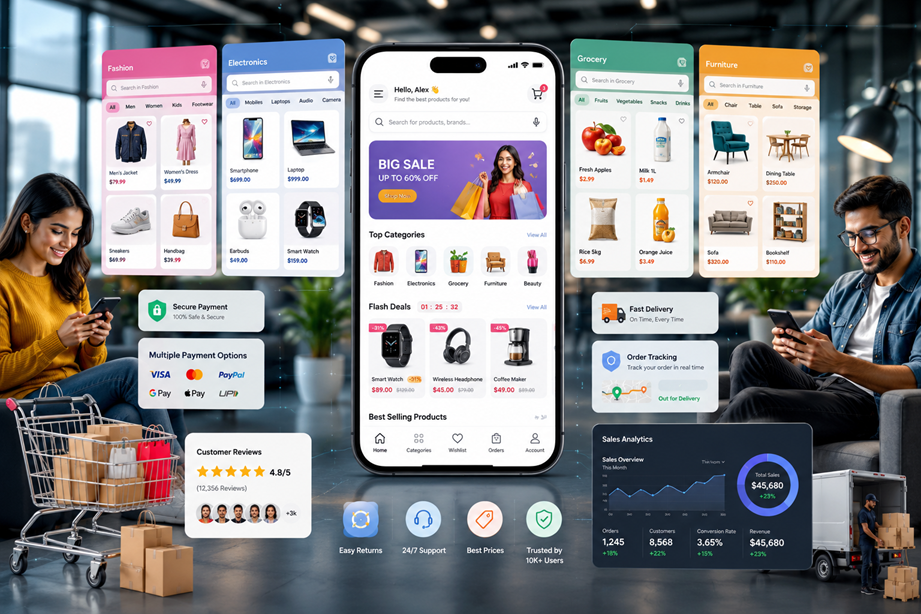
Types of eCommerce Apps
Before beginning development, businesses should determine which type of eCommerce application best suits their goals.
Business to Consumer (B2C)
This is the most common type of online shopping application where businesses sell products directly to customers.
Examples include clothing stores, electronic retailers, bookstores, cosmetic brands, and grocery businesses.
Business to Business (B2B)
These applications enable wholesalers and manufacturers to sell products to distributors and retailers.
Common features include bulk ordering, quotation systems, negotiated pricing, and customer-specific catalogs.
Consumer to Consumer (C2C)
Marketplace platforms allow individuals to buy and sell products with each other.
These apps require seller verification, product approval, dispute resolution, and secure payment systems.
Multi Vendor Marketplace
Multiple sellers list products on a single platform while the administrator manages commissions, payments, and customer support.
Marketplace applications are more complex but highly scalable.
Understanding the Core Requirements for an eCommerce App
When businesses ask, what are the requirements for an eCommerce app, the answer extends beyond attractive design. Success depends on combining business strategy, technology, customer experience, and security into one reliable platform.
These requirements can be divided into several major categories.
Business Requirements
Every successful eCommerce application begins with clear business planning.
Identify Your Target Audience
Understanding your audience helps define app functionality.
Consider factors such as:
- Age group
- Shopping behavior
- Preferred payment methods
- Geographic location
- Device usage
- Purchasing habits
For example, a fashion brand targeting young adults requires different features than a wholesale industrial supplier.
Define Your Product Categories
Organize products into logical categories that customers can easily navigate.
Examples include:
- Electronics
- Fashion
- Home décor
- Beauty products
- Sports equipment
- Groceries
- Furniture
Proper categorization improves both user experience and search functionality.
Decide Your Revenue Model
An eCommerce application may generate revenue through:
- Direct product sales
- Marketplace commissions
- Membership subscriptions
- Premium seller accounts
- Advertising
- Affiliate partnerships
Choosing the right business model influences future development decisions.
Competitor Research
Study successful competitors in your industry.
Analyze:
- Navigation
- Checkout process
- Product presentation
- Customer reviews
- Delivery options
- Loyalty programs
- App ratings
This helps identify opportunities for innovation rather than simple imitation.
Functional Requirements of an eCommerce App
These are the features users directly interact with.
User Registration
Customers should be able to register using:
- Mobile number
- Google account
- Apple ID
- Facebook login
A quick registration process reduces user abandonment.
User Profile Management
Every customer should have access to:
- Personal information
- Saved addresses
- Payment methods
- Order history
- Wishlist
- Coupons
- Loyalty points
- Notifications
Product Catalog
A well-organized catalog should include:
- High-quality images
- Product videos
- Specifications
- Multiple variants
- Size options
- Color options
- Availability status
- Related products
Rich product pages significantly improve purchase confidence.
Powerful Search
Search functionality should support:
- Keyword search
- Voice search
- Auto suggestions
- Recent searches
- Popular products
- Brand search
The faster users find products, the higher the conversion rate.
Smart Filters
Filters allow customers to narrow results using:
- Price
- Category
- Rating
- Brand
- Availability
- Color
- Size
- Discount
- Popularity
These filters improve shopping efficiency and reduce frustration.
Shopping Cart
The shopping cart should provide:
- Quantity updates
- Product removal
- Coupon application
- Shipping estimates
- Tax calculation
- Save for later
- Wishlist transfer
A user-friendly cart significantly reduces abandoned purchases.
Wishlist
Wishlists encourage customers to return later and complete purchases.
Businesses can also send personalized notifications when wishlist products become available or go on sale.
Technical Requirements for an eCommerce App
Strong technology is the foundation of every reliable online shopping application.
Scalable Backend
Your backend should support thousands or even millions of users without affecting performance.
It should efficiently handle:
- User accounts
- Products
- Orders
- Payments
- Notifications
- Inventory
- Customer support
- Analytics
Database Management
The database stores critical information including:
- Customer profiles
- Product inventory
- Orders
- Payment records
- Shipping information
- Reviews
- Coupons
Choosing a secure and scalable database ensures long-term reliability.
API Integration
Modern eCommerce applications depend heavily on APIs.
Common integrations include:
- Payment gateways
- Shipping providers
- SMS services
- Email platforms
- Analytics tools
- CRM software
- ERP systems
- Inventory software
These integrations automate business operations and improve efficiency.
Cloud Infrastructure
Cloud hosting provides:
- Better uptime
- Faster performance
- Automatic scaling
- Secure backups
- Disaster recovery
- Global accessibility
Cloud-based infrastructure is now considered a standard requirement for growing businesses.
User Interface and User Experience Requirements
An attractive design alone is not enough. Every interaction should feel smooth, intuitive, and effortless.
Simple Navigation
Users should reach any product within just a few taps.
Good navigation includes:
- Bottom navigation menu
- Clear categories
- Breadcrumb navigation
- Smart search
- Recently viewed products
Fast Loading Speed
Every second of delay reduces customer satisfaction.
Optimize:
- Images
- Videos
- Database queries
- API requests
- Cache management
Performance directly affects search rankings and sales.
Responsive Design
Your application should function perfectly across:
- Android phones
- iPhones
- Tablets
- Foldable devices
- Different screen sizes
Consistency builds customer trust.
Attractive Product Pages
Effective product pages should include:
- Multiple images
- Zoom functionality
- Product videos
- Ratings
- Customer reviews
- Delivery estimates
- Stock availability
- Related products
Detailed product information reduces return rates and improves purchasing confidence.

Security Requirements for an eCommerce App
Security is one of the most important factors in mobile commerce. Customers trust businesses with sensitive personal and financial information, making robust security essential for building credibility and long-term success.
Secure User Authentication
Your application should provide secure login methods such as password protection, biometric authentication using fingerprint or facial recognition, and one-time password verification. Multi-factor authentication adds an extra layer of security, especially for users storing payment methods within the app.
Data Encryption
Sensitive information such as passwords, payment details, and personal data should always be encrypted during transmission and storage. Strong encryption standards help protect customer information from unauthorized access and cyber threats.
Secure Payment Processing
Integrating trusted payment gateways ensures safe online transactions. Payment processing should comply with industry standards and support multiple payment methods while maintaining the highest level of transaction security.
Fraud Detection
A modern eCommerce application should include systems that monitor suspicious activities, unusual purchasing patterns, and unauthorized login attempts. Early detection helps prevent fraudulent transactions and protects both customers and businesses.
Regular Security Updates
Cybersecurity threats continue to evolve. Regular software updates, security patches, and vulnerability testing are necessary to keep the application secure and compliant with the latest industry standards.
Developing a secure, scalable, and user-friendly eCommerce application requires careful planning across business, technical, and customer experience aspects. In the next part, we will explore advanced features, technology stack, development process, cost factors, future trends, common challenges, FAQs, and why partnering with Infotech Wayout can help you build a successful eCommerce app that stands out in today’s competitive digital marketplace.
Advanced Features Every Modern eCommerce App Should Include
Building an eCommerce app is no longer just about listing products and accepting payments. Customers expect intelligent features that simplify shopping, save time, and provide a personalized experience. Adding advanced functionality not only improves user satisfaction but also helps businesses increase sales and customer loyalty.
AI Powered Product Recommendations
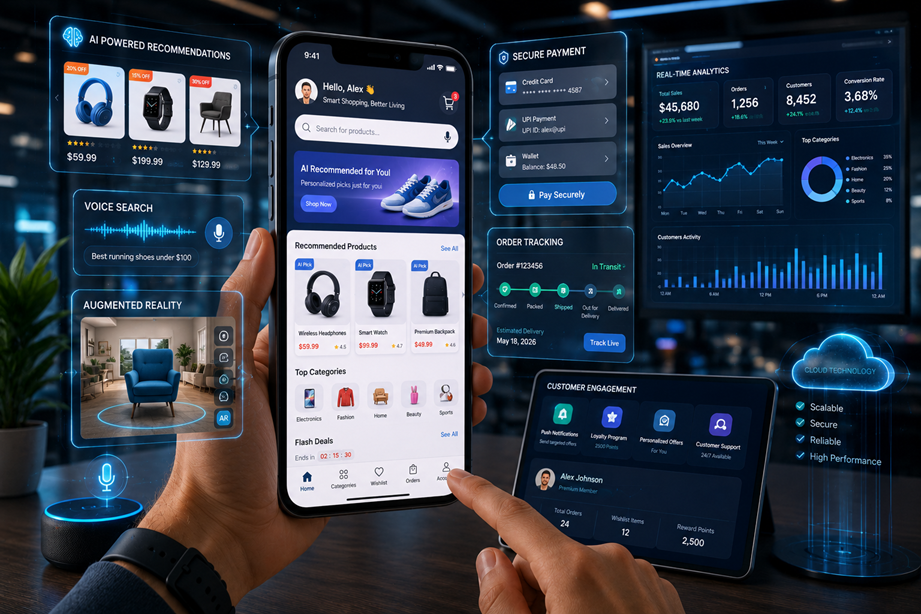
Artificial Intelligence has become an essential part of successful eCommerce applications. By analyzing customer behavior, browsing history, previous purchases, and preferences, AI can recommend products that users are more likely to buy.
Benefits include:
- Higher average order value
- Improved customer engagement
- Increased repeat purchases
- Personalized shopping experience
For example, if a customer frequently purchases fitness equipment, the app can recommend protein supplements, workout accessories, or sportswear.
Smart Search with Filters
Customers should be able to find products quickly using:
- Keyword search
- Voice search
- Barcode search
- Auto-complete suggestions
- Search history
- Trending products
Advanced filters should include:
- Brand
- Price
- Rating
- Availability
- Color
- Size
- Discount
- New arrivals
- Best sellers
An intelligent search system reduces frustration and improves conversion rates.
Push Notifications
Push notifications are one of the most effective customer engagement tools.
Businesses can notify users about:
- Flash sales
- New product launches
- Order updates
- Delivery status
- Cart reminders
- Personalized discounts
- Festival offers
- Loyalty rewards
Notifications should always provide value rather than overwhelming customers with promotional messages.
Multiple Payment Options
Providing flexible payment methods increases customer confidence and reduces cart abandonment.
A modern eCommerce app should support:
- Credit Cards
- Debit Cards
- UPI Payments
- Net Banking
- Digital Wallets
- Cash on Delivery
- EMI Options
- Buy Now Pay Later services
The more payment options available, the easier it becomes for customers to complete purchases.
Real Time Order Tracking
Customers appreciate transparency after placing an order.
Order tracking should display:
- Order confirmation
- Processing
- Packed
- Shipped
- Out for delivery
- Delivered
Live tracking with maps and delivery notifications significantly improves customer satisfaction.
Customer Reviews and Ratings
Reviews influence purchasing decisions more than advertisements.
Customers should be able to:
- Rate products
- Upload photos
- Share experiences
- Ask questions
- Read verified reviews
Businesses also gain valuable insights to improve product quality and customer service.
Loyalty Programs
Rewarding repeat customers encourages long-term relationships.
Popular loyalty features include:
- Reward points
- Cashback
- Referral bonuses
- Birthday discounts
- Membership levels
- Exclusive offers
These programs help increase customer retention while reducing marketing costs.
Technology Stack for eCommerce App Development
Choosing the right technology stack plays a major role in determining your app’s performance, scalability, and long-term maintenance.
Mobile App Development
Businesses can choose from several approaches:
Native Android Development
Ideal for businesses targeting Android users with maximum performance and device-specific features.
Native iOS Development
Provides an optimized experience for Apple users with excellent security and performance.
Cross Platform Development
Frameworks like Flutter enable developers to create Android and iOS apps from a single codebase. This approach reduces development time and maintenance costs while maintaining a high-quality user experience.
Backend Development
The backend powers the entire application by handling:
- User authentication
- Product management
- Orders
- Inventory
- Payments
- Notifications
- Reports
- Customer data
The backend should be designed to handle future business growth without compromising performance.
Database Selection
A reliable database ensures fast access to information and secure storage of business data. The database should efficiently manage:
- Customer information
- Product catalogs
- Orders
- Inventory
- Reviews
- Coupons
- Delivery records
Proper database architecture improves application speed and reliability.
Cloud Hosting
Cloud infrastructure offers:
- Automatic scalability
- High availability
- Secure backups
- Faster content delivery
- Disaster recovery
- Improved performance
As your business grows, cloud hosting allows the application to handle increasing traffic without major infrastructure changes.
Step by Step eCommerce App Development Process
Understanding the development journey helps businesses set realistic expectations.
Step 1: Business Analysis
The first stage focuses on understanding:
- Business objectives
- Target audience
- Product categories
- Revenue model
- Competitor analysis
This forms the foundation of the project.
Step 2: Requirement Gathering
Developers work with the client to identify all required features and technical specifications.
Clear documentation at this stage helps avoid costly changes later.
Step 3: UI and UX Design
Designers create wireframes and interactive prototypes that define how users will navigate the application.
The focus is on creating an intuitive and visually appealing shopping experience.
Step 4: App Development
Developers build:
- Customer application
- Admin panel
- Seller dashboard if required
- Backend APIs
- Database
- Third-party integrations
This is the most time-intensive phase of the project.
Step 5: Testing and Quality Assurance
Before launch, the application undergoes extensive testing, including:
- Functional testing
- Performance testing
- Security testing
- Compatibility testing
- User acceptance testing
A thoroughly tested application minimizes bugs and ensures a smooth user experience.
Step 6: App Store Deployment
Once testing is complete, the application is published on Google Play Store and Apple App Store after meeting all platform guidelines.
Step 7: Maintenance and Updates
Launching the app is only the beginning.
Regular maintenance includes:
- Bug fixes
- Performance improvements
- Security updates
- Feature enhancements
- Operating system compatibility
- Customer support
Continuous improvements help the app remain competitive in the market.
Common Challenges in eCommerce App Development
Developing an eCommerce application involves several challenges that businesses should prepare for.
Managing Large Product Catalogs
As product inventory grows, maintaining organized categories, search functionality, and inventory synchronization becomes more complex.
Payment Security
Handling online payments requires strong security measures and compliance with industry standards to protect customer data.
Performance During High Traffic
Festival sales and promotional campaigns can generate sudden spikes in traffic. Without scalable infrastructure, the application may slow down or crash.
Customer Retention
Acquiring new customers is important, but retaining existing ones is even more valuable. Personalized experiences, excellent customer service, and loyalty programs play a significant role in customer retention.
Integration with Third Party Services
Connecting payment gateways, logistics providers, CRM systems, ERP software, and marketing platforms requires careful planning and ongoing maintenance.
How Much Does an eCommerce App Cost?
One of the most common questions businesses ask is about development cost.
The final investment depends on several factors, including:
- Number of features
- Platform selection
- Design complexity
- Third-party integrations
- Custom development
- Security requirements
- Admin panel functionality
- Maintenance requirements
A basic eCommerce application costs significantly less than a feature-rich multi-vendor marketplace with AI recommendations, advanced analytics, and custom integrations.
Rather than focusing only on the initial development cost, businesses should consider the long-term value an app brings through increased sales, customer loyalty, and operational efficiency.
At Infotech Wayout, we help businesses choose the right solution based on their budget, growth plans, and operational requirements.
Future Trends in eCommerce App Development
Technology continues to transform online shopping. Businesses that embrace innovation gain a competitive advantage.
Some important trends include:
Artificial Intelligence
AI will continue to power personalized recommendations, intelligent search, customer support, and predictive analytics.
Augmented Reality
Customers can virtually try products before purchasing, especially in fashion, eyewear, furniture, and home décor.
Voice Commerce
Voice assistants will simplify product searches and purchases using natural language.
Blockchain Technology
Blockchain can improve payment security, supply chain transparency, and transaction verification.
Social Commerce
Direct shopping through social media platforms will become increasingly popular, allowing customers to purchase products without leaving their favorite apps.
Sustainable Commerce
Consumers are becoming more conscious of environmentally responsible businesses. Apps that highlight sustainable products, eco-friendly packaging, and carbon-conscious delivery options are likely to attract more customers.
Why Choose Infotech Wayout for eCommerce App Development?
Choosing the right development partner is just as important as choosing the right technology.
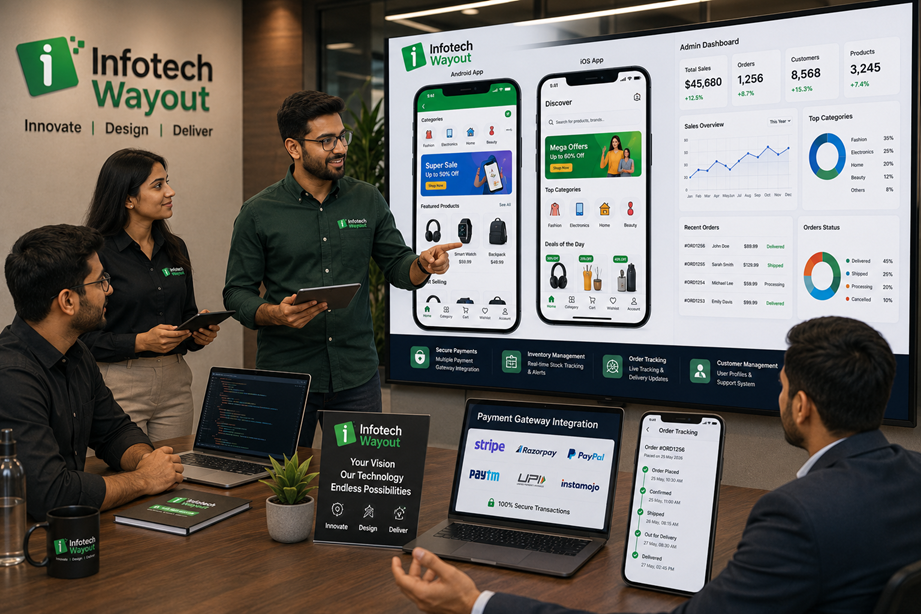
At Infotech Wayout, we specialize in designing and developing secure, scalable, and user-friendly eCommerce applications tailored to your business goals.
Our services include:
- Custom eCommerce app development
- Android and iOS application development
- Flutter cross-platform app development
- UI and UX design
- Secure payment gateway integration
- Shopping cart development
- Inventory management systems
- Multi-vendor marketplace solutions
- API integration
- App maintenance and support
- Performance optimization
- App Store deployment assistance
Our experienced development team works closely with clients to understand their business objectives and deliver solutions that drive measurable results.
Whether you are launching a startup, expanding an existing online store, or building a large-scale marketplace, Infotech Wayout can help transform your vision into a high-performing mobile application.
Conclusion
The success of an online shopping business depends not only on the products it sells but also on the quality of the shopping experience it provides. Understanding what are the requirements for an eCommerce app helps businesses make informed decisions before investing in development.
A successful eCommerce application combines thoughtful business planning, intuitive user experience, reliable technology, robust security, seamless payment processing, efficient inventory management, and continuous innovation.
From user registration and product catalogs to AI-powered recommendations, real-time order tracking, and secure payment gateways, every feature contributes to customer satisfaction and long-term business growth.
As mobile commerce continues to expand, businesses that invest in professionally developed applications will be better positioned to compete, build customer loyalty, and increase revenue.
If you are ready to build a feature-rich, scalable, and future-ready eCommerce application, Infotech Wayout is here to help. Our team delivers customized solutions that align with your business objectives while ensuring exceptional performance, security, and user experience.
Frequently Asked Questions (FAQs)
1. What are the basic requirements for an eCommerce app?
The essential requirements include user registration, product catalog, search functionality, shopping cart, secure payment gateway, order tracking, customer profiles, admin panel, inventory management, responsive design, and strong security measures. These features create a complete shopping experience for customers.
2. Which platform is better for developing an eCommerce app?
The choice depends on your target audience and budget. Native Android and iOS apps offer excellent performance, while cross-platform solutions like Flutter allow businesses to build applications for both platforms using a single codebase, reducing development time and cost.
3. How long does it take to build an eCommerce app?
Development time depends on the project’s complexity. A basic application may take three to four months, while a custom solution with advanced features such as AI recommendations, multi-vendor support, and third-party integrations may require six months or more.
4. What security features should an eCommerce app have?
A secure application should include encrypted data transmission, secure payment processing, multi-factor authentication, fraud detection, regular security updates, role-based access control, and compliance with payment security standards.
5. Can I integrate my existing website with an eCommerce app?
Yes. Most modern eCommerce applications can be integrated with an existing website, allowing products, inventory, customer accounts, and orders to synchronize automatically across both platforms.
6. Why is user experience important in an eCommerce app?
An intuitive user experience encourages customers to browse products, complete purchases quickly, and return for future shopping. Fast loading times, simple navigation, attractive product pages, and easy checkout significantly improve customer satisfaction.
7. How much does it cost to develop an eCommerce app?
The cost varies based on features, platforms, design complexity, integrations, and customization. Businesses should choose a solution that aligns with their budget while considering future scalability and maintenance requirements.
8. Why should I choose Infotech Wayout for eCommerce app development?
Infotech Wayout offers customized eCommerce app development services with a focus on performance, security, scalability, and user experience. Our team provides end-to-end support, from planning and design to development, testing, deployment, and ongoing maintenance, helping businesses build reliable mobile commerce solutions that support long-term growth.

