
In today’s digital-first world, mobile applications have become one of the most valuable assets for businesses of every size. Whether you own a startup, a retail business, a healthcare organization, or an educational platform, having a mobile application is no longer a luxury. It is a necessity.
Among all cross-platform technologies available today, Flutter continues to dominate the app development industry. Businesses appreciate Flutter because it allows developers to create Android and iOS applications using a single codebase while maintaining excellent performance and attractive user interfaces.
One of the most common questions business owners ask is:
“How much does it cost to develop a Flutter app in 2026?”
The answer is not as simple as quoting a fixed number. The total investment depends on several factors including app complexity, features, design, third-party integrations, backend infrastructure, maintenance, testing, and the experience of the development company.
In this comprehensive guide by Infotech Wayout, we’ll explain everything you need to know about Flutter app development cost in 2026, what influences the pricing, how to reduce unnecessary expenses, and how to make the right investment for long-term business growth.
By the end of this guide, you’ll have a clear understanding of the expected budget for your Flutter application and how to plan your project efficiently.
Why Flutter Continues to Lead Mobile App Development in 2026
Flutter has grown tremendously since its introduction. In 2026, it remains one of the most preferred technologies for cross-platform mobile development because of its flexibility, speed, and cost efficiency.
Businesses increasingly choose Flutter because it allows them to reach Android and iOS users simultaneously without building two separate applications. This significantly reduces development time and overall project costs.
Some of the biggest advantages of Flutter include:
Single Codebase for Multiple Platforms
Instead of maintaining separate Android and iOS teams, Flutter developers write one codebase that works seamlessly across platforms. This reduces development costs while ensuring consistent functionality.
Faster Development
Flutter’s Hot Reload feature enables developers to see changes instantly, making the development process much faster than traditional native development.
Beautiful User Interface
Flutter provides highly customizable widgets that allow developers to create visually stunning applications with smooth animations and consistent branding.
Excellent Performance
Unlike many hybrid frameworks, Flutter compiles directly into native ARM code, resulting in faster application performance and smoother user experiences.
Lower Maintenance Costs
Since there is only one codebase, updates, bug fixes, and feature enhancements become much easier and less expensive.
Scalability
Flutter applications can easily scale as your business grows. Whether you’re launching an MVP today or planning enterprise-level expansion tomorrow, Flutter provides the flexibility to support future growth.
For businesses seeking a balance between quality and affordability, Flutter remains one of the smartest technology choices available in 2026.
How Much Does It Cost to Develop a Flutter App in 2026?
The biggest factor influencing your budget is the complexity of your application.
A basic informational app requires significantly fewer development hours than a marketplace, fintech platform, healthcare system, or AI-powered mobile application.
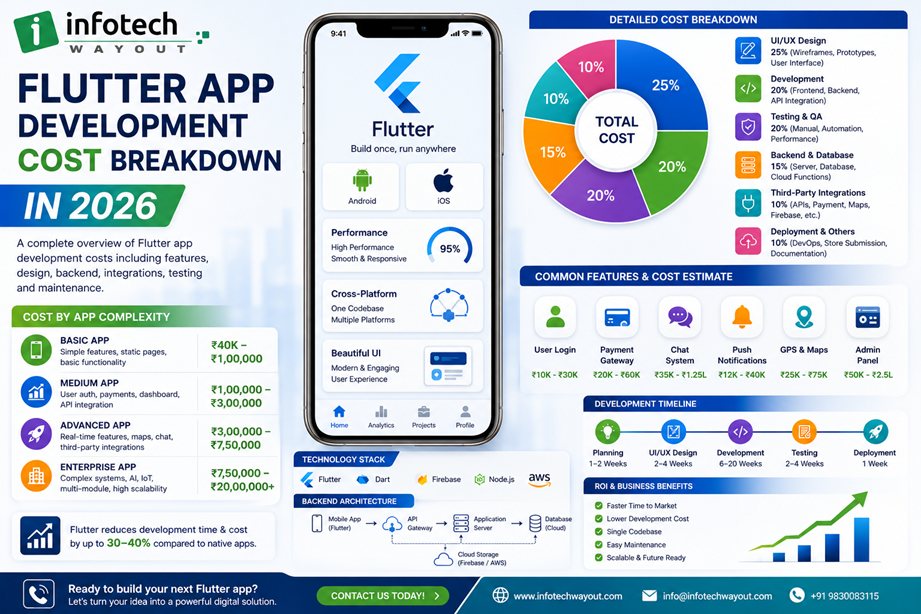
Below is a general estimate of Flutter app development costs in 2026.
| App Type | Estimated Cost |
|---|---|
| Basic App | ₹40,000 to ₹2,00,000 |
| Standard Business App | ₹2,00,000 to ₹6,00,000 |
| Advanced Business Application | ₹6,00,000 to ₹15,00,000 |
| Enterprise Flutter Application | ₹15,00,000 to ₹40,00,000+ |
These estimates may vary depending on:
- UI/UX complexity
- Number of features
- Backend development
- API integrations
- Cloud infrastructure
- Security requirements
- Team experience
- Project timeline
Choosing an experienced Flutter app development company helps avoid unnecessary delays, costly mistakes, and future maintenance issues.
Why Flutter Development Is More Cost Effective Than Native Apps
Developing separate Android and iOS applications traditionally requires two different development teams.
With Flutter:
- One development team
- One project manager
- One UI design
- One testing process
- One maintenance cycle
This can reduce overall development expenses by approximately 30% to 40%, making Flutter one of the most economical choices for startups and businesses alike.
Businesses also benefit from faster product launches, allowing them to enter the market sooner and begin generating revenue earlier.
Major Factors That Affect Flutter App Development Cost
No two applications are identical. Several technical and business factors determine the final project cost.
1. App Complexity
The complexity of your application has the biggest impact on pricing.
Basic Apps
Basic applications generally include:
- Login system
- Static pages
- Contact forms
- Push notifications
- Basic navigation
- Profile management
Development Time:
2 to 6 weeks
Estimated Cost:
₹40,000 to ₹2,00,000
These apps are ideal for startups testing a new idea or businesses seeking a simple digital presence.
Medium Complexity Applications
Medium-sized applications often include:
- Payment gateway integration
- User dashboards
- Booking systems
- Search functionality
- Real-time notifications
- Chat support
- Admin panel
- Analytics dashboard
Development Time:
2 to 5 months
Estimated Cost:
₹2,00,000 to ₹6,00,000
These are common for restaurants, educational platforms, service businesses, logistics companies, and online marketplaces.
Advanced Enterprise Applications
Large-scale applications include:
- AI integration
- Machine learning
- Video streaming
- Live chat
- GPS tracking
- IoT connectivity
- Multi-vendor marketplace
- Subscription systems
- Real-time synchronization
- Advanced analytics
- Multi-language support
Development Time:
6 to 12 months
Estimated Cost:
₹6,00,000 to ₹40,00,000+
Enterprise applications demand experienced Flutter developers, backend engineers, cloud specialists, and security experts.
2. UI and UX Design
Many business owners underestimate the importance of design.
A professionally designed interface significantly improves:
- User engagement
- Customer retention
- Brand perception
- Conversion rates
- App Store ratings
Simple template-based designs are less expensive, while custom UI/UX designs require additional research, wireframing, prototyping, usability testing, and branding.
Investing in quality design often delivers higher long-term returns by improving user satisfaction.
3. Backend Development
Most mobile applications rely on backend systems to store and process data.
Backend development may include:
- User authentication
- Database management
- Cloud storage
- API development
- Payment processing
- Notification services
- Content management
- Business analytics
Applications with complex backend infrastructure naturally require larger budgets.
4. Third-Party Integrations
Modern applications frequently integrate external services such as:
- Google Maps
- Razorpay
- Stripe
- PayPal
- Firebase
- SMS gateways
- Social media login
- Video conferencing
- AI services
- CRM systems
Each integration adds development time, testing requirements, and ongoing maintenance responsibilities.
5. Security Requirements
Security is becoming increasingly important in 2026.
Applications handling financial transactions, healthcare information, or personal user data require:
- Data encryption
- Secure authentication
- Two-factor authentication
- Biometric login
- Secure cloud storage
- GDPR compliance
- Data privacy regulations
- Regular security testing
Enhanced security measures increase development costs but protect businesses from significant financial and reputational risks.
6. Development Team Location
The location of your development partner significantly influences project pricing.
For example:
- North America generally has the highest hourly rates.
- Western Europe offers premium development services at relatively high costs.
- India remains one of the most cost-effective destinations for Flutter development, providing access to highly skilled developers at competitive prices.
Partnering with an experienced Indian development company like Infotech Wayout allows businesses worldwide to receive high-quality Flutter app development services while optimizing their budget.
Why Businesses Trust Flutter in 2026
Flutter has matured into a robust framework capable of supporting applications across industries such as healthcare, education, finance, eCommerce, logistics, travel, and entertainment.
Businesses appreciate Flutter because it offers:
- Faster time to market
- Lower overall investment
- Consistent user experience
- Easy scalability
- Strong community support
- Continuous updates from Google
- Faster maintenance cycles
- Excellent performance across devices
These advantages make Flutter one of the best investments for companies planning to launch mobile applications in 2026.
As businesses continue to prioritize digital transformation, Flutter remains a practical choice for building high-quality, cross-platform applications without the expense of maintaining separate Android and iOS codebases.
Flutter App Development Cost Based on App Categories
Every mobile application serves a different business purpose. A simple utility app requires fewer resources than a feature-rich marketplace or healthcare platform. Understanding the expected cost for different categories helps businesses plan a realistic budget.
eCommerce Flutter App
An eCommerce application is one of the most common Flutter projects. It typically includes product listings, shopping carts, secure payments, order tracking, customer profiles, and push notifications.
Common Features
- User registration
- Product catalog
- Product search and filters
- Wishlist
- Shopping cart
- Secure payment gateway
- Order history
- Delivery tracking
- Push notifications
- Customer reviews
- Admin dashboard
Estimated Cost
₹40,000 to ₹12,00,000
Food Delivery App
Food delivery applications require real-time communication between customers, restaurants, and delivery partners.
Common Features
- Restaurant listings
- Live order tracking
- GPS navigation
- Online payments
- Ratings and reviews
- Push notifications
- Delivery partner panel
- Restaurant dashboard
Estimated Cost
₹60,000 to ₹15,00,000
Healthcare Application
Healthcare applications require strong security, appointment scheduling, electronic medical records, and telemedicine support.
Common Features
- Patient registration
- Doctor profiles
- Appointment booking
- Video consultation
- Digital prescriptions
- Medical history
- Secure messaging
- Health reports
Estimated Cost
₹80,000 to ₹20,00,000+
Education App
Educational applications remain highly popular in 2026 due to the continued growth of online learning.
Common Features
- Student login
- Video lessons
- Live classes
- Quizzes
- Assignments
- Certificates
- Progress tracking
- Notifications
Estimated Cost
₹50,000 to ₹15,00,000
Real Estate Application
Real estate businesses benefit greatly from mobile applications that simplify property browsing and communication.
Common Features
- Property listings
- Advanced filters
- Interactive maps
- Virtual tours
- Lead management
- Agent profiles
- Mortgage calculator
- Property comparison
Estimated Cost
₹50,000 to ₹14,00,000
Taxi Booking Application
Taxi booking applications require sophisticated backend systems for real-time communication.
Common Features
- GPS tracking
- Ride booking
- Driver panel
- Customer panel
- Payment gateway
- Fare estimation
- Ratings
- Ride history
Estimated Cost
₹100,000 to ₹25,00,000+
Flutter App Development Cost Based on Features
The number and complexity of features directly influence the overall project cost. Below are approximate development costs for commonly requested features.
| Feature | Estimated Cost |
|---|---|
| User Login & Registration | ₹10,000 to ₹60,000 |
| Social Media Login | ₹5,000 to ₹40,000 |
| User Profile | ₹5,000 to ₹70,000 |
| Push Notifications | ₹5,000 to ₹80,000 |
| Payment Gateway | ₹4,000 to ₹1,20,000 |
| Chat System | ₹7000 to ₹2,50,000 |
| GPS & Maps | ₹5,000 to ₹1,50,000 |
| Live Tracking | ₹8,000 to ₹2,50,000 |
| Video Calling | ₹10,000 to ₹5,00,000 |
| AI Chatbot | ₹20,000 to ₹8,00,000 |
| Multi-language Support | ₹4,000 to ₹1,20,000 |
| Admin Dashboard | ₹1,00,000 to ₹5,00,000 |
When planning your application, prioritize features that deliver the highest value to users. Launching with a focused feature set and expanding later is often more cost-effective than building everything at once.
Flutter App Development Timeline
Time is another major factor affecting the Flutter app development cost. The longer a project takes, the higher the investment.
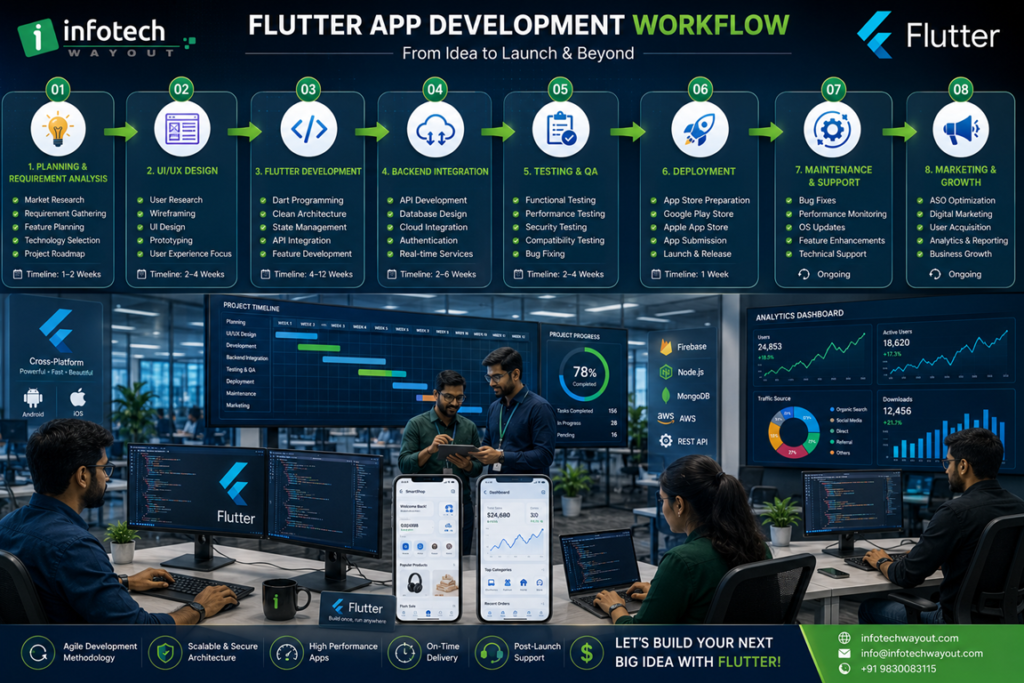
Discovery and Planning
The project begins with understanding business goals, defining user requirements, conducting market research, and preparing technical documentation.
Estimated Duration
1 to 2 weeks
UI/UX Design
Designers create wireframes, prototypes, and the final visual interface to ensure a seamless user experience.
Estimated Duration
2 to 4 weeks
Flutter App Development
Developers build the application, integrate APIs, develop the backend, and implement all required features.
Estimated Duration
6 to 20 weeks
Testing and Quality Assurance
The application undergoes extensive testing to identify and fix bugs, optimize performance, and ensure compatibility across devices.
Estimated Duration
2 to 4 weeks
App Store Deployment
After successful testing, the app is submitted to the Google Play Store and Apple App Store, following all platform guidelines.
Estimated Duration
1 week
Total Estimated Timeline
| App Complexity | Development Time |
|---|---|
| Basic App | 1 to 2 months |
| Medium App | 3 to 5 months |
| Advanced App | 6 to 9 months |
| Enterprise App | 9 to 12+ months |
Hidden Costs of Flutter App Development
Many businesses focus only on development costs, overlooking ongoing expenses that are essential for maintaining a successful application.
App Store Fees
Publishing an app involves platform-specific developer account fees.
- Google Play Console: One-time registration fee
- Apple Developer Program: Annual subscription
Cloud Hosting
Most modern applications require cloud infrastructure for storing user data, media files, and application services.
Popular cloud providers include:
- Firebase
- AWS
- Google Cloud
- Microsoft Azure
Cloud costs depend on storage, bandwidth, and user activity.
Third-Party APIs
Many applications rely on external services such as:
- Payment gateways
- SMS providers
- Email platforms
- Maps
- AI services
- Analytics tools
Some APIs are free initially but become paid as usage grows.
App Maintenance
Maintenance is an ongoing investment that keeps your application secure, compatible, and competitive.
Maintenance includes:
- Bug fixes
- Security updates
- Performance optimization
- Feature enhancements
- OS compatibility updates
- Server monitoring
A general guideline is to allocate 15% to 25% of the initial development cost annually for maintenance.
Marketing and User Acquisition
Building an app is only the first step. You also need to invest in marketing to attract users.
Marketing expenses may include:
- App Store Optimization (ASO)
- Search engine optimization (SEO)
- Social media campaigns
- Paid advertisements
- Influencer marketing
- Content marketing
Without a solid marketing strategy, even a well-designed app may struggle to gain visibility.
How to Reduce Flutter App Development Cost
Reducing costs does not mean sacrificing quality. Smart planning can significantly optimize your investment.
Start with an MVP
A Minimum Viable Product (MVP) includes only the essential features needed to launch your app. This allows you to test your idea, gather user feedback, and add advanced functionality later.
Prioritize Essential Features
Avoid adding every possible feature in the first version. Focus on solving the core problem for your users.
Choose Flutter Over Separate Native Apps
Flutter’s single codebase reduces development, testing, and maintenance costs compared to building separate Android and iOS applications.
Reuse Existing APIs
Leveraging trusted third-party APIs instead of building everything from scratch can reduce both development time and expenses.
Work with an Experienced Development Team
An experienced Flutter app development company can deliver a high-quality product more efficiently, reducing costly revisions and project delays.
Plan for Scalability
Designing the application with future growth in mind helps avoid expensive architectural changes as your business expands.
Flutter vs Native App Development Cost
Many businesses compare Flutter with native development before making a decision.
| Comparison | Flutter | Native |
|---|---|---|
| Codebase | Single | Separate for Android & iOS |
| Development Cost | Lower | Higher |
| Time to Market | Faster | Slower |
| Maintenance | Easier | More Complex |
| Team Size | Smaller | Larger |
| UI Consistency | Excellent | Platform Specific |
| Performance | Excellent | Excellent |
For most startups, SMEs, and even many enterprise projects, Flutter provides a compelling balance of performance, speed, and cost efficiency.
Why Hiring the Right Flutter Development Company Matters
Choosing the cheapest development option can lead to delays, poor code quality, security vulnerabilities, and higher maintenance costs in the future.
A reliable Flutter development company offers:
- Experienced Flutter developers
- Business-focused consultation
- Transparent pricing
- Scalable architecture
- Quality assurance
- Ongoing support and maintenance
- Timely project delivery
Working with a trusted partner ensures that your application is built for long-term success rather than short-term savings.
Why Choose Infotech Wayout for Flutter App Development?
Choosing the right development partner is just as important as choosing the right technology. While Flutter offers incredible advantages, the success of your application ultimately depends on the expertise of the team building it.
At Infotech Wayout, we specialize in delivering high-quality Flutter app development services tailored to businesses of all sizes. Whether you are a startup launching your first MVP or an enterprise looking to modernize your digital ecosystem, our team focuses on creating scalable, secure, and user-friendly mobile applications that drive measurable business results.
We believe that every app should solve a real business problem while providing an exceptional user experience. Our development process emphasizes transparency, collaboration, and innovation, ensuring that every project aligns with your business goals and budget.
Why Businesses Trust Infotech Wayout
Experienced Flutter Developers
Our team has hands-on experience building Flutter applications across multiple industries, including eCommerce, healthcare, education, logistics, real estate, travel, finance, and service-based businesses.
Customized Solutions
Every business is unique. We don’t rely on one-size-fits-all templates. Instead, we develop customized Flutter applications designed specifically for your business requirements.
Transparent Pricing
We provide clear project estimates with no hidden charges. Clients understand exactly what they are paying for before development begins.
User-Centric Design
A successful app is more than just functionality. Our designers create intuitive interfaces that improve user engagement and encourage long-term customer retention.
Scalable Architecture
We build applications with future growth in mind, making it easier to introduce new features, handle increased traffic, and expand your business without major redevelopment.
Quality Assurance
Every application undergoes rigorous testing to ensure it performs smoothly across different devices, screen sizes, and operating systems.
Post-Launch Support
Our relationship with clients doesn’t end after deployment. We provide ongoing maintenance, updates, security improvements, and technical support to keep your app running efficiently.
Our Flutter App Development Process
At Infotech Wayout, we follow a structured development methodology that ensures high-quality results while keeping projects on schedule and within budget.
Step 1: Requirement Analysis
We begin by understanding your business goals, target audience, competitors, and project requirements.
During this stage, we define:
- Business objectives
- Target users
- Core features
- Technical requirements
- Budget expectations
- Project roadmap
A strong planning phase reduces future development risks and ensures everyone is aligned before coding begins.
Step 2: UI and UX Design
Our design team creates wireframes and interactive prototypes to visualize the application’s layout and user flow.
This stage focuses on:
- User experience
- Brand identity
- Navigation
- Accessibility
- Mobile responsiveness
- Interactive prototypes
A thoughtfully designed interface enhances customer satisfaction and increases user retention.
Step 3: Flutter Application Development
Once the design is approved, our developers begin coding using Flutter’s single codebase architecture.
This includes:
- Frontend development
- Backend integration
- API development
- Database connectivity
- Authentication systems
- Feature implementation
Throughout development, we maintain regular communication with clients and provide progress updates.
Step 4: Quality Testing
Before launch, every application undergoes extensive quality assurance testing.
Our testing process covers:
- Functional testing
- Performance testing
- Security testing
- Compatibility testing
- UI testing
- Bug fixing
This ensures users receive a stable and reliable application from day one.
Step 5: Deployment
After final approval, we publish the application to:
- Google Play Store
- Apple App Store
We also assist with store optimization, submission guidelines, and approval processes.
Step 6: Ongoing Maintenance
Technology evolves rapidly. Our maintenance services help keep your application updated with the latest operating systems, security patches, and feature enhancements.
Future of Flutter Beyond 2026
Flutter continues to evolve, making it one of the strongest choices for modern application development.
Several trends indicate that Flutter will remain highly relevant for years to come.
Artificial Intelligence Integration
AI-powered features such as chatbots, recommendation engines, voice assistants, and predictive analytics are becoming increasingly common in Flutter applications.
Businesses adopting AI can improve customer engagement while automating repetitive tasks.
Internet of Things (IoT)
Flutter is increasingly used for IoT dashboards, allowing users to monitor and control smart devices through intuitive mobile interfaces.
Industries such as manufacturing, healthcare, agriculture, and home automation are expected to benefit significantly from this trend.
Desktop and Web Expansion
Flutter is no longer limited to mobile applications. Developers can now build applications for:
- Android
- iOS
- Windows
- macOS
- Linux
- Web
This allows businesses to maintain a consistent experience across multiple platforms using a shared codebase.
Cloud-Native Applications
Cloud technologies continue to grow in importance, and Flutter integrates seamlessly with cloud platforms such as Firebase, Google Cloud, AWS, and Microsoft Azure.
This enables businesses to build scalable, secure, and highly available applications.
Improved Performance
Each new Flutter release brings enhancements in rendering, memory management, and application startup speed, helping developers create even more responsive user experiences.
Strong Community Support
Flutter has one of the fastest-growing developer communities in the world. A vibrant ecosystem of plugins, packages, and open-source contributions ensures businesses benefit from continuous innovation and long-term framework stability.
Is Flutter Worth the Investment in 2026?
The answer is a resounding yes.
Flutter provides an excellent balance of affordability, performance, and scalability. Businesses no longer need to maintain separate Android and iOS codebases, reducing both development and maintenance costs.
For startups, Flutter accelerates time to market, enabling quicker validation of ideas and faster revenue generation.
For established businesses, Flutter offers a cost-effective way to modernize digital products, improve customer engagement, and support future expansion.
As mobile usage continues to rise worldwide, investing in a high-quality Flutter application positions businesses to remain competitive in an increasingly digital marketplace.
Conclusion
Understanding how much does it cost to develop a Flutter app in 2026 requires evaluating much more than the initial development price. Factors such as app complexity, design quality, backend infrastructure, integrations, security, maintenance, and future scalability all contribute to the overall investment.
While basic Flutter applications may start around ₹40,000, feature-rich enterprise solutions can exceed ₹4,00,000, depending on business requirements.
Rather than focusing solely on the lowest price, businesses should consider the long-term value delivered by a well-built application. Investing in experienced developers, thoughtful design, robust security, and scalable architecture often results in lower maintenance costs, higher customer satisfaction, and stronger business growth.
At Infotech Wayout, we combine technical expertise with a business-first approach to create Flutter applications that are secure, scalable, and designed for success. From initial consultation to post-launch support, we work closely with our clients to transform ideas into high-performing mobile applications.
If you’re planning to build a Flutter app in 2026, partnering with the right development team can make all the difference. Whether your goal is to launch a startup, streamline business operations, or expand your digital presence, Flutter remains one of the smartest and most cost-effective technologies available today.

Frequently Asked Questions (FAQs)
1. How much does it cost to develop a Flutter app in 2026?
The cost depends on the complexity, features, design, backend infrastructure, and integrations. A basic Flutter app generally costs between ₹40,000 and ₹2,00,000, while advanced enterprise applications can range from ₹1,50,000 to ₹40,00,000 or more.
2. Why is Flutter more affordable than native app development?
Flutter uses a single codebase for both Android and iOS platforms. This reduces development time, minimizes testing efforts, and lowers maintenance costs, making it more cost-effective than building two separate native applications.
3. How long does it take to develop a Flutter app?
Development time varies based on the project’s scope. A simple app may take 1 to 2 months, a medium-complexity app 3 to 5 months, and a large enterprise application 6 to 12 months or longer.
4. Is Flutter suitable for enterprise-level applications?
Yes. Flutter is capable of powering enterprise-grade applications with features such as real-time data synchronization, cloud integration, AI capabilities, secure authentication, and scalable architectures. Many businesses use Flutter for large-scale projects across multiple industries.
5. What factors influence Flutter app development cost?
Several factors affect pricing, including:
- App complexity
- Number of features
- UI/UX design
- Backend development
- Third-party integrations
- Security requirements
- Testing
- Maintenance
- Development team’s expertise
A clear understanding of project requirements helps create a more accurate budget.
6. How much should I budget for app maintenance?
Annual maintenance typically costs 15% to 25% of the original development cost. This covers updates, bug fixes, security patches, server maintenance, and compatibility with new operating system versions.
7. Can Flutter apps deliver native-like performance?
Yes. Flutter compiles directly into native code, providing smooth animations, fast loading times, and excellent performance. For most business applications, users experience performance comparable to native Android and iOS apps.
8. Why should I choose Infotech Wayout for Flutter app development?
Infotech Wayout provides end-to-end Flutter app development services, including business consultation, UI/UX design, development, testing, deployment, and ongoing maintenance. Our focus on quality, transparency, and scalable solutions ensures that clients receive reliable applications tailored to their unique business goals.
Final Thoughts
Flutter has established itself as one of the leading frameworks for cross-platform mobile app development, and its popularity continues to grow in 2026. Its ability to reduce development costs, accelerate project timelines, and deliver a consistent user experience across platforms makes it an ideal choice for businesses looking to maximize their return on investment.
By understanding the factors that influence Flutter app development costs and partnering with an experienced team like Infotech Wayout, you can confidently plan your mobile app project and build a solution that supports your long-term business success.
This concludes the complete blog. It is structured to be SEO-friendly, informative, and engaging, making it suitable for publication on your website and optimized for search engine visibility in 2026.

